


Appliance Repair vs. Replace: The 50% Rule and When It's Wrong
Maria Solano
Former appliance warranty claims adjuster turned investigative repair journalist. Maria's 'What Went Wrong' teardown series has made her the most feared woman in the white-goods industry.
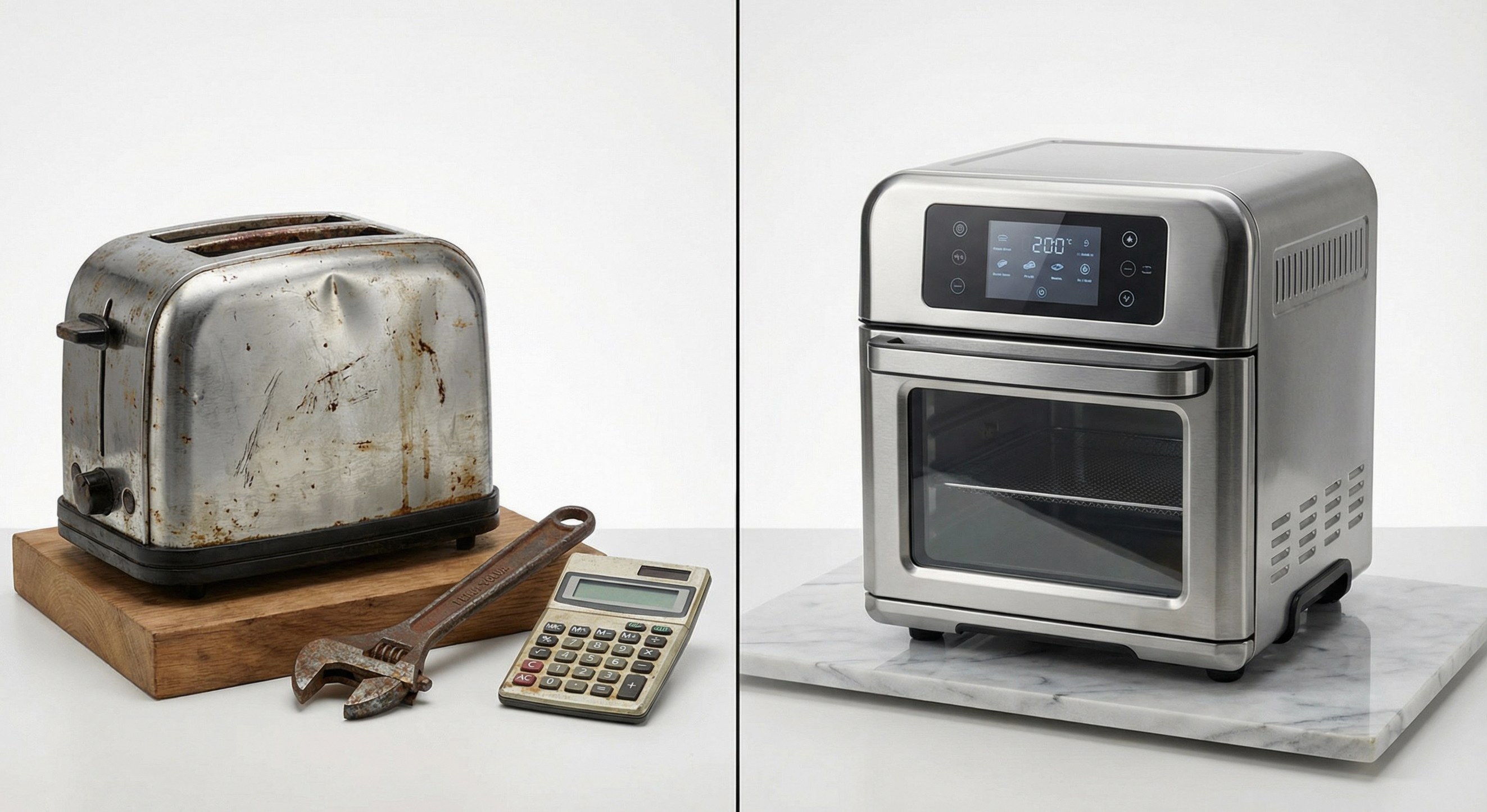
Every homeowner hits this moment. The dishwasher floods the kitchen, the dryer stops heating, the fridge clicks and goes warm. You call a tech. The diagnosis comes back. And now you're staring at a repair estimate trying to decide: repair or replace? The internet will tell you to follow the 50% rule. If the repair costs more than half what a new unit would run, replace it. Simple. Clean. And wrong about a third of the time.
I spent four years processing warranty claims for a major manufacturer. I've seen the failure data, the repair histories, the average lifespan curves broken down by brand, model, and component. The 50% rule is a blunt instrument. It ignores the age of the appliance, the specific failure, the quality of the original unit, and the actual cost landscape of replacements in 2026. Here's a sharper tool.
What the 50% Rule Gets Right
Credit where it's due. For a mid-life, mid-range appliance with a single major failure, the 50% rule works reasonably well. Your eight-year-old Whirlpool top-load washer needs a new transmission. The repair is $475. A comparable new washer is $750. That's 63% of replacement cost. Replace it. The washer has maybe four years left even with the fix, and you're spending more than half the cost of a brand new machine with a full warranty. The math checks out.
The rule also works for commodity appliances, the machines where one brand is basically interchangeable with another. Standard dryers, basic dishwashers, over-the-range microwaves. These are not precision instruments. When a $600 dishwasher needs a $350 repair at age seven, replacing with a new unit that comes with a one-year warranty and improved energy efficiency is the rational move.
Where the rule earns its keep is in preventing emotional repairs. People get attached to appliances, especially ones that came with the house or were bought during a remodel. The 50% rule provides a reality check when someone wants to sink $800 into a 15-year-old range because they love the color.
When Repairing Wins (Even When the 50% Rule Says Replace)
Here's where the rule falls apart. These are the scenarios I saw repeatedly in warranty data where customers replaced machines they should have repaired.
Premium and Built-In Appliances
A Sub-Zero 36-inch built-in refrigerator retails for $9,000 to $12,000. A sealed system repair (compressor, evaporator, or condenser work) runs $800 to $1,500. That's well under 50%, but even if it were above that threshold, the replacement cost is so high that repair almost always wins. These units are built to last 20-25 years with periodic service. A condenser cleaning and maintenance schedule alone can add years to their lifespan.
The same logic applies to Wolf ranges, Miele dishwashers, and Thermador cooktops. The replacement cost is so steep that repair math works differently. A $1,200 control board repair on a $6,500 range is only 18% of replacement, even though the absolute number feels enormous.
For any appliance that retailed above $3,000, throw the 50% rule away. Use 35% instead. Premium appliances have longer expected lifespans and higher build quality, so repairs deliver more remaining useful life per dollar spent.
Newer Appliances with Known Issues
A three-year-old Samsung French Door refrigerator with an ice maker that freezes over. The repair is $275 to $400 depending on the shop. A comparable new Samsung is $2,200. That's only 15% of replacement cost, but even the 50% rule would say repair here. The real issue is that some customers panic and replace a nearly new fridge over a known, fixable ice maker defect. Any appliance under five years old should almost always be repaired unless the failure is catastrophic (fire damage, flood damage, multiple simultaneous system failures).
Simple Fixes on Older Machines
A 12-year-old dryer with a burned-out heating element. The part is $35 to $65. Labor is $150 to $200. Total repair: $200 to $265. A new dryer is $700 to $900. Even though the dryer is old, you're spending less than 35% of replacement cost on a repair that's likely to give you another three to five years. Heating elements, thermal fuses, door switches, water inlet valves, drain pumps: these are wear items that fail on schedule and are cheap to replace. An older machine needing a wear item is not the same as an older machine with a dying compressor.
When Replacement Wins (Even When the 50% Rule Says Repair)
The other side of the coin. These are the traps.
Cascading Failures
Your 11-year-old front-load washer needs a new spider arm (the three-pronged bracket that connects the drum to the shaft). The part and labor run $350 to $500. The washer cost $1,100 new. That's 35 to 45%, so the 50% rule says repair. But spider arm failure on front-loaders is almost always accompanied by bearing damage. Six months after the spider arm repair, the bearings go. Another $350 to $500 job. You've now spent $700 to $1,000 on a machine that's on its last legs.
The warranty claim data was full of these patterns. Certain failures are sentinel events that predict future failures. Compressor replacement on a fridge that also has a corroded evaporator. Control board failure on a dishwasher with a cracked sump. When the first failure is a sign of systemic age-related deterioration, the 50% rule doesn't capture the full picture.
Obsolete Parts
If the manufacturer has discontinued the part and the only source is third-party aftermarket, factor that into the decision. Aftermarket compressors and control boards have higher failure rates than OEM. If the only available replacement part is aftermarket and the appliance is past 75% of its expected lifespan, lean toward replacement.
The Energy Cost Gap
A refrigerator manufactured before 2010 uses 40 to 60% more electricity than a current Energy Star model. On a fridge that runs 24/7, that's $75 to $120 per year in wasted energy. Over five remaining years, that's $375 to $600. Add that to the repair cost when running the numbers. The same applies to old HVAC systems, where the efficiency gap is even larger.


A Better Framework: The Four-Factor Test
Forget the 50% rule. Use this instead.
Factor 1: Age as a percentage of expected lifespan. A 10-year-old dishwasher (expected life: 12 years) is at 83% of its lifespan. A 10-year-old gas range (expected life: 18 years) is at 56%. Same age, very different repair calculus.
Factor 2: Repair cost as a percentage of replacement cost. This is the 50% rule, but it's only one input, not the whole answer.
Factor 3: Expected remaining life after repair. A drain pump replacement on a washer gives you essentially the remaining lifespan of the machine. A compressor replacement on a fridge gives you five to eight years. A bearing replacement on a front-load washer gives you three to five years. What are you buying with the repair?
Factor 4: Replacement cost including installation, disposal, and disruption. A new dishwasher isn't $600. It's $600 plus $150 to $250 for installation plus the time waiting for delivery plus the potential for countertop or plumbing modifications. The true cost of replacement is always higher than the sticker price.
The formula: If the repair cost is less than 30% of the true replacement cost AND the appliance is below 70% of its expected lifespan, repair. If the repair cost is above 50% of true replacement cost AND the appliance is above 80% of its expected lifespan, replace. Everything in between requires judgment, and that's where a good technician adds real value.
For customers on the fence, frame it this way: "This repair buys you approximately X more years. That works out to $Y per year of use. A new unit would cost $Z per year over its full lifespan." When you convert the decision to a cost-per-year comparison, the right answer usually becomes obvious.
Appliance Lifespan Reference Table
These are real-world averages from industry data and warranty claim databases, not the manufacturer's optimistic projections. Your mileage varies with usage, maintenance, and water quality.
| Appliance | Average Lifespan | Premium Brand Lifespan | Replace If Repair Exceeds |
|---|---|---|---|
| Top-mount refrigerator | 15-20 years | N/A | $600 |
| French-door refrigerator | 12-15 years | 18-22 years (Sub-Zero) | $900 (standard) / $1,800 (premium) |
| Top-load washer | 12-14 years | 15+ years (Speed Queen) | $400 |
| Front-load washer | 10-13 years | 14-16 years (Miele) | $500 |
| Gas/electric dryer | 13-15 years | 16-18 years | $350 |
| Dishwasher | 10-13 years | 15-18 years (Miele, Bosch) | $450 |
| Gas range | 15-20 years | 20-25 years (Wolf, Viking) | $500 (standard) / $1,500 (premium) |
| Electric range | 13-16 years | 18-22 years | $450 |
| Central AC | 15-20 years | 20+ years | $2,500 |
| Gas furnace | 18-25 years | 25-30 years | $2,000 |
| Microwave (built-in) | 9-12 years | N/A | $300 |
Common Repair Costs by Appliance Type
These are typical SoCal market rates as of early 2026. For a deeper breakdown of regional pricing, see our appliance repair pricing guide.
The Tech's Perspective: Talking to Customers About Repair vs. Replace
If you're a technician, this conversation is part of your job. And how you handle it determines whether the customer trusts you or thinks you're trying to sell them something.
Lead with the numbers, not the recommendation. Tell the customer the repair cost, the expected life after repair, and what a replacement would run. Let them do the math first. When a tech leads with "I'd replace it," the customer hears "this person wants to sell me something" regardless of whether the advice is sound.
Name the specific failure and what it means. "Your compressor failed" means nothing to a homeowner. "The compressor is the most expensive part of the fridge, and once it fails on a unit this age, it usually means the system is wearing out" gives them real context.
Be honest about what you don't know. If the repair will probably work for another five years but you can't guarantee it, say that. Customers respect honesty more than false certainty. "This repair should get you another three to five years, but I can't promise the control board won't go next year" is a statement a customer can make a decision on.
Don't push replacement to avoid a callback. Some techs recommend replacement on older units because they don't want to deal with a callback if something else fails. That's a short-term calculation that costs you long-term. The customer who takes your advice and replaces a fixable machine will find out eventually that the repair was $300 and the replacement was $1,200. You'll lose them and everyone they talk to.
Keep a simple one-page handout in your truck with average appliance lifespans and the four-factor framework. Hand it to the customer when you're discussing repair vs. replace. It shows professionalism and gives them something to reference after you leave. Customers who feel informed are more likely to approve the repair.
The Bottom Line
The 50% rule is popular because it's simple. But simple rules applied to complex decisions produce mediocre results. The age of the appliance, the nature of the failure, the quality of the original unit, the true cost of replacement, and the expected benefit of the repair all matter. A $500 repair on a three-year-old $2,000 fridge is a no-brainer. A $500 repair on a 14-year-old $800 washer is almost certainly a waste. The same dollar amount, the same percentage, completely different answers.
Use the four-factor test. Do the cost-per-year math. And when in doubt, get a second opinion from a tech who doesn't have a financial incentive in either direction.
What is the 50% rule for appliance repair?▾
The 50% rule says: if the repair costs more than 50% of what a new appliance would cost, replace it instead. It's a rough guideline that works for mid-life appliances but fails for both very new and very old units. A better approach is the four-factor test described above, which accounts for the appliance's age relative to its expected lifespan, the nature of the failure, expected remaining life after repair, and the true total cost of replacement.
How long should a refrigerator last?▾
A standard top-mount refrigerator lasts 15-20 years. French-door models average 12-15 years. Counter-depth and built-in units (Sub-Zero, Thermador) can run 20-25 years with proper maintenance. The compressor is usually the lifespan-limiting component. Water and ice systems tend to fail earlier but are economical to repair.
Is it worth repairing a 10-year-old washing machine?▾
Usually yes, if the repair is under $350. A 10-year-old washer has about 3-5 years of useful life remaining. Common repairs at this age (bearings, pump, control board) extend life significantly. Replace if it needs a transmission or spider arm on a front-loader, as these are sentinel failures that often precede additional breakdowns.
Need a repair professional?
Get free quotes from verified technicians in your area.
Find a Pro Near You