


Washer Not Draining: Complete Diagnostic Guide for All Brands
Terry Okafor
Master refrigeration tech and NATE-certified instructor who moonlights as the magazine's advice columnist. His 'Ask Big Terry' mailbag has been settling shop disputes and diagnosing mystery leaks since 2011.
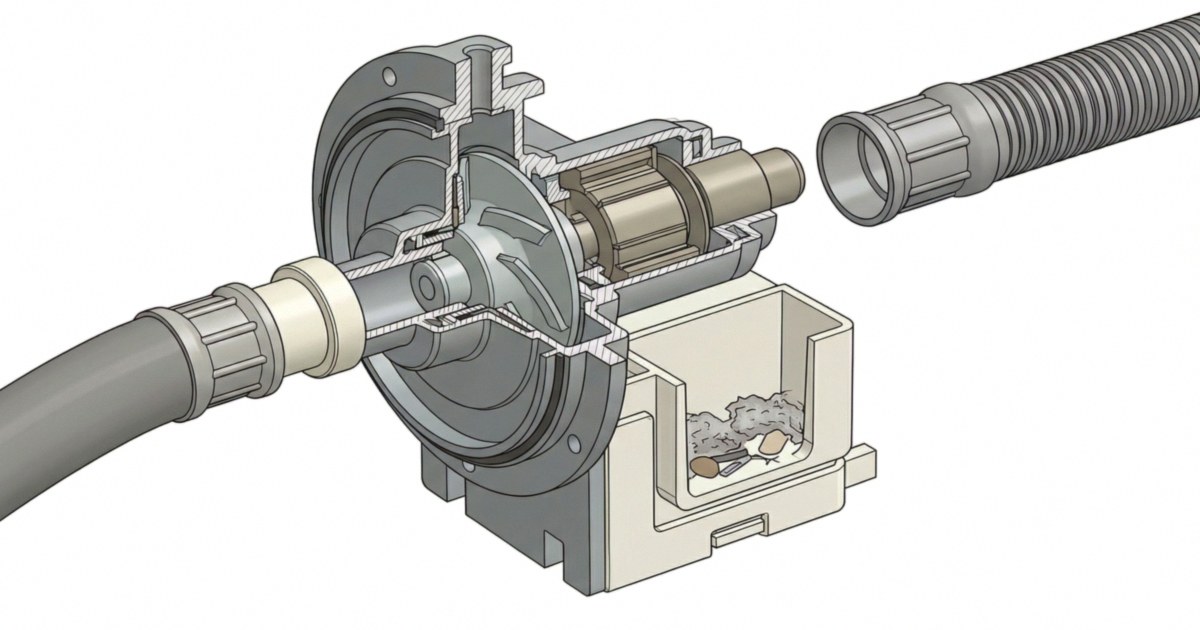
A washing machine not draining is one of the most common service calls I run. It also has one of the highest rates of DIY resolution — if you know where to look. Standing water in the drum, clothes soaking wet at the end of the cycle, an error code on the display: all roads lead to the same four or five failure points.
This guide covers every brand I regularly service: Whirlpool, Samsung, LG, GE, and Maytag. Some of the diagnostic steps are universal; some are brand-specific. I'll flag which is which.
For a Maytag-specific walkthrough covering the F21 and F9E1 error codes specifically, see our Maytag washer not draining F21 guide. This guide covers the broader all-brand diagnostic.
Start With the Drain Pump Filter — It Solves a Lot of My Calls
Front-load washers have a drain pump filter (also called a coin trap) accessible from the front of the machine. The filter catches coins, lint, small socks, hair ties, and anything else the customer left in their pockets. After a few years of use, these filters get packed with debris. A packed filter restricts flow enough to prevent draining entirely.
Location on common brands:
- Whirlpool/Maytag front-loaders — small square access panel at the bottom-left of the front panel. Pull the panel tab, unscrew the cap counterclockwise. Have a towel and a shallow tray ready.
- Samsung front-loaders — similar bottom-right panel on most models. The filter cap has a small emergency drain hose next to it — use that first to drain the water before unscrewing the cap.
- LG front-loaders — bottom-right panel on most models. LG filter caps sometimes require a flat-head screwdriver to pry the panel open.
- GE front-loaders — bottom-front panel, similar to Whirlpool configuration.
Top-loaders generally do not have an accessible coin filter. On top-loaders, debris gets past the pump directly, and you'll find it inside the pump housing when you open it up.
Every front-load washer filter should be cleaned every 2-3 months as routine maintenance. I tell every customer: add it to your calendar the same day you change your HVAC filter. The customers who come back with a second clog-related service call inside a year are almost always the ones who didn't follow through on this. It's a 10-minute job that prevents a $150 service call.
Checking the Drain Hose
Before you go deeper into the machine, check the drain hose. This is a 2-minute check that costs nothing and catches two common problems.
Kinked or crushed hose: Pull the washer away from the wall and look at the drain hose. It's the large flexible hose exiting the back of the machine and going into a standpipe or laundry tub. Kinks and compression bends from pushing the machine too close to the wall are extremely common — especially after a recent move or reinstallation.
Improper routing height: The drain hose outlet must sit within the height window your manufacturer specifies — Whirlpool and Maytag call for a minimum of 39 inches (GE specs 30 inches), and most brands cap the maximum at 96 inches. Too low and water siphons out continuously during the wash cycle, causing the machine to never complete washing before it tries to drain. Too high (over 96 inches) and the pump struggles to push water that far. Always check the installation manual for your specific machine — the minimum varies by brand.
Drain hose blockage: In older homes, the standpipe itself sometimes gets partially blocked with lint buildup. Disconnect the hose from the standpipe and pour a gallon of water down the standpipe to check flow. If the water backs up immediately, the plumbing drain is the problem, not the washer.
Drain Pump Failure — The Most Common Repair
When the filter is clean and the hose is good, the drain pump itself is the most likely culprit. The pump is a small motor with an impeller that forces water through the drain hose. It runs every cycle, and like any motor, it eventually wears out.
How to know the pump is the problem:
- Washer humming at the end of the cycle but not moving water: pump motor receiving power, impeller jammed or motor internally failed
- No sound at all during drain cycle: pump motor not receiving power (check lid switch, control board)
- Grinding noise during draining: debris in the impeller, or bearing failure
- Intermittent draining: pump that works sometimes but not others — usually early-stage motor winding failure
Testing the pump: Pull power. Access the pump (location varies by brand — usually reached from the front by tilting the machine or from the back on some top-loaders). Disconnect the pump wiring connector. Check motor winding resistance across the two motor terminals. A healthy pump motor reads 5-20 ohms depending on brand. An open reading (OL) means the motor windings are blown.
Whirlpool / Maytag Drain Pump
Whirlpool and Maytag front-loaders share the same drain pump across most models. The Whirlpool W10730972 pump is the dominant part — it fits most Whirlpool, Maytag, Kenmore, Amana, and KitchenAid front-loaders from approximately 2010-present. I stock this on the truck. It's that common.
For older Whirlpool Duet and Maytag Epic series, the 280187 pump is the predecessor.
Top-loaders use a different pump style. The Whirlpool 3363394 or 3352492 fits the agitator-style top-loaders. These pumps are mounted differently and accessed from the back panel.
Samsung Drain Pump
Samsung front-loaders use the DC31-00054A pump on most WF series front-loaders. One note on Samsung: the pump housing often collects debris even when the filter is clean, because the filter doesn't catch everything. Always open the pump housing during any Samsung drain repair, regardless of what the filter looks like.
Samsung also has a higher rate of pump wiring harness issues than average. Before condemning the pump, check the connector at the pump and at the control board. Samsung's connectors sometimes back out slightly from vibration over time.
LG Drain Pump
LG front-loaders use the 5859ER1002C pump (also sold as 5859ER1002M) on most WM series models. LG pumps are notably reliable — when they fail on LG, I look harder at the control board and the wiring harness before condemning the pump, because LG pump failures are less common than on competing brands.
One LG-specific issue: on some WM3500, WM3700, and WM4500 series, the drain pump runs continuously during the wash cycle as a circulation pump, not just during draining. If the pump impeller is obstructed, the machine may throw an OE (drain error) even in the middle of the wash cycle, not just at the drain phase.
GE Drain Pump
GE front-loaders use WH23X10030 on most WCVH and WBVH series. GE top-load washers — particularly the GTW series — use a different drain mechanism involving a shift actuator that engages the spin basket and clutch during spin/drain. Failure of the shift actuator on these machines produces a symptom of "won't drain and won't spin," which is distinct from a pure pump failure. The GE shift actuator on GTW-series top-loaders is WH03X30517 (it supersedes WH05X25036 and WH05X24435).


Lid Switch / Door Lock Failure — Top and Front Loaders
On top-loaders, the lid switch is a safety interlock that stops the machine from operating with the lid open. But a failed lid switch — particularly one that stays open — can prevent the drain cycle from initiating entirely, even when the lid is closed.
Diagnosing lid switch failure:
Press the lid switch plunger manually (the small plastic post near the top of the wash tub opening) while the machine is in drain mode. If the machine starts draining when you manually depress the switch, the lid strike (the plastic piece on the lid that activates the switch) is broken or misaligned. If pressing the plunger does nothing, test continuity on the switch with the lid closed: should show continuity. Open position should show open. Either state locked up means replace the switch.
On front-loaders, the door lock mechanism (door latch assembly) plays the same role. The door lock must engage before the cycle starts. A door lock that fails to engage, or fails to signal the control board that it's engaged, prevents the machine from starting — or from completing — a drain cycle.
Whirlpool door lock: W10443885. Samsung door lock: DC34-00024B. LG door lock: 6601ER1004C.
Control Board Faults — Last Resort
If the filter is clean, hose is good, pump tests functional, and lid switch checks out — you're looking at a control board fault. The board manages the drain cycle: it sends power to the pump, it monitors drain timing, and it throws error codes when the drain doesn't complete in the expected window.
Control board replacement is expensive and should be a last-resort diagnosis. Before ordering a board:
- Run a diagnostic mode on the washer (every brand has a test mode — look up your specific model). Most diagnostic modes will manually activate the drain pump. If the pump runs on diagnostic command but won't run during a normal cycle, the board's programming or relay may be at fault.
- Check for error codes stored in the machine's memory.
- Verify all wiring connectors to and from the board are seated fully and free of corrosion.
I've saved more than a few control board replacements by cleaning and re-seating a corroded board connector. The board is innocent until proven guilty.
On Samsung front-loaders in particular, power cycling the machine by unplugging it for 60 seconds and holding the Start button for 10 seconds after plugging back in (to drain residual capacitor charge) clears spurious control board errors on draining often enough that it's worth trying first. Try the power cycle before any parts.
Why is my washing machine not draining?▾
The most common causes are a clogged drain pump filter (on front-loaders and some top-loaders), a failed drain pump motor, a kinked or improperly routed drain hose, or a lid switch failure that prevents the drain cycle from starting. On modern machines, a control board fault can also prevent draining. Start with the filter and drain hose — in my experience these zero-cost checks resolve a large share of no-drain calls.
How much does it cost to fix a washing machine that won't drain?▾
If the drain pump filter is clogged, a service call runs $100-150. Drain pump replacement (the most common repair) costs $175-325 total including parts and labor. Lid switch replacement on a top-loader runs $125-200. Control board replacement is the most expensive at $250-450 total.
Can I fix a washer that won't drain myself?▾
The drain pump filter is a DIY-friendly repair on most front-loaders — it's the small panel at the bottom-front of the machine. Unscrew the cap, drain the water, remove debris. Takes 10 minutes. Drain pump replacement is intermediate-level DIY; it requires pulling the machine away from the wall and partial disassembly. If you're comfortable with basic appliance work, it's doable.
What does it mean when my washer hums but won't drain?▾
Humming without draining almost always means the drain pump motor is receiving power but the impeller is jammed by debris, or the motor windings have failed internally. Check the pump filter first to clear any obstruction. If the filter is clean and the pump still hums without moving water, the pump motor needs replacement.
Need a repair professional?
Get free quotes from verified technicians in your area.
Find a Pro Near You