


How to Start an Appliance Repair Business in California (2026)
ServiceMag Staff
ServiceMag editorial team
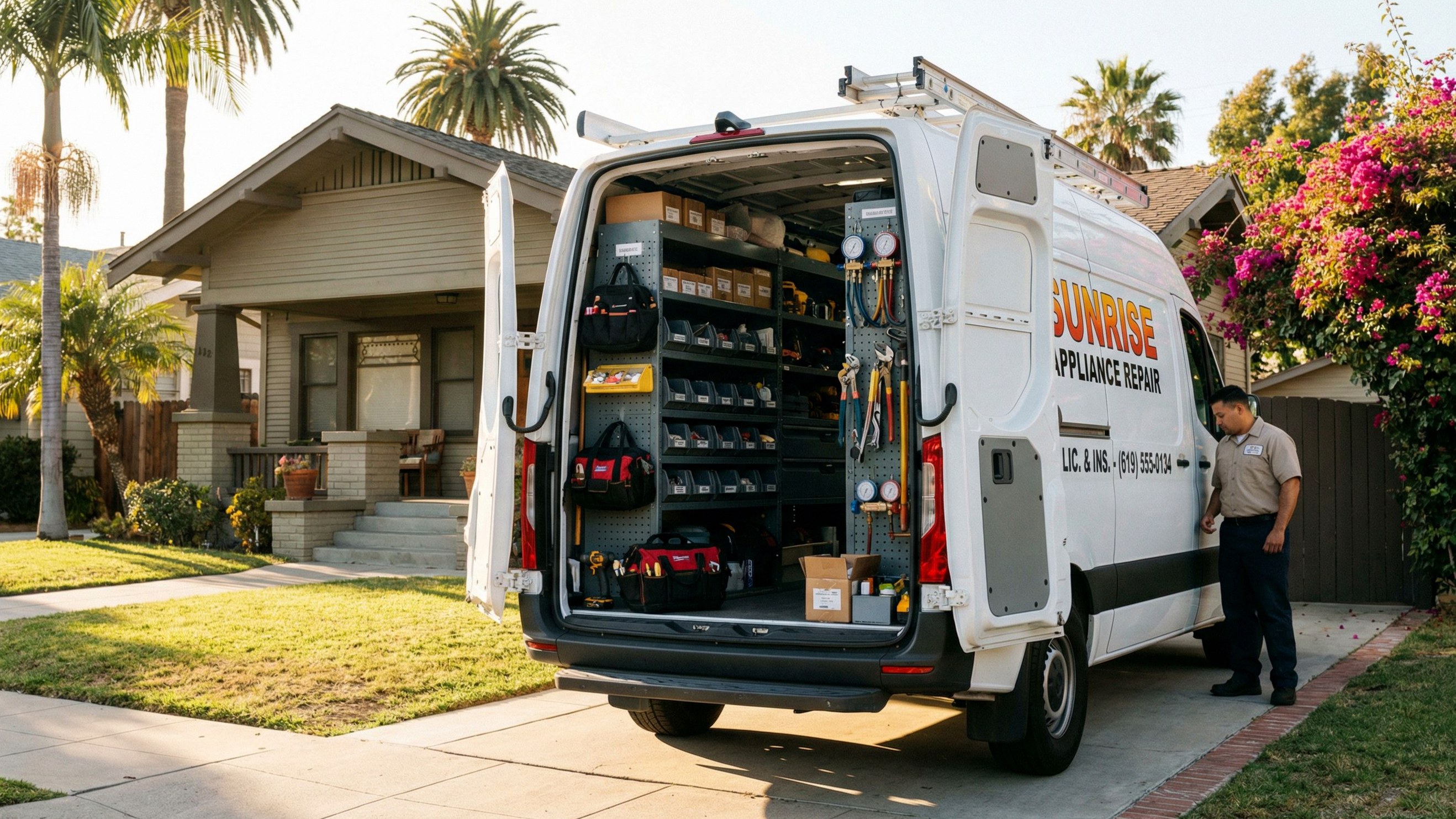
California has over 14 million households. Appliances break constantly. And unlike electricians, plumbers, and HVAC contractors, the state doesn't require a license to fix a dishwasher. If you've been thinking about how to start an appliance repair business, California is one of the best markets in the country for it. The barrier to entry is low, the demand is relentless, and most of your competition will be mediocre. That last part matters more than you think.
This isn't a motivational piece about "following your passion." This is a breakdown of what it actually takes — the legal paperwork, the startup costs, the tools, the first customers, and the real numbers — to launch and sustain an appliance repair business in California's biggest metro markets.
The California Market: Why It Works
Southern California alone has roughly 6 million households concentrated in Los Angeles, Orange, Riverside, San Bernardino, and Ventura counties. The median home age in much of the region is 30-50 years, which means the installed appliance base is a mix of aging equipment and builder-grade replacements that will fail within 5-8 years.
The appliance repair industry in California generates over $2 billion annually. But the supply of qualified techs has been tightening for years. The average appliance repair technician is over 50. Younger workers are going into tech and trades that pay better out of the gate. That's bad for the industry but good for you — if you show up, do quality work, and answer the phone, you're already ahead of half the shops in your zip code.
Setting Up Your Business the Right Way in California
Before you touch a single appliance, get the business structure right. Skip this step and you're one slip-and-fall away from personal financial disaster.
Choose your entity. An LLC is the standard move for a one-truck operation. It separates your personal assets from the business, it's simple to set up, and the tax flexibility is better than a sole proprietorship. File with the California Secretary of State — the fee is $75 online. You'll also owe the $800 annual California LLC franchise tax, which is due regardless of revenue. Budget for it from day one.
Get your city business license. Every city in California requires one. Costs vary: Los Angeles charges $151 to start, Long Beach runs about $140, Riverside is around $75. Unincorporated county areas are typically cheaper. Walk into your city's finance or business license office, fill out the form, and pay the fee. This takes an afternoon, not a week.
Register your fictitious business name if you're operating under anything other than your legal name. File a DBA with your county clerk ($26-50 depending on the county) and publish it in a local newspaper ($30-60). Yes, that newspaper publication requirement is real and still enforced.
Open a separate business bank account the same week you register your LLC. Mixing personal and business finances is the fastest way to lose your liability protection. Every dollar in and out of the business goes through that account. No exceptions.
Insurance: The Part Nobody Wants to Pay For
You need two policies before you take your first service call.
General liability insurance covers property damage and bodily injury at customer homes. A tech who floods a kitchen pulling a dishwasher, or scratches hardwood dragging out a fridge — that's general liability. Standard policies for appliance repair in California run $100-200 per month ($1,200-2,400 per year) for $1 million in coverage. Get $2 million if you plan to work on high-end homes or sub for property management companies, as most will require it.
Commercial auto insurance covers your van or truck while you're using it for business. Your personal auto policy won't cover a claim if you're driving to a service call. Expect $150-250 per month depending on your driving record and the vehicle. If you're financing a work vehicle, the lender will require commercial auto anyway.
Once you hire your first employee, you'll also need workers' compensation insurance — mandatory in California, no exceptions. But as a solo operator, those two policies get you started.
EPA 608 Certification: Non-Negotiable for Refrigerant Work
Here's where California gets specific. If you're going to work on refrigerators, freezers, or any sealed-system appliance that contains refrigerant, federal law requires EPA Section 608 certification. It's not a California rule — it's federal, enforced by the EPA, and the fines start at $44,539 per violation per day.
The exam covers four areas: small appliances (Type I), high-pressure systems (Type II), low-pressure systems (Type III), and Universal, which covers all three. Get Universal. The test is 80 multiple-choice questions. Study time is typically 10-20 hours depending on your background. The exam fee runs $20-30 through most proctors (ESCO Institute and HVAC Excellence are the common ones). You can take it at trade schools, supply houses, and community colleges throughout SoCal.
You do not need EPA 608 to work on washers, dryers, dishwashers, ovens, or ranges. But roughly 40% of residential service calls involve a refrigerator or freezer. Skipping the cert means turning away nearly half your potential revenue.
Take the EPA 608 Universal exam before you launch. The pass rate is over 80% for anyone who studies the ESCO prep material. One afternoon of testing opens up every refrigerant-containing appliance in every home you walk into.
A Note on CSLB and What You Don't Need
The California State License Board (CSLB) licenses contractors: electricians (C-10), plumbers (C-36), HVAC (C-20). Appliance repair — meaning diagnosis and replacement of appliance components — does not fall under CSLB jurisdiction as long as you're not doing work that crosses into those trades.
Replacing a dishwasher drain pump? That's appliance repair. Replumbing the water line behind it? That's plumbing, and you need a C-36 or a licensed plumber on the job. Swapping a dryer heating element? Appliance repair. Rewiring the 240V outlet it plugs into? That's electrical, C-10 territory.
Stay in your lane. The work is clearly defined, and the volume of appliance-only repairs is more than enough to build a six-figure business.
Tools and Equipment: Starting an Appliance Repair Business Without Overspending
You don't need $20,000 in tools on day one. You need enough to handle the top 10 most common repairs, and you build from there.
The starter kit ($2,000-4,000): A quality multimeter (Fluke 117 or equivalent, $160-200), a clamp meter for amp readings ($80-120), a basic hand tool set with nut drivers, screwdrivers, and pliers ($300-500), a 5-in-1 painter's tool (you'll use it more than you expect), appliance dollies and moving blankets ($150-300), a shop vacuum ($100-150), and a refrigerant manifold gauge set if you've got your 608 ($150-250).
The "full shop" upgrade ($4,000-8,000 additional): A watt meter, a megohmmeter for insulation resistance testing, a refrigerant leak detector ($200-400), a thermal camera ($300-600 — the FLIR ONE Pro attachment works fine starting out), a refrigerant recovery machine ($400-800), and brand-specific diagnostic tools for Samsung and LG smart appliances.
Buy quality on the multimeter and clamp meter — those are your diagnostic backbone. Everything else, mid-range is fine until you know which repairs you're running most.
The van or truck. A used cargo van (Ford Transit Connect, Ram ProMaster City, or Chevy City Express) in the $8,000-15,000 range is the SoCal standard for a solo operation. Compact enough for residential streets, big enough for parts stock and a small tool wall. Skip the full-size van until you have a helper. Wrap it with your business name and phone number — vinyl lettering costs $200-500 and generates calls while it's parked in driveways.


Getting Your First Customers in the California Market
Nobody cares about your LLC paperwork or your new van. They care whether you can fix their washing machine before Saturday. Here's where the first calls come from.
Google Business Profile. Set this up before anything else. It's free, it puts you on Google Maps, and it's where 60-70% of your calls will originate within six months. Fill out every field. Add photos of your van, your tools, and completed jobs. Post weekly updates. Ask every satisfied customer for a review — in person, before you leave. The techs who hit 50+ five-star reviews in their first year own their local map pack.
Thumbtack and similar platforms. Thumbtack, Yelp, and Angi generate leads for a fee. They're expensive per lead ($15-40 each on Thumbtack), and the close rate is lower than organic Google traffic. But when you're starting from zero, they fill the calendar. Use them aggressively for the first three to six months, then reduce spend as your organic presence grows.
Property management companies. Every property management office in your area handles maintenance requests for dozens or hundreds of rental units. Walk in with a business card, your insurance certificate, and a one-page rate sheet. Offer a 10% discount on the first five service calls. Property managers need reliable techs who answer the phone and show up on time — many of their current vendors do neither. This is where recurring revenue starts.
Word of mouth. It's slow to build and impossible to buy. Do great work, communicate clearly, and leave the appliance area cleaner than you found it. The referrals compound over time. By year two, your best customers should be sending you two or three new ones per quarter.
Pricing: What to Charge and How to Structure It
This is where most new operators leave money on the table. They undercharge because they're afraid to lose the job. Don't do that.
The SoCal standard in 2026 is a service call fee of $89-129, applied toward the repair if the customer approves the work. Flat rate pricing for the repair itself, which includes parts and labor as a single quoted number. We've published a full breakdown of current SoCal appliance repair pricing benchmarks — read it before you set your rates.
Parts margins matter just as much as labor rates. Build relationships with local distributors and wholesale suppliers early. Having the right part on your truck (or available same-day) is the difference between a one-trip close and a callback that costs you time and gas. Our guide to building a parts supplier network in SoCal covers the major distributors, account setup, and markup strategies in detail.
Track your average revenue per call from week one. In SoCal, a healthy solo operation should average $225-350 per completed job. If you're consistently below $200, you're either undercharging or running too many diagnostic-only calls that don't convert to repairs. Fix the pricing, not the volume.
Scaling: When to Hire and When to Add a Second Truck
Don't hire too early. The number one mistake first-year operators make is adding overhead before the revenue justifies it. Here are the benchmarks.
You're ready for a helper when: you're consistently booking 5-6 calls per day and turning away work, your callback rate is under 5%, and your monthly gross is above $15,000 for three consecutive months.
You're ready for a second truck when: you've had a trained tech working with you for 3-6 months, your monthly gross exceeds $25,000, and you have enough inbound demand to keep two trucks running 4+ calls per day each.
Hiring in California means payroll taxes, workers' comp, and compliance with California labor law — which is among the most employee-friendly in the country. Misclassifying a W-2 employee as a 1099 contractor is an expensive mistake. The state Employment Development Department (EDD) actively audits service businesses. If your tech drives your van, uses your tools, and follows your schedule, that's an employee. Period.
An experienced tech in SoCal commands $22-35 per hour, or $55,000-75,000 annually with benefits. A well-utilized tech should generate $1,200-2,000 per day in revenue. The math works if the volume is there. It doesn't if you're hiring based on hope.
Common Mistakes That Kill New Appliance Repair Businesses
Not answering the phone. It sounds too simple to matter. It's the single biggest factor. Customers call two or three companies and book whoever picks up first. If you can't answer live, use a virtual receptionist service ($100-200 per month). Every missed call is a missed $250+ job.
Skipping insurance. One water damage claim at a customer's home can cost $10,000-50,000. Without general liability coverage, that comes out of your pocket. Carrying proper insurance isn't just protection — it's what separates a real business from a guy with a toolbox.
Working on everything. Don't take commercial restaurant equipment calls when you're trained on residential. Don't attempt sealed-system work without the 608 cert and proper equipment. Botched jobs generate bad reviews that take months to recover from. It's better to refer a job out than to do it badly.
Ignoring the books. Track every dollar — revenue, parts cost, fuel, insurance, phone bill, everything. Use QuickBooks Self-Employed or Wave (free). If you don't know your actual profit margin by month three, you're guessing. Guessing doesn't work.
Undervaluing your time. Driving 45 minutes across the Inland Empire for an $89 diagnostic that might not convert to a repair is a losing proposition. Set a service radius, stick to it, and price travel time into jobs that fall outside it.
Startup Cost Breakdown
Here's what a realistic launch looks like for a solo appliance repair operation in Southern California.
The lean version — using a vehicle you already own, starting with the basic tool kit, and keeping insurance at minimum levels — runs about $5,000-7,000 out the door. The fully equipped version with a dedicated work vehicle lands at $15,000-25,000. Most techs we talk to started somewhere in the middle.
Revenue Benchmarks: What the Numbers Actually Look Like
Month 1-3: Building. Expect 2-3 calls per day, mostly from paid lead sources. Monthly gross: $4,000-8,000. You'll feel like it's not working. Keep going.
Month 4-6: Google Business Profile reviews start compounding. Organic calls increase. Repeat customers and referrals begin. Monthly gross: $8,000-12,000.
Month 7-12: If you've been consistent with quality work and review collection, organic calls should be 50%+ of your volume. Monthly gross: $10,000-18,000. At the top of that range, you're hitting six figures annualized.
Year 2: A well-run solo operation in SoCal grosses $100,000-150,000 with net margins of 40-50% before owner compensation. That's $40,000-75,000 in your pocket after all business expenses. Adding a second tech pushes gross toward $200,000-300,000.
These aren't projections from a franchise brochure. They're based on operators we work with across Los Angeles, Orange County, and the Inland Empire.
Do I need a license to repair appliances in California?▾
California does not require a state license for appliance repair. You need a local business license from your city or county, and EPA Section 608 certification if you handle refrigerants. Some cities require a home solicitation permit for door-to-door marketing. The CSLB does not regulate appliance repair work as long as you stay within the scope — replacing appliance components, not doing plumbing, electrical, or HVAC trade work.
How much does it cost to start an appliance repair business?▾
Most techs start for $5,000-15,000. The low end assumes you already have a vehicle and start with a basic tool kit. The high end includes a used cargo van, full tool set, insurance, business registration, and initial parts stock. You can start part-time evenings and weekends to validate demand before going full-time.
How much do appliance repair technicians make in California?▾
Independent techs in Southern California typically gross $60,000-120,000 in their first full year depending on call volume and pricing. Experienced operators running two or three trucks can gross $300,000-500,000 annually. Net margins range from 35-50% depending on overhead, with solo operators keeping the largest share.
Need a repair professional?
Get free quotes from verified technicians in your area.
Find a Pro Near You