


AI Is Moving Past the Receptionist Job in the Trades
ServiceMag Staff
Reporting and editorial coverage from the ServiceMag newsroom.
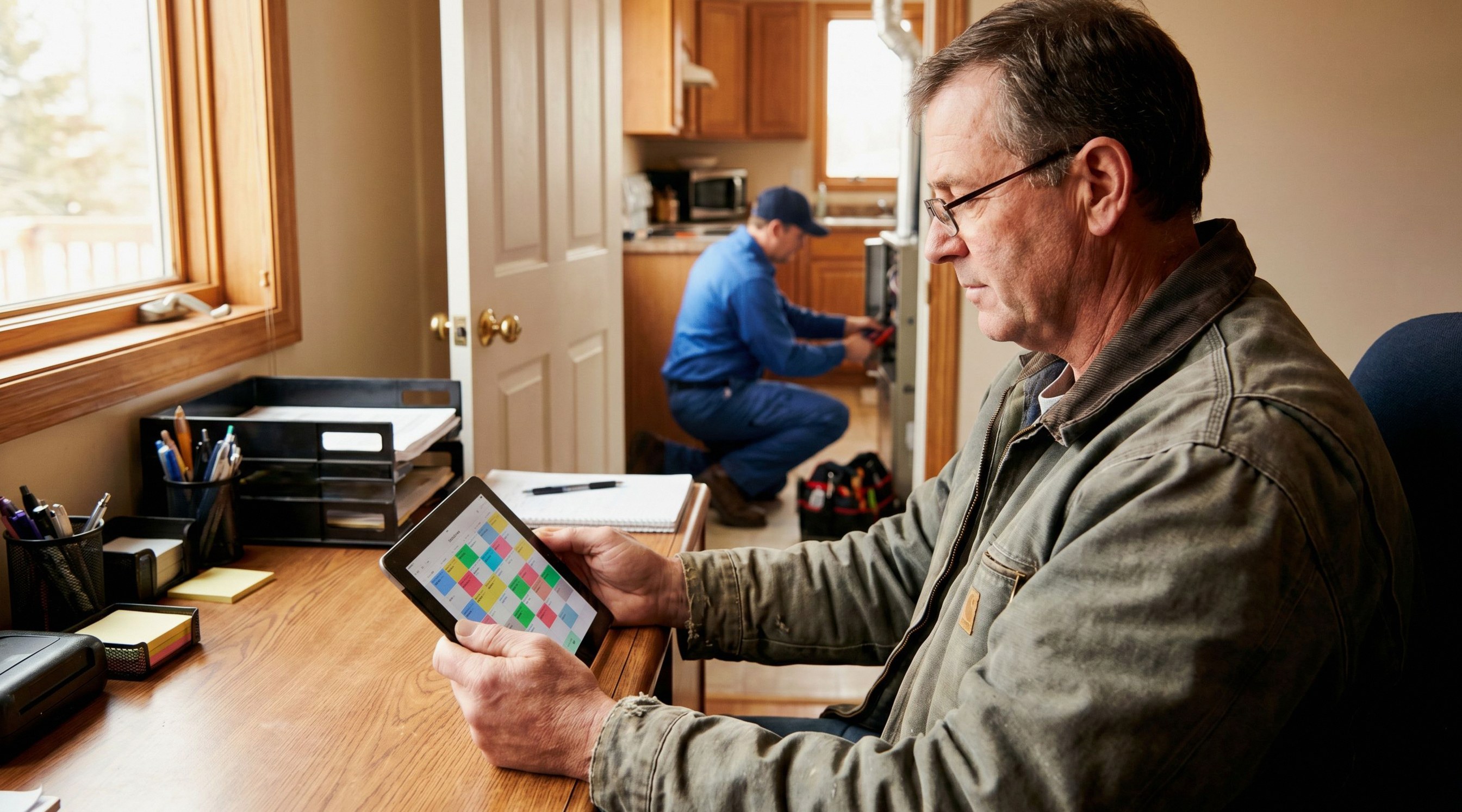
The first thing AI did in home services was pick up the phone. The next thing it does is run the schedule. That shift — from answering a call to actually booking the job, qualifying the lead, following up, and rescheduling the cancellation — is the part of the AI story most owners haven't priced in yet, and it's moving faster than the headlines about voice bots suggest.
For most of the last two years, "AI in the trades" meant one feature: a voice that answers when the office can't. Useful, but narrow. It was a voicemail replacement with better diction. The agent could take a message, maybe collect a name and number, and hand it back to a human to do the real work. The conversation was automated. The job wasn't.
What's changing in 2026 is the layer underneath the conversation. The newer systems are built to take actions inside the business — read the live calendar, book against real availability, send the confirmation text, watch for a no-reply, and move a canceled 2 p.m. into an open slot without anyone touching it. The industry has started calling these "agents" rather than "receptionists," and the distinction is real: an agent completes a multi-step task end to end, instead of just navigating a phone menu and taking dictation.
What an AI Agent Actually Does That a Receptionist Bot Doesn't
The distinction is easiest to see in a single workflow. A homeowner calls a plumbing shop at 7:40 p.m. about a water heater that quit.
A first-generation AI receptionist answers, takes the name and number, and promises someone will call back. The next morning, a dispatcher calls — and finds out the customer already booked with whoever answered live the night before.
A workflow agent runs the rest of the play. It checks tomorrow's route, sees a 10 a.m. opening near the customer's zip code, books it, texts a confirmation with the technician's name and a two-hour window, and logs the job in the CRM. If the customer doesn't reply to the confirmation, it follows up. If they cancel at 8 a.m., it offers the slot to the next lead in the queue. None of that requires a person until the truck shows up.
That is the difference between automating a conversation and automating an operation. The receptionist bot handles the hello. The agent handles the calendar, the qualification, the confirmation, the follow-up, and the reschedule — the unglamorous middle of the job that quietly eats an owner's evenings.
Why It's Reaching Small Shops Now
The capability itself isn't new. Large call centers have run automated booking and routing flows for years. What changed is the cost and setup curve. Building a system that can hold a natural phone conversation and write a confirmed appointment back into scheduling software used to require an enterprise budget and an integration team. Off-the-shelf voice models and prebuilt connectors to the field-service CRMs that small shops already use have collapsed both. The same always-on booking layer a regional franchise pays for is no longer priced out of an independent's reach — which is the real story, more than any single product launch.
Jason Luo, who runs the voice-AI firm Newo, made the same point about the economics when we asked: AI team members are "now practical for a two-truck operation, not just national chains." His framing is narrower than the marketing around the category — not that AI replaces the crew, but that the booking-and-follow-up layer has dropped to where a small shop can run it.
For an independent shop, the appeal is less about labor savings than capture. A two-truck HVAC or appliance business usually can't justify a full-time CSR, let alone a night shift. The owner is the after-hours line. An agent that books and follows up while the owner is on a job — or asleep — isn't replacing a salary the shop was paying. It's catching revenue the shop was losing by default. ServiceMag has covered the underlying economics of that leak in detail; see our reporting on what a mid-sized shop is actually losing on after-hours calls and on cost-per-customer and booking-rate conversion.


The Numbers Behind the Shift
The macro case for automation here isn't subtle. Gartner has projected that conversational AI deployments in contact centers will cut agent labor costs by $80 billion in 2026, and that roughly one in ten agent interactions will be automated by that year, up from an estimated 1.6 percent when the forecast was published in 2022. Those figures were aimed at large contact centers. The same tooling is now landing in the trades at small-business scale.
There's a real debate worth flagging, and it cuts against the hype. Consumer research — some of it commissioned by companies that sell human answering services — has found that a meaningful share of callers will hang up the moment they realize they've reached a bot, and that most people still prefer a human on a high-stress emergency call. The honest read of the current state of the art: AI agents are strongest on the structured, repeatable parts of the job — qualifying, booking, confirming, reminding, rescheduling — and weakest on the parts that need a person to sound like a person at 11 p.m. The shops getting the most out of these tools point them at the workflow first and keep a human on the emotionally loaded first contact.
If you're evaluating an AI agent, separate two questions that vendors blur together: can it talk, and can it do? Plenty of products demo a smooth conversation but can't write a confirmed appointment back into your scheduling software. Ask for a live test against your actual calendar and CRM before you sign anything. The workflow integration is where the value is — and where most of the failures hide.
Start Where You're Leaking
The mistake owners make with this category is buying the platform before the problem. The pitch is usually a full AI staff — answer, book, dispatch, invoice, market. The practical entry point is one leak. Pick the hour of the day you most reliably miss calls, put an agent on that single window, and measure booked jobs against the prior month. If it books work the shop would otherwise have lost, the next step argues for itself. If it doesn't, you've spent a small amount finding that out.
The receptionist phase of AI in the trades was about not missing the call. This phase is about what happens in the twenty minutes after it — and increasingly, none of those minutes need a human in them. That's the line a two-truck shop couldn't cross a year ago. It can now.
Sources
- Gartner. "Gartner Predicts Conversational AI Will Reduce Contact Center Agent Labor Costs by $80 Billion in 2026." August 31, 2022. gartner.com ($80B labor-cost reduction by 2026; ~1 in 10 agent interactions automated, up from ~1.6%).
The quoted remark from Jason Luo was provided to ServiceMag by Newo, a company that builds AI voice and text agents for small and mid-sized businesses.
Need a repair professional?
Get free quotes from verified technicians in your area.
Find a Pro Near You