


AC Not Cooling: Troubleshooting Central Air From the Thermostat to the Compressor
Dale Resnick
A 30-year veteran of residential HVAC who's crawled through more attics than he can count. Dale writes the 'Duct Tape & Beyond' column and believes every compressor tells a story if you listen close enough.
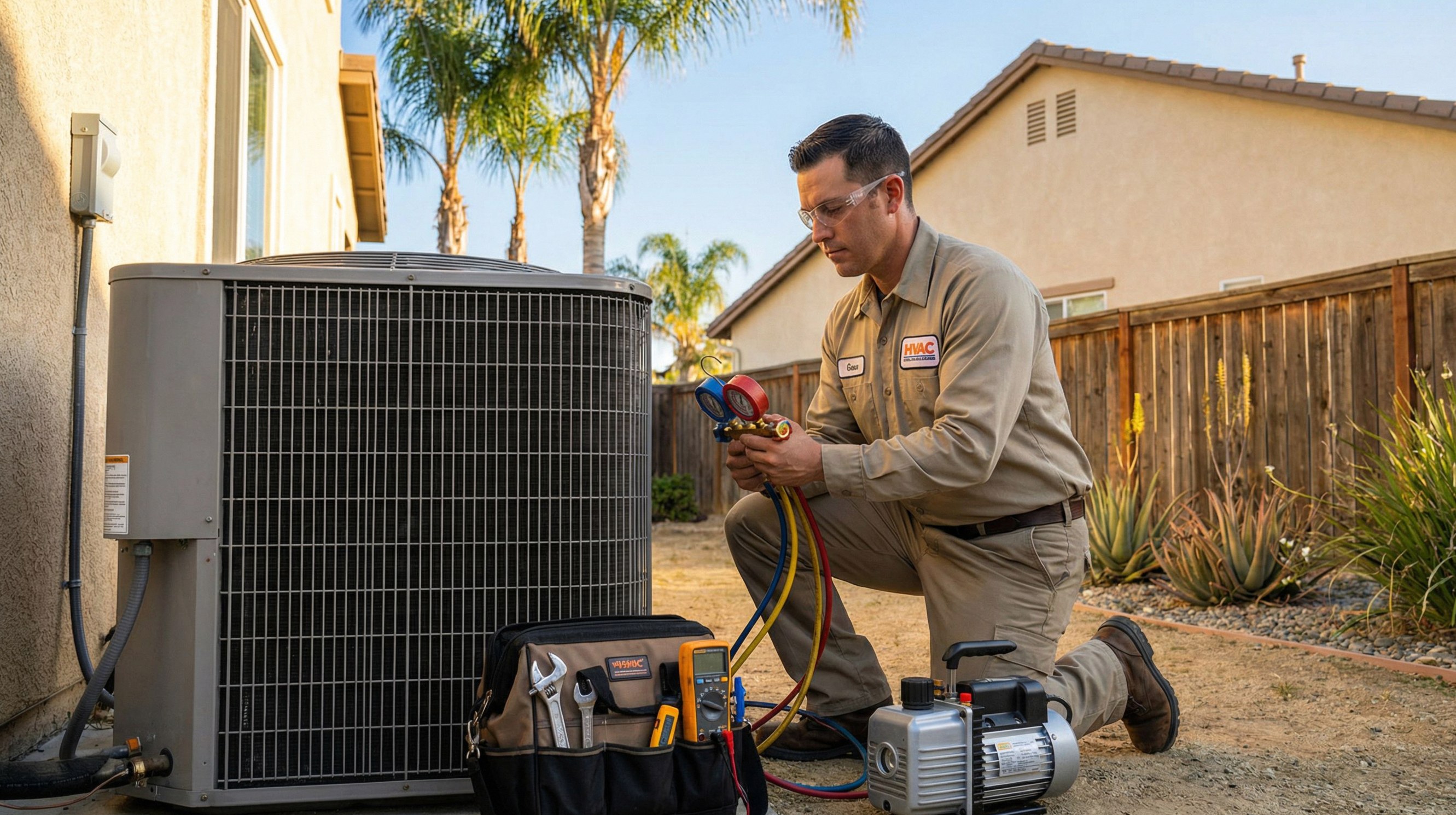
An AC not cooling is the single most common residential HVAC service call in Southern California from May through October. I've been running these calls for thirty years, and the diagnostic path is almost always the same six stops. Thermostat. Airflow. Evaporator coil. Outdoor unit components. Refrigerant. Compressor. Work through them in order and you'll find the problem without wasting time or misquoting parts.
Here's the full walkthrough, written for techs and informed homeowners alike.
Start at the Thermostat and the Obvious Stuff
Before you pull out the gauges, spend three minutes inside the house. You'd be surprised how often the fix never leaves the hallway.
Check the thermostat setting. It sounds too simple, but I close a handful of these calls every summer because someone bumped the mode to "Heat" or "Fan Only." On Honeywell T6 and Ecobee units, verify the system mode shows "Cool" and the setpoint is at least 3 degrees below room temperature. If the fan runs but the outdoor unit doesn't start, the thermostat or the Y-wire connection is your first suspect.
Pull the thermostat off the wall and jump R to Y at the subbase. If the outdoor unit kicks on, the thermostat or its wiring is the issue. If it doesn't, move on.
Next, the air filter. A clogged filter restricts airflow across the evaporator coil, which drops the coil temperature below freezing and ices it over. The system runs. Air comes out of the vents. But it's barely cool, or room temperature. In the San Fernando Valley and Inland Empire, where systems run twelve to sixteen hours a day in summer, a standard 1-inch fiberglass filter can load up in three to four weeks. The 4-inch MERV-11 media filters last longer but still need checking monthly during peak season.
Check all supply registers and return grilles. Closed or blocked registers cause the same problem as a dirty filter, just more localized. Furniture over returns is the most common version. I've found area rugs draped over floor returns, boxes stacked against wall returns, and one memorable call where the customer's dog bed was sitting directly on top of the only return in the house.
Carry a cheap infrared thermometer on every call. Measure supply air temperature at the register closest to the air handler and compare it to the return air temperature. You should see a 16 to 22 degree split. Less than 14 degrees means the system is underperforming. More than 22 might mean low airflow. This takes ten seconds and gives you real data before you ever go outside.
Frozen Evaporator Coil: The Silent Killer of Cooling
A frozen evaporator coil is behind roughly 30% of "AC not cooling" calls in my experience. The system runs, the compressor is fine, refrigerant charge might even be correct, but the coil is a solid block of ice and no air gets through.
Three things cause a freeze-up: restricted airflow (dirty filter, collapsed duct, blower failure), low refrigerant charge, or a failing blower motor that isn't moving enough air. Sometimes two of these stack on top of each other.
If you open the access panel on the air handler and see ice on the coil, don't start scraping. Turn the system to "Fan Only" and let it melt. This takes 30 to 90 minutes depending on how bad it is. Trying to run the system or force-defrost with a heat gun damages the coil fins and can crack solder joints on the return bends.
While the coil thaws, check the blower motor. On most Goodman, Carrier, and Rheem air handlers common in SoCal tract homes, the blower is a PSC (permanent split capacitor) motor with its own run capacitor, typically 7.5 or 10 MFD. A weak blower capacitor means the motor runs slow, moves less air, and the coil freezes. Test the capacitor with a meter that reads microfarads. Anything more than 10% below the rated value means it's done.
Once the ice is melted, check the coil itself. Dirty evaporator coils are everywhere. The filter catches most airborne debris, but fine dust passes through over years and builds up on the wet coil surface. A coil that looks fuzzy gray needs cleaning. Use a no-rinse evaporator coil cleaner (Nu-Calgon Evap Foam is the industry standard) and let it drip into the drain pan.
In houses with pets, especially multiple dogs or cats, the evaporator coil loads up two to three times faster than normal. If you clean a coil and it's heavily matted with pet hair and dander, talk to the customer about upgrading to a 4-inch media filter cabinet. The Honeywell FC100A1037 and Aprilaire 413 are good options that actually fit most air handlers without modification.
Why Your AC Runs But Doesn't Cool: The Outdoor Unit
If the indoor side checks out, head outside. The condenser unit is where most of the expensive problems live, but also some of the cheapest fixes.
The Run Capacitor
This is the single most common part failure on residential AC systems. Period. The run capacitor (also called a dual capacitor because it serves both the compressor and condenser fan) sits inside the outdoor unit's electrical panel. A failed capacitor means the compressor hums but doesn't start, or the fan doesn't spin, or both.
Common sizes on residential units: 35/5 MFD for 2-ton systems, 40/5 MFD for 2.5 to 3-ton, and 45/5 MFD for 3.5 to 5-ton. The first number is the compressor side, the second is the fan. Pull the capacitor and test it. A swollen top is a dead giveaway, but plenty of failed capacitors look perfectly normal.
On Carrier, Bryant, and Payne units (extremely common in SoCal new construction from 2005-2020), the factory capacitor is almost always the first component to fail, usually between year 5 and year 8. I keep 35/5 and 45/5 MFD capacitors on every truck. They're $15 to $30 at the supply house. The customer sees a $150 to $250 bill, the system is back online in 20 minutes, and everyone's happy.
The Contactor
The contactor is the relay that sends 240V to the compressor and fan motor when the thermostat calls for cooling. Contactors wear out. The contact points pit and burn over time, especially in coastal areas like the South Bay and Ventura County where salt air accelerates corrosion.
A chattering contactor or one with visibly burnt contacts needs replacement. These are $10 to $20 parts (Honeywell DP1030A5014 fits most residential units). With the power off, swap it out. Total call time: 30 minutes including the drive.
The Condenser Coil
A dirty condenser coil can't reject heat. The compressor works harder, head pressure climbs, and the system delivers warm air. In the Inland Empire and high desert areas, condenser coils get packed with cottonwood fluff, dust, and pollen every spring. In coastal zones, salt deposits build up year-round.
Hose it down from the inside out. Use a coil cleaner if it's heavily soiled (Nu-Calgon Cal-Clean or 4171-75). Straighten bent fins with a fin comb. If the coil is damaged beyond cleaning, that's a bigger conversation, but cleaning alone solves the problem about 80% of the time.


Refrigerant: Leak Signs, Costs, and the 2026 Transition
If the capacitor is good, the fan spins, the compressor runs, the coils are clean, and the system still isn't cooling, you're looking at a refrigerant issue. Connect your gauges.
On an R-410A system at 95°F outdoor ambient (a normal summer afternoon in most of SoCal), expect suction pressure around 118 to 128 PSI and head pressure around 350 to 400 PSI. Subcooling should be 8 to 14 degrees on TXV systems, which is nearly everything built after 2006. If suction pressure is low and subcooling is high, the charge is low. If suction is low and subcooling is also low, you likely have a restriction.
Low charge means a leak somewhere. Common leak points: the service valve Schrader cores, the evaporator coil return bends (especially on aluminum evaporators), the line set flare connections, and the condenser coil itself. Use an electronic leak detector and soap bubbles at every joint. On systems that lose charge slowly, a UV dye test is worth the effort. Inject dye, run the system for a week, come back with a UV light.
R-22 vs. R-410A vs. R-454B: Where Things Stand in 2026
R-22 (Freon) has been out of production since January 2020. Reclaimed R-22 still exists but runs $80 to $150 per pound. A typical residential system holds 6 to 12 pounds. If you've got an R-22 system with a significant leak, the cost to repair and recharge often pushes $800 to $1,500. At that point, system replacement is usually the smarter play.
R-410A is the current standard but is being phased down under the EPA's 2026 AIM Act rules. New equipment manufactured after January 1, 2025 uses lower-GWP alternatives, primarily R-454B (marketed as Opteon XL41 by Chemours). R-410A equipment already installed can be serviced indefinitely with R-410A refrigerant, which remains available. But expect R-410A prices to climb as production shifts. Right now it's $8 to $15 per pound. Plan accordingly.
R-454B is mildly flammable (A2L classification). Technicians servicing new equipment need to understand the updated safety protocols, and if you haven't taken the A2L training yet, now is the time. Service procedures are similar but not identical to R-410A.
For a deeper look at ductless systems and refrigerant options, see our mini-split installation guide for Southern California.
When you find a leak on an R-22 system, give the customer three options with real numbers: (1) repair the leak and recharge at today's R-22 price, (2) convert to an R-407C drop-in replacement (cheaper refrigerant but 5-10% efficiency loss), or (3) replace the system with a new R-410A or R-454B unit. Put the ten-year cost of each option on paper. Most customers pick option three once they see the math, but they appreciate having the choice.
Compressor Diagnosis: The Big One
If the compressor won't start at all, you already checked the capacitor and contactor. Good. Now check for power at the compressor terminals. You should have 240V line-to-line when the contactor is pulled in. If voltage is present and the compressor doesn't start, test the windings.
On a single-phase reciprocating or scroll compressor (Copeland, Bristol, Danfoss), measure resistance between Common-Start, Common-Run, and Start-Run terminals. C-S plus C-R should roughly equal S-R. Open or shorted readings mean the motor is burned. Any reading from a winding to the compressor shell means a ground fault. Replace the compressor or, more often, the entire condensing unit.
A compressor that starts but trips on the overload after a few minutes is typically running on high head pressure (dirty condenser, overcharge, or a failing condenser fan) or has internal mechanical damage. Check the condenser coil and fan first. If those are good and the compressor still trips, it's likely done.
On Copeland Scroll compressors (ZR and ZP series, found in most Carrier, Lennox, Trane, and Rheem units), listen for the distinctive "scroll slap" at startup. A healthy scroll compressor has a smooth, quiet start. A failing one makes a metallic clunking sound during the first two seconds. That's the scroll set coming apart.
When Compressor Replacement Makes Sense
On systems under 8 years old with a manufacturer's parts warranty still in effect, compressor replacement can make sense. Most major brands offer 10-year parts warranties on compressors. Carrier, Lennox, Trane, Goodman, and Rheem all cover the part. Labor is on the customer.
On systems over 10 years old, especially if they use R-22, compressor replacement is rarely the right call. A new compressor costs $800 to $1,800 for the part alone, plus $600 to $1,200 in labor for recovery, brazing, evacuation, and recharge. By the time you're done, the customer has spent $1,500 to $3,000 on a unit that's already past its expected lifespan. A new 3-ton condensing unit with R-410A runs $2,500 to $4,000 installed. The warranty resets, the efficiency improves, and you avoid chasing the next failure on a worn-out system.
Always replace the liquid line filter drier when you open the sealed system. Every single time. And flow nitrogen through the lines while brazing. If you skip either of these, you'll be back within a year. I've seen new compressors fail in six months because someone brazed without a nitrogen purge and the resulting carbon flakes plugged the metering device.
SoCal-Specific Notes
Southern California heat loads are no joke. Inland Empire cities like Riverside, San Bernardino, and Redlands regularly hit 110°F in July and August. At those outdoor ambient temperatures, even a properly functioning system is working near its limits. Compressor failures spike when the delta-T between indoor and outdoor exceeds 35 degrees, which happens every afternoon in a desert summer.
Most tract homes built between 1990 and 2015 in the Inland Empire and San Fernando Valley have Carrier or Goodman package units or 14-SEER split systems. These are workhorses but they weren't sized for 115°F days. If a customer tells you "it keeps up until about 2 PM and then falls behind," that's not a malfunction. That's an undersized system meeting its design limit.
Coastal areas (Ventura, the South Bay, Orange County coast) see fewer cooling-related calls but deal with salt corrosion on condenser coils and electrical connections. If you're working on a unit within three miles of the ocean, expect corroded wire terminals, pitted contactor contacts, and condenser coils that need cleaning twice a year.
Putting It All Together
Walk the diagnostic in order. Thermostat and airflow first. Frozen coil second. Outdoor unit components third. Refrigerant fourth. Compressor last. Following this sequence means you catch the $20 fix before you quote the $2,000 one. Most AC not cooling calls resolve somewhere in the first three stops.
When the diagnosis points to sealed system work or compressor replacement, give the customer honest numbers and let them decide. For pricing guidance on how to structure your quotes in this market, check our guide to pricing appliance repair in Southern California.
Why is my AC running but not cooling the house?▾
The most common causes are a dirty air filter restricting airflow, a frozen evaporator coil, low refrigerant from a leak, or a failed run capacitor on the outdoor unit. Start by checking the filter and thermostat settings, then work outward to the condenser unit. A $15 capacitor or a $5 air filter solves more of these calls than you'd expect.
How much does it cost to fix an AC that's not cooling?▾
Simple fixes like a capacitor or contactor replacement run $150 to $300 with labor. Refrigerant leak repair with a recharge costs $400 to $1,200 depending on the leak location and refrigerant type. Compressor replacement runs $1,500 to $3,000, at which point you should compare the cost of a full system replacement.
Should I replace my AC if the compressor fails?▾
Usually yes, especially if the system is over 10 years old or uses R-22 refrigerant, which is no longer manufactured and costs $80 to $150 per pound for reclaimed supply. A compressor replacement on a 12-year-old unit often costs more than half the price of a new system. Get quotes for both options and compare the numbers.
How often should I change my AC filter?▾
In Southern California, check your filter monthly during cooling season (May through October). Standard 1-inch fiberglass filters should be replaced every 30 to 45 days when the system runs heavily. Four-inch media filters last 3 to 6 months. Homes with pets or near construction need more frequent changes.
Need a repair professional?
Get free quotes from verified technicians in your area.
Find a Pro Near You