


Refrigerator Not Cooling: Complete Diagnostic Guide for Every Fridge Style

Terry Okafor
Master refrigeration tech and NATE-certified instructor who moonlights as the magazine's advice columnist. His 'Ask Big Terry' mailbag has been settling shop disputes and diagnosing mystery leaks since 2011.
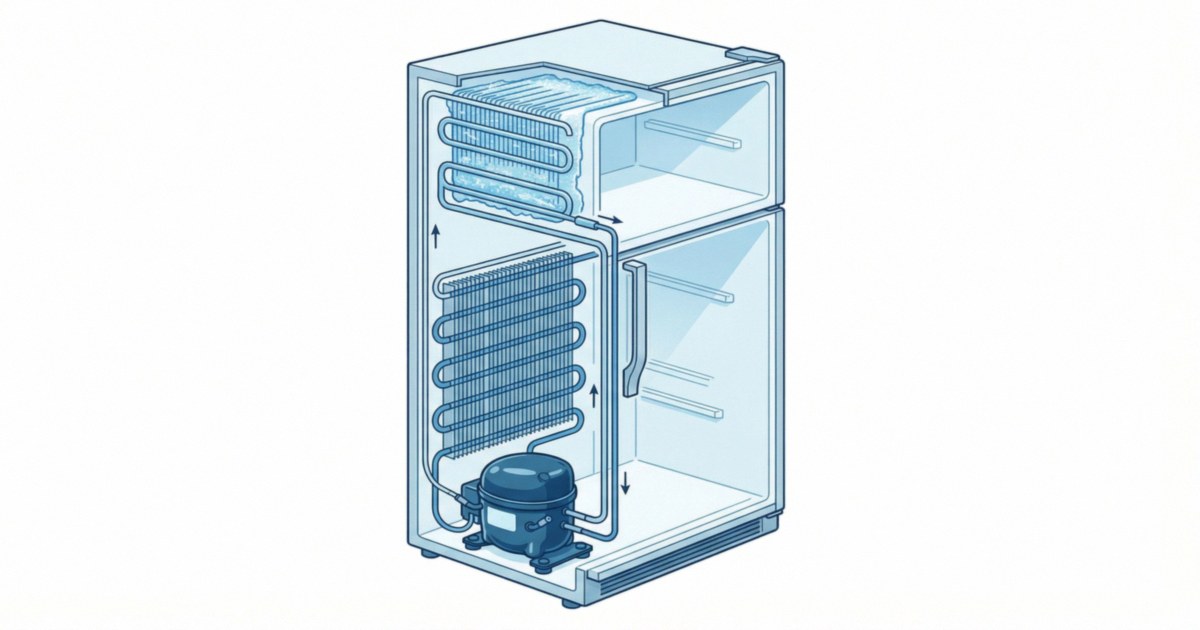
A refrigerator not cooling is one of the most urgent service calls in residential repair — the customer has food at risk and a ticking clock. I've run these calls for over twenty years, and the good news is that most of them resolve quickly and cheaply. The bad news is that there are enough failure points that you need to work through them in the right order, or you'll waste time chasing the expensive diagnosis before you've ruled out the cheap one.
Here's the full walkthrough, organized by probability. Work top to bottom and you'll find the problem.
Step One: Dirty Condenser Coils
This is the most common cause of gradual cooling decline and it costs nothing to fix. The condenser coils reject heat from the refrigerant to the surrounding air. When they're coated in dust and pet hair, they can't reject heat efficiently. The refrigerant stays warmer, the compressor works harder, and the cabinet temperature climbs — usually over weeks or months rather than suddenly.
On most top-mount and side-by-side models, the condenser coils are underneath the unit behind the front kick plate or at the back behind a rear access panel. French-door models, including Samsung and LG four-door designs, typically have the condenser coils at the bottom rear. Pull the kick plate, look for a flat coil covered in dust. Sub-Zero and Thermador units with top-mounted condensers are the exception — those coils are behind a grille at the top of the unit.
Clean the coils with a refrigerator coil brush and a vacuum. The typical coil brush is a 25-inch flexible brush that fits between the fins. Do this every 6-12 months in homes with pets. In coastal SoCal, salt dust accelerates buildup. I've seen 2-year-old units with coils that look like they haven't been touched in a decade.
On the service call, clean the coils and then let the unit run for 20 minutes before you start pulling any other components. I've closed plenty of calls where the fridge was back to temperature before I got back from the truck. Dirty coils plus a hot ambient is a surprisingly common combination that mimics sealed system failure.
Step Two: The Evaporator Fan Motor
The evaporator fan is inside the freezer compartment, behind the rear wall panel. Its job is to pull air across the cold evaporator coil and circulate it through both the freezer and the refrigerator sections. When the fan fails, the freezer usually stays somewhat cold (direct contact with the coil) but the fresh food section warms up. The compressor runs — you can hear it — but the refrigerator side loses cooling first.
The quick test: open the freezer door and hold the door switch in (simulating a closed door). Listen for the fan. If the compressor is running and the fan isn't, you've found your problem. On some models, press the light switch manually rather than using the door switch — check your service manual.
Evaporator fan part numbers by brand:
- Whirlpool/KitchenAid/Maytag — WPW10189703 covers most top-mount and bottom-mount models built after 2008. Verify by the motor mounting style — some older platforms use 2315539.
- Samsung French-door (RF series) — DA31-00146E. This is an extremely common failure on RF28 and RF23 series units. The plastic fan blades also crack on these and cause intermittent noise before complete failure — part DA97-07365G for blades only.
- LG French-door (LRMVS, LRFXS series) — 4681JB1027H for the evaporator fan motor. LG fans run quietly and typically give no audible warning before they stop.
- GE Profile and standard GE — WR60X10220 for most French-door and side-by-side models. GE French-door units have two evaporator fans — one for the freezer and one for the fresh food section. Test both.
Step Three: The Start Relay and Overload Protector
The start relay is a small component — typically the size of a salt shaker — that clips onto the side of the compressor. It provides the starting kick of current that gets the compressor motor spinning from a dead stop. When the relay fails, the compressor tries to start, trips the overload protector (a thermal safety that prevents motor damage), and shuts off after 2-3 seconds. The cycle repeats every few minutes. You'll hear a click, a brief hum, then silence. Repeat. That pattern is almost always a bad start relay.
The rattle test: unplug the fridge, unclip the relay from the compressor pins, and shake it next to your ear. A rattling sound means the internal PTC element has cracked. Replace it.
Start relay part numbers:
- Whirlpool/Amana/Maytag — WP2204106 (universal fit for most Whirlpool-platform compressors). Also check for W10613606, which Whirlpool revised the relay to multiple times.
- Samsung — DA35-00178B for most RS and RF series. Samsung relays are known to fail between years 3 and 7. They also sell a combo relay/overload kit — DA35-00150A — worth using if the overload looks discolored.
- LG — 6749C-0014B. LG relays are very reliable. If the relay rattles on an LG, look closely at the compressor — LG's linear compressor design (used on LDT, LRMVS, LRFXS series) has a separate failure mode. See the LG linear compressor guide.
- GE — WR07X10112 covers most GE and GE Profile models. If you're working a GE with a Embraco or Danfoss compressor (common on GE Cafe and Monogram), the relay is press-on and identified on the compressor label.
Keep a universal start relay on the truck. The Supco SP72 and RCO410 are generic relays that fit most domestic refrigerator compressors in a pinch. The fit isn't always perfect and I'd rather use the OEM part, but when you're at a call at 5 PM on a Friday and the part house is closed, the universal gets the customer's food out of danger overnight.
Step Four: Defrost System Failure
The defrost system is the most misdiagnosed cause of refrigerator cooling failure. When it fails, frost builds up on the evaporator coil over several days, eventually blocking all airflow. The result looks like a sealed system problem — compressor runs, nothing gets cold — but the fix is a $25 heater, not a $600 sealed system repair.
The pattern that gives it away: the unit gradually gets warmer over 5-7 days, food spoils, and when you remove the rear freezer wall panel, you find the evaporator coil completely iced over. Run a manual defrost cycle (hold both the freezer temp up and down buttons simultaneously on most Samsung/LG, or use the service mode sheet on Whirlpool) and the unit usually returns to normal temperature within 24 hours — then the defrost system fails again and the cycle repeats.
The defrost system has three components:
The defrost heater wraps around or mounts below the evaporator coil and melts the frost during the defrost cycle. Most are glass or calrod elements, typically 120V, 300-450W.
- Whirlpool/Maytag: WP2321799 (most platforms after 2005)
- Samsung: DA47-00244E for RF series, DA47-00784A for RS side-by-side
- LG: 6615JB2005H for most French-door models
- GE: WR51X10101 for most side-by-side; French-door models vary by sub-model
The defrost thermostat (also called the bi-metal limit thermostat) cuts power to the heater when the coil reaches ~46°F, preventing overheating. If it fails open, the heater never runs.
- Whirlpool: WP2321799 often sold as kit with thermostat
- Samsung: DA47-00157A
- LG: 6615JB2005E
The defrost timer or adaptive defrost control initiates the defrost cycle. Older mechanical-timer models (pre-2000 Whirlpool, GE) use a rotary timer that advances every 6-12 hours. Advance it manually to the defrost cycle — if the heater runs, the timer is bad. Newer models use an adaptive defrost control board that initiates defrost based on door open frequency and compressor run time.
If the evaporator coil is iced over, defrost it before you start replacing parts. Use warm water in a spray bottle or a heat gun on low setting, keeping it moving. Don't use a hair dryer pointed at one spot — you'll crack the drain trough or damage the coil. Once defrosted, put a thermometer probe in the freezer and watch. If the coil ices back up within 3-4 days, the defrost system failed. If it stays clear, you may have had a one-time fault from a power interruption.


Step Five: Sealed System and Compressor
If the coils are clean, the fan is running, the relay is good, and the defrost system isn't blocked — and the unit still isn't cooling — you're into sealed system territory. This is where the diagnosis changes character. You need refrigerant gauges, leak detection equipment, and an EPA 608 certification to proceed.
Connect your service manifold at the process tube or service port. On most residential refrigerators, the suction pressure at steady state should match the saturation temperature of the refrigerant at the set point. A 0°F freezer on R-134a should show roughly 14 PSI suction. Significantly lower than that points to a leak or restricted metering device. Suction near atmospheric (0-2 PSI) usually means a total loss of charge.
Common sealed system failure points:
- Leaks at the evaporator coil return bends — especially on aluminum evaporators (LG, Samsung, and GE after about 2010). Formicary corrosion from trace amounts of formic acid in household air attacks aluminum tubing, creating pinhole leaks. Inspect with UV dye under blacklight after 24 hours of runtime.
- Leaks at the Schrader process tube fitting — check the cap is on tight and test the core with a piercing tool.
- Partial restriction in the cap tube or dryer — suction pulls into a vacuum, head pressure is low. The refrigerant cycles through a restriction, evaporation happens before the coil. Feels like low charge but adding refrigerant doesn't help.
- Failed compressor — either mechanically seized (locked rotor, no start attempt) or electrically failed (open winding, shorted winding, grounded winding). Test the compressor windings once the relay is confirmed good.
On LG French-door models using the linear compressor (LT series piston design), watch for the specific LG linear compressor failure mode detailed in our LG refrigerator linear compressor failure guide.
Design-Specific Notes by Configuration
Top-Mount Refrigerators (Most Common in Field)
Top-mount models — Whirlpool WRT and WRS series, GE GTS series, Maytag MBR series — are the most straightforward to diagnose. One evaporator coil, one fan, one defrost heater. The airflow path is simple: freezer to refrigerator section through a damper door. If the damper is stuck closed (a plastic or foam baffle controlled by a thermostat or bi-metal actuator), warm fridge but cold freezer. Whirlpool damper assembly WPW10171984 covers most platforms.
French-Door Refrigerators
French-door models complicate the diagnosis because many have separate cooling circuits for the freezer and fresh food section. Samsung RF series units have a dual evaporator design — one coil for the freezer (top), one for the fresh food (bottom). Failure of the lower evaporator fan (DA31-00020E) warms the fresh food section while the freezer stays cold. Samsung also has a well-documented ice maker defrost heater issue — if the ice maker compartment has heavy frost, check Samsung service bulletin REFSG-00-0061.
LG French-door units are similar in concept. The LG Dual Ice system (present on LRFXC and LRMVS platforms) has a separate ice compartment with its own small heater and fan. Failure in that compartment is often reported as the fridge "not making ice" rather than "not cooling" — same root cause, different customer complaint.
Side-by-Side Models
Side-by-side units (Whirlpool WRS series, Samsung RS series, LG LSXS series) typically have one evaporator coil in the freezer side, with a single fan pushing air into both compartments through shared ductwork. The refrigerator side is nearly always warmer than the freezer when the system is failing because it gets the cold air second. A defrost failure in a side-by-side often shows up as warm refrigerator first, then warm freezer as the ice block grows.
Quick-Reference Diagnostic Order
For every refrigerator-not-cooling call, work this sequence:
- Clean condenser coils — free, 10 minutes, solves 25% of cases.
- Evaporator fan test — hold door switch, listen. Fan off with compressor running = fan motor.
- Start relay rattle test — 30 seconds. Click-hum-click pattern = bad relay.
- Defrost system check — pull freezer panel. Ice block on coil = defrost failure.
- Sealed system — gauges, leak detection, compressor winding test.
For guidance on when sealed system costs tip the scale toward replacement, see our appliance repair vs. replace guide. And if you're working an LG with a linear compressor, the failure mode is distinct enough that it warrants its own approach — see the LG linear compressor failure guide.
Why is my refrigerator running but not cooling?▾
The most common causes are dirty condenser coils (free fix), a failed evaporator fan motor ($200-300 repair), a bad start relay on the compressor ($150-200 repair), or defrost system failure that has let ice block the evaporator coil ($200-350 repair). Work through these in order before considering sealed system diagnosis.
How much does it cost to fix a refrigerator that won't cool?▾
Most repairs fall between $150 and $400. A start relay replacement runs $125-200 total. An evaporator fan motor is $200-300. Defrost heater and thermostat kits are $200-350. Sealed system repairs — refrigerant leaks, compressor replacement — start at $500 and can reach $1,100 or more. At that level, compare against the cost of a new unit.
Why does my refrigerator feel warm inside even though the compressor is running?▾
If the compressor is running but nothing is cold, you have either a blocked airflow path (check whether the evaporator fan is running — hold the freezer door switch closed and listen) or a sealed system issue. A completely iced-over evaporator coil from defrost failure mimics a sealed system problem and is far cheaper to fix.
Should I repair or replace a refrigerator that stopped cooling?▾
For fan motors, start relays, defrost components, and thermostats — repair. These are $150-350 fixes on a unit that likely has years of life left. For sealed system work on a unit over 10 years old, get a replacement quote first. Our repair-vs-replace guide has a full framework with expected lifespans by refrigerator type.
Need a repair professional?
Get free quotes from verified technicians in your area.
Find a Pro Near You