


Common HVAC Electrical Failures: Contactors, Capacitors, Relays, and More

Terry Okafor
Master refrigeration tech and NATE-certified instructor who moonlights as the magazine's advice columnist. His 'Ask Big Terry' mailbag has been settling shop disputes and diagnosing mystery leaks since 2011.
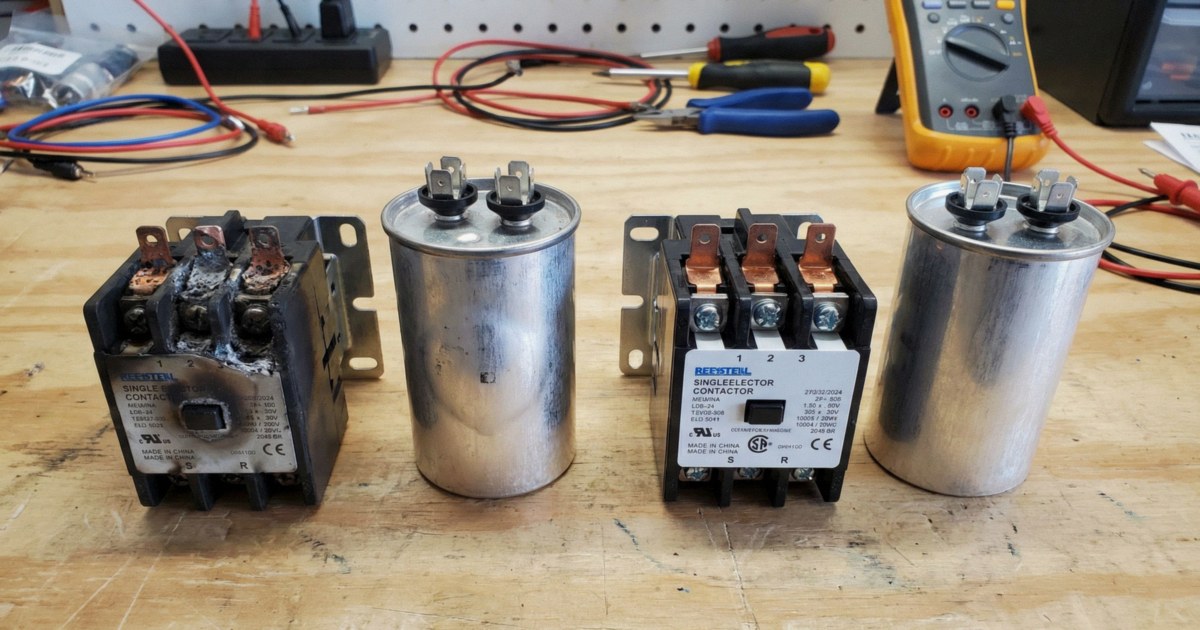
HVAC electrical failures are responsible for more service calls than refrigerant issues, more callbacks than dirty filters, and more customer frustration than almost anything else in the trade. The good news is that the failure list is short. Five categories cover about 85% of the electrical problems you'll encounter on residential and light-commercial systems: contactor pitting, capacitor degradation, blower motor relay failures, transformer burnout, and low-voltage wiring faults.
Work through them systematically and safely, and most of these calls wrap up in under an hour. Rush through them and skip safety steps, and you'll either be back for a callback or standing in an ER.
Safety note before anything else: HVAC equipment carries both 240V line voltage and 24V control voltage. Capacitors store a lethal charge even with power disconnected. Always discharge capacitors before handling, and always verify power is off with a meter before touching any terminal. This isn't boilerplate — it's the part of this job that kills people who skip it.
Contactor Pitting and Failure
The contactor is the high-current relay that connects line voltage to the compressor and condenser fan motor when the thermostat sends a 24V signal to the coil. On most residential systems it's the single component doing the heaviest electrical work, and it fails accordingly.
What goes wrong: The contact points are designed to carry 30-40 amps under load. Every time they open and close under load, there's a small arc. Over thousands of cycles, that arc pits and erodes the contact surface. Pitted contacts have higher resistance, which means they run hotter, which accelerates the pitting. Eventually the contacts don't make solid contact, the resistance becomes high enough to cause a voltage drop across the contactor, and the compressor gets undervoltage — which will eventually destroy it.
The failure mode you really don't want: welded contacts. Contacts that weld closed keep the compressor running after the thermostat opens the 24V circuit. Customer reports the system won't shut off. Left long enough, the compressor destroys itself from continuous operation.
Diagnostic approach: With power locked out, visually inspect the contact surfaces. Pitting, scoring, or carbon buildup are grounds for replacement. A good contact surface looks clean and flat. Then check contact resistance — a good contactor reads near zero ohms across closed contacts. With power restored (carefully), check for voltage drop across the contactor under load. More than 2-3 volts drop across a closed contactor is too much.
Part notes: Single-pole contactors for most residential systems run $15-30 and are relatively universal by amperage and coil voltage rating. Carrier, Lennox, and Trane all use standard 24V coil, 30-amp contactors on most residential units. I stock a few in the truck and rarely need to special-order one.
When you replace a contactor, check the coil voltage while you're at it. Apply 24V to the coil and measure how long it takes to pull in fully. A sluggish contactor — one that chatters or pulls in slowly — has a weak coil. The contacts will look fine but you'll be back in three months. When the contacts are shot, replace the whole contactor, not just the points.
Capacitor Degradation — Run and Start
If I had to pick one component that fails more than any other on outdoor HVAC equipment, it's the run capacitor. There's no close second. Southern California's heat amplifies this — capacitors in units running through a 110°F SoCal summer degrade faster than capacitors in mild climates.
Run capacitors are dual-rated on most residential systems: one section for the compressor, one for the condenser fan motor. You'll see ratings like 35+5 MFD or 45+5 MFD, 370V or 440V. Both sections can fail independently.
A weak compressor capacitor produces a hard-starting compressor that draws high current during startup. Over time, that high startup current burns the compressor windings. A weak fan capacitor produces a slow-starting or non-starting condenser fan. No fan means no heat rejection. The head pressure climbs, the compressor trips on its high-pressure safety, and the customer gets no cooling with a compressor that looks like it's running.
Start capacitors are found on systems with hard-start kits or on older equipment that needs the extra starting torque. A failed start capacitor usually means the compressor won't start at all under load — you'll hear a hum and feel vibration but no rotation.
Diagnostic approach: Pull the capacitor (after discharging it — bleed the terminals with a 20k ohm resistor or a meter on the resistance setting). Measure capacitance. Any reading more than 10% below the marked value is a failing capacitor. A capacitor reading zero is obviously dead. Check for bulging tops and oil leaks while you're at it.
Get a real capacitance meter. Your general-purpose HVAC meter with a capacitance function works fine. Don't use the "test the capacitor by watching if the fan starts" method — a weak capacitor will sometimes start the motor but will destroy it over the following season. Test it with numbers.


Blower Motor Relay Failures
The blower motor relay — sometimes called the IFC relay or fan relay — is the component on the air handler control board that switches 24V control signals to line-voltage blower motor operation. On older systems it's a standalone relay on the air handler. On modern systems it's usually integrated into the control board, which complicates the diagnosis.
What goes wrong: Relay contacts burn and pit just like contactor points, but at lower current levels. A failed-open blower relay means no air circulation: the compressor runs, condenser fan runs, but no indoor airflow. The evaporator coil freezes in about 20 minutes. A failed-closed relay means the blower runs continuously regardless of the thermostat call — customers complain about the fan running when the system is off.
Diagnostic approach: On systems with a standalone fan relay, check for 24V at the coil terminals during a call for fan operation. Then check for line voltage continuity across the switching contacts. No 24V at the coil means the problem is upstream in the control circuit. 24V at the coil but no switching means the relay is bad.
On systems with integrated control boards, the relay is on the board itself. You can sometimes see burned relay contacts on board inspection, but often the failure is internal and not visible. If all other diagnostics point to a fan-runs/no-fan problem and the control board relay is the last suspect, it's a board replacement.
For more on electrical diagnosis with meters, see our guide to advanced multimeter techniques for HVAC.
Transformer Burnout
The 24V control transformer powers every low-voltage circuit in the system: thermostat, control board, contactor coil, zone valves. When it burns out, nothing works. The system is completely dead below the line voltage level.
What goes wrong: Transformers burn out from secondary-side shorts. The transformer is rated for a certain VA load — 40VA is standard on most residential units. When a short occurs in the 24V circuit, the current spike exceeds the transformer's rating and the primary winding burns. The transformer sacrifices itself to protect the rest of the control circuit — which is the intended behavior, but it's cold comfort when you're explaining it to a customer.
Diagnostic approach: Measure secondary voltage first. A burned transformer produces zero or very low 24V output. Measure primary voltage — if you have 240V input and zero output, the transformer is burned. Before you install the new transformer, find the short in the secondary circuit. If you skip this step, the new transformer will burn within seconds of energizing.
Secondary circuit short hunting: disconnect the thermostat wires at the air handler. Restore power and check secondary voltage. Voltage present? The short is in the thermostat wiring or the thermostat itself. No voltage? The short is in the air handler control circuit. Disconnect loads one at a time (board, contactor coil, any zone boards) until voltage appears. That's your shorted component.
Many modern transformers have a self-resetting internal breaker. Before you condemn a transformer that reads zero volts, let the unit sit for 15 minutes (transformer cooled down) and test again. If it now reads 24V, you have an intermittent short that trips the protection circuit. Find the intermittent short before the customer complains the new transformer also "blew up."
Low-Voltage Wiring Faults
The 18-gauge thermostat wire running between the thermostat, air handler, and outdoor unit is the nervous system of the HVAC control circuit. It's also the most overlooked failure point.
Common faults: Pinched wire (from wire stapled too aggressively, or pulled tight around a corner), rodent damage (chewed insulation causes intermittent shorts), corrosion at terminal blocks (especially in coastal SoCal where salt air gets into outdoor units), and reversed or swapped wire connections after a previous repair.
A pinched or damaged wire produces intermittent operation — the system works some of the time, which is the hardest kind of problem to diagnose. The customer tells you it "just started working again" when you arrive. Your meter shows everything normal. Come back two days later, same problem.
Diagnostic approach: Inspect the full wire run from the thermostat to the air handler. Look for tight bends, staple points, and any routing through areas that could cause mechanical damage. At the outdoor unit, inspect the wire entry point — this is where rodent damage is most common. Check every terminal block connection: look for loose screws, corrosion, and strands that missed the terminal.
For intermittent faults, measure resistance on each conductor with both ends disconnected. More than a few ohms on an 18-gauge run of less than 100 feet means a damaged conductor.
This work is the least glamorous part of HVAC electrical diagnosis. It's also the part that separates the techs who fix things from the techs who replace expensive parts and hope for the best.
For the full AC diagnostic picture when an electrical fix doesn't solve the no-cool call, see our guide on AC not cooling — which covers refrigerant, coils, and compressor diagnostics.
What is the most common electrical failure in an HVAC system?▾
Run capacitor failure is the single most common electrical failure in residential HVAC. The capacitor degrades from heat cycles, and a weak or failed capacitor will prevent the compressor or condenser fan from starting. Test capacitance with a meter — any reading more than 10% below the rated value means replacement. In Southern California heat, plan for capacitor replacement every 5-8 years on heavily used systems.
How do I know if my HVAC contactor is bad?▾
Visual inspection first: look for pitted, burned, or welded contact points on the contact surfaces. A multimeter check with power off should show open contacts (infinite resistance). With 24V applied to the coil, contacts should close and show near-zero resistance. If contacts are welded closed, the unit will run continuously — that's an immediate replacement situation.
Why does my HVAC system hum but not start?▾
A humming compressor or fan motor that won't turn over almost always points to a failed run or start capacitor. The motor is trying to start but lacks the capacitive kick to get the rotor moving. Replace the capacitor before condemning the motor — it's a $12-25 part and solves the majority of hum-no-start calls.
What causes transformer burnout in an HVAC system?▾
The 24V control transformer burns out when the secondary circuit is shorted or overloaded. Common causes: a shorted thermostat wire, a control board component drawing too much current, or rodent damage to low-voltage wiring. Always find and fix the short before installing a new transformer or the new one will burn immediately.
Need a repair professional?
Get free quotes from verified technicians in your area.
Find a Pro Near You