


The $25,000 Bond Isn't the Whole Story: California License Bonds and LLC Worker Bonds Explained

Michael Senderovich
Michael Senderovich, MBA, is president of Six-Thirteen Business Insurance, a commercial brokerage that places coverage for contractors and tradespeople across California, Texas, the Carolinas, Missouri, Colorado, and Louisiana. He has spent more than a decade in commercial lines and holds an MBA from the University of Redlands.
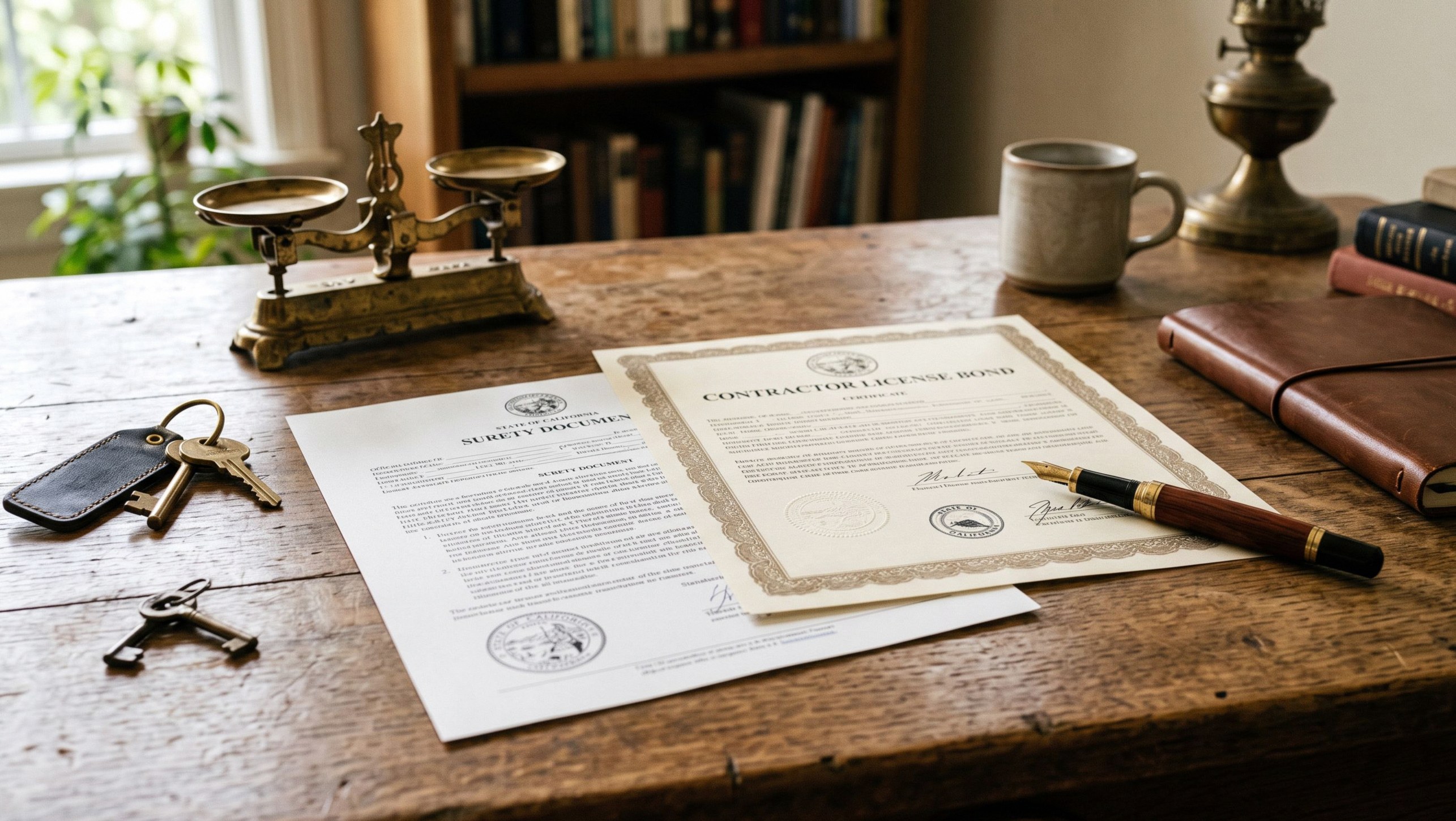
Every licensed California contractor posts a $25,000 contractor license bond. Most treat it as a line item, sign where the surety points, and move on. That's a mistake, because two of the most common assumptions about that bond are wrong: contractors think it protects them, and LLCs think it's the only bond they owe. Neither is true.
Here's what the California contractor license bond actually does, what the LLC bond adds, and what the whole thing costs.
What the $25,000 License Bond Is
The CSLB contractor license bond is a $25,000 surety bond required to hold an active license. That amount was set by SB 607, effective January 1, 2023, and it remains $25,000 for 2026. You can't skip it. Your license depends on it.
What trips people up is who it protects. The bond protects consumers and project owners, not you. If you violate a construction contract, breach the licensing law, or leave code violations behind, an owner can make a claim against your bond. The surety company evaluates the claim and, if it's valid, pays up to the $25,000 limit.
Then it comes back to you. A surety bond is not insurance. When the surety pays a claim, you are on the hook to reimburse the surety for every dollar it paid out, plus costs. That's the fundamental difference between a bond and a liability policy: your general liability carrier pays claims and doesn't ask for the money back; a surety pays claims and absolutely does.
That reimbursement obligation is spelled out in the indemnity agreement you sign when you buy the bond. It's the reason a surety underwrites your credit before issuing: they're not really betting on whether a claim comes in, they're betting on whether you can pay them back if one does. A homeowner who wins a valid claim against your bond gets paid by the surety. You then get a bill from the surety. Treat a bond claim like a loan you didn't ask for and never wanted, because that's effectively what it becomes.
Think of the license bond as a line of credit you guarantee, not a policy that covers you. The person protected is the customer. The person ultimately paying is you. That's why keeping clean documentation on every job matters, it's your defense when a bond claim shows up.
The Second Bond LLCs Owe
If you're licensed as an LLC, the $25,000 bond is only half of it. California requires LLC-licensed contractors to also carry a separate $100,000 LLC Employee/Worker Bond.
This one points in a different direction. Where the license bond protects your customers, the LLC bond protects your own workers. It guarantees payment of wages and fringe benefits the LLC owes its employees. The state added this requirement because an LLC gives its owners liability protection that a sole proprietorship or partnership doesn't, and the worker bond backstops employees who might otherwise be left chasing unpaid wages from a shielded entity.
So a licensed LLC in California carries two bonds at once: the $25,000 license bond for consumers, and the $100,000 worker bond for its own crew. Sole proprietors and most other structures owe only the first.
This matters at the moment you choose your business structure. Contractors form an LLC for the liability protection and the tax flexibility, and those can be good reasons. But the LLC route carries this extra bonding cost that a sole proprietorship doesn't, and it's worth pricing before you file the paperwork rather than after. If you're weighing the entity decision, factor the second bond's premium into the comparison, not just the filing fees and franchise tax.


What Any of This Costs
The number that scares people is the bond amount. It shouldn't, because you don't pay the bond amount. You pay a premium, and the premium is a small percentage of the guarantee limit, priced on your credit and history.
For a well-qualified contractor with solid credit, the annual premium on a $25,000 CSLB license bond commonly starts somewhere around $100 to $165. Thin credit, a young business, or prior bond claims raise it. The $100,000 LLC worker bond is a larger guarantee, so its premium runs higher, but it's still a fraction of the face amount, not the face amount itself.
The premium ranges above are typical, not guaranteed. A surety underwrites you individually, so your quote depends on credit, financials, and claims history.
One habit that saves money over time: keep the bond clean. A contractor with no bond claims and steady credit is a cheap risk to write, and stays a cheap risk at renewal. A contractor who's had the surety pay out on a dispute, even a small one, becomes more expensive to bond and, in a bad case, harder to bond at all. The bond premium is small, but the underwriting relationship behind it is worth protecting the same way you'd protect a good standing with a supplier or a lender.
Watch the renewal dates, too. The license bond has to stay continuously in force for your license to stay active. A lapse, even an accidental one because a renewal notice went to an old address, can put your license status in question. Put the bond renewal on the same calendar you use for your license renewal and your insurance renewals, and treat all three as non-negotiable dates.
Where the Bond Fits in the Bigger Picture
A bond is not liability insurance, and it's not workers' comp. It sits alongside them. Getting a California appliance or HVAC operation legal means stacking the license bond, the right liability coverage, and, for LLCs, the worker bond, on top of whatever workers' comp your classification requires.
For how bonds fit with licensing and insurance on the appliance side, see our guide on appliance repair licensing and insurance in California. And if you're setting the whole thing up from scratch, our guide on starting an appliance repair business in California walks through the entity and licensing order.
The bond isn't the expensive part. The misunderstanding is. Know that it protects your customer, know that you repay any claim, and know that an LLC owes a second one.
Sources
- Contractors State License Board. "Bond Requirements." cslb.ca.gov
- Surety First. "CLB vs. LLC Bond, California LLC Employee/Worker Bond." suretyfirst.com