


Ductless Mini-Split Troubleshooting: Fault Codes, Frozen Coils, and Communication Errors

Terry Okafor
Master refrigeration tech and NATE-certified instructor who moonlights as the magazine's advice columnist. His 'Ask Big Terry' mailbag has been settling shop disputes and diagnosing mystery leaks since 2011.
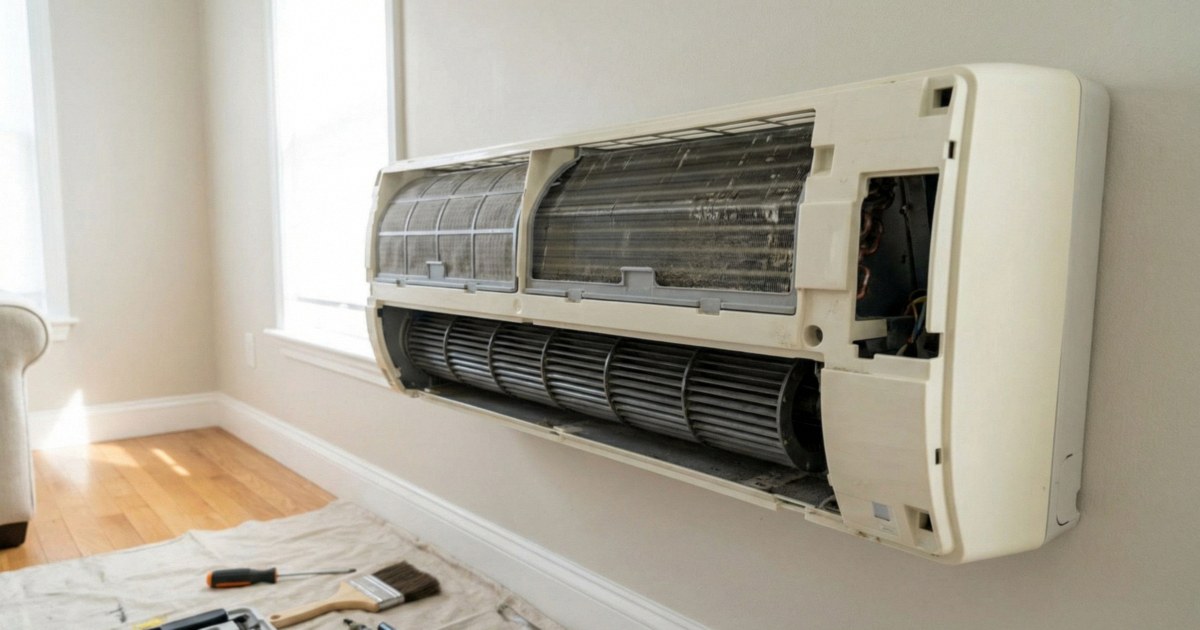
Mini-split installation is a growing part of the Southern California market — see our mini-split installation guide for what that work entails. But service calls on existing mini-splits are a different skill set entirely. These systems fail in specific patterns, and the diagnostic approach needs to match the architecture: two-part systems with refrigerant, communication wiring, and inverter drive electronics all working together.
This guide covers the failures that actually occur in the field, starting with the information the unit is already trying to give you.
Reading Fault Codes: Start Here Every Time
Every mini-split has a self-diagnostic system. Before you touch anything, read the fault code. Most units store the last fault in memory even after the code clears.
How to Read Blink Codes
Mini-splits communicate faults through LED blink patterns on the indoor unit. The general convention across most brands:
- Count the number of blinks in a group
- Note the pause between groups
- Some brands use a combination of two different LEDs to encode a two-digit code
The critical rule: Do not assume a code means the same thing across brands. A "7 blinks" means completely different failures on a Mitsubishi versus a Gree versus a Pioneer. Always reference the brand-specific service manual.
Brand-Specific Code Access
Mitsubishi Electric (MSZ/MUZ series): Self-diagnostic mode is accessible by holding the AUTO button on the wired controller for 10 seconds. The indoor LED will display the error code. Mitsubishi's most common codes in SoCal service:
- P6 — Indoor coil frost/overheat protection (freezing in cooling, overheating in heating)
- E6 — Communication error (indoor to outdoor)
- U6 — Compressor overload or overcurrent
Daikin (FTXS/RXS series): Hold the CANCEL button on the indoor controller for 5 seconds. Common Daikin codes:
- A1 — Indoor PCB failure
- C4 — Heat exchanger thermistor fault (indoor)
- E7 — Outdoor fan motor fault
- H6 — Compressor position-detection / startup fault
LG (Art Cool / Ceiling Cassette): LG stores the last error in the indoor unit display. Use the TEMP + and TEMP - buttons held simultaneously for 3 seconds. Common codes:
- CH01 — Indoor room thermistor fault
- CH21 — Outdoor inverter IPM / DC-peak / compressor overcurrent
- CH38 — Low refrigerant (gas)
Gree / Pioneer / Cooper&Hunter (often shared platform): These share control board designs. Blink pattern is typically single-digit. Code 6 on many Gree/Pioneer units = communication fault between indoor and outdoor.
Photograph the fault code display before you clear it or disconnect power. I've arrived on calls where a homeowner or another tech already reset the unit and the code is gone. If the unit is running when you arrive but the customer says it was showing an error, check the error history — most modern mini-splits store a log of the last 3-5 faults in the controller or outdoor unit board memory.
Frozen Evaporator: The Four Causes
A frozen indoor coil is a symptom. The mini-split's defrost system will try to manage it, but the system will never run normally until you find and fix the root cause.
Cause 1: Restricted Airflow (Most Common)
A mini-split with a dirty filter or blocked return will starve the evaporator of warm air. The coil temperature drops below the frost point and ice forms. The unit may go into protection mode and shut down, or it may display a high-humidity / freeze protection code.
Check: Pull the filter. If it's clogged, clean it and test. Then look at the air path — the front panel louver should be fully open and unobstructed. In installations where the unit is mounted in a corner or close to the ceiling, inadequate return airflow is often the issue even with a clean filter.
Cause 2: Low Refrigerant Charge
Low refrigerant means low suction pressure. Low suction pressure means the evaporator runs colder than it should. Ice follows.
Check: Connect your manifold gauges. At 75-80°F ambient, a properly charged R-410A system should show roughly 118-128 PSI on the suction side. Below 100 PSI is low. Below 80 PSI on a warm day is significantly low — you're looking at a refrigerant leak somewhere.
On mini-splits, the most common leak locations: flare fittings at the line set connections (indoor and outdoor), the Schrader valve core on the service port, and factory welds on the outdoor unit coil. Always check flares before assuming a coil leak.
Cause 3: Outdoor Ambient Temperature Below Operating Range
Mini-splits are not all-weather machines without modification. A standard residential mini-split (non-hyper-heat) typically has a minimum operating temperature around 17°F for heating and around 50°F for cooling. Below the cooling minimum, refrigerant pressures drop and the system can freeze on short cycles.
In Southern California this rarely applies in summer, but in winter when a customer runs their mini-split for cooling in a garage that drops to 45°F overnight, you'll see this.
Cause 4: Failed Indoor Fan Motor (Low Speed Operation)
An indoor fan motor running at low speed due to winding degradation moves insufficient air across the coil. This presents exactly like restricted airflow — the root cause is different, but the result is the same.
Test: Disconnect the indoor unit fan lead and test motor winding resistance across each winding. Also test while running — an amp clamp on the fan motor leads will show whether it's drawing normal current. Most mini-split indoor fan motors draw 0.3-0.8A at rated speed.
Sensor Faults: Thermistors and Pressure Sensors
Mini-splits use more thermistors than any other common HVAC system. A typical Mitsubishi or Daikin unit has five to seven: room air, indoor inlet, indoor outlet, outdoor ambient, outdoor coil, discharge pipe, and suction pipe. Any one of these can fail and generate a sensor fault code.
Testing Thermistors
Mini-split thermistors are NTC (negative temperature coefficient) resistors. As temperature increases, resistance decreases. The reference charts are in the service manual for each brand, but a general guide:
- At 68°F (20°C): most mini-split NTC thermistors read approximately 10,000 ohms (10K)
- At 32°F (0°C): approximately 33,000 ohms
- At 104°F (40°C): approximately 4,300 ohms
Remove the thermistor from its mount, measure resistance, and compare to the service manual chart for that exact temperature. A reading of 0 ohms (short) or open circuit is a definitive failure. A reading that doesn't track the temperature curve is a marginal failure.
Common thermistor part replacement approach: Most mini-split thermistors connect via a 2-wire harness to the board. They're inexpensive ($15-45) and straightforward to replace. Buy brand-specific where available — aftermarket thermistors often have slightly different resistance profiles that cause nuisance faults.
Suction and discharge pipe thermistors on the outdoor unit are exposed to the elements. In coastal Southern California, salt air causes these connectors to corrode faster than in inland areas. Before condemning a thermistor on a coastal installation, clean the connector terminals and retest. I've resolved more than a few sensor codes with contact cleaner and a few minutes of effort.
High and Low Pressure Protection
Many mini-split fault codes are actually pressure protection events, not sensor failures. The system monitors high-side and low-side pressure via pressure transducers (not Schrader-mounted gauge ports — they're usually internally wired transducers).
High-pressure protection codes (Mitsubishi U1, Daikin E3, LG CH34) mean the discharge pressure spiked above the cutout threshold. Common causes:
- Outdoor coil dirty/blocked
- Outdoor fan not running
- Overcharge
- Non-condensables in the system
Low-pressure protection codes usually correspond to the freeze conditions described above.


Communication Errors: Indoor-to-Outdoor Data Link
Communication errors are among the most frustrating mini-split faults because they can be wiring, a board, or a power quality issue. The diagnostic approach is systematic.
The Communication Wire
Most residential mini-splits use a 3-wire or 4-wire shielded cable between the indoor and outdoor units. This cable carries both power (24V in some systems) and data. It's typically installed through the same line set hole as the refrigerant lines.
Troubleshooting steps:
- Disconnect the communication wire at both the indoor and outdoor control boards.
- Visually inspect for damage: chafing against the line set, pinching at the wall penetration, corrosion at terminals.
- Test continuity of each wire end-to-end. Any open = replace the wire.
- Test for shorts between wires and between wires and ground.
- On systems where the communication wire also carries 24V or 12V: measure the voltage at the outdoor board terminal under load.
Polarity matters. On most brands, the communication wire must be connected S1-to-S1 and S2-to-S2 (or A-to-A and B-to-B depending on labeling). A reversed connection causes an immediate communication fault. I've found this on systems that were "working fine for a year then stopped" — what actually happened is a rodent damaged the wire, someone repaired it with reversed polarity, and it's been trying to communicate backwards ever since.
Board-Level Communication Faults
If the wiring tests perfect and the fault persists, you're looking at a board failure — either the indoor board's communication chip, the outdoor board's, or both. The complication: some brands transmit communication from the indoor unit and some from the outdoor. Replace the transmitting board first.
Mitsubishi: the outdoor unit is the communication master. If the outdoor board fails, communication dies. Daikin: similar — outdoor unit drives communication. LG: indoor unit drives communication on most models.
Board replacement costs range from $350-900 depending on brand and unit size. Always confirm the new board revision is compatible with your unit's firmware before ordering.
Drain Line Clogs and Overflow Issues
Mini-splits produce condensate during cooling operation. The drain pan under the indoor unit coil collects it, and a small drain pump or gravity drain runs it to the exterior. Clogs in this line are common and cause water damage if not caught early.
Symptoms: Water dripping from the indoor unit, musty odor, mold visible on the unit face or drain pan, or a P or Water Overflow fault code.
The clog location: Usually in the first 12 inches of the drain line, inside the wall or at the elbow near the line set penetration. Algae and biofilm accumulate there, especially in humid environments or in units that run continuously.
Clearing the clog:
- Locate the drain outlet at the exterior (usually a small tube exiting near the line set).
- Wet/dry vacuum the exterior end for 30-60 seconds.
- If the clog doesn't clear, access the interior drain line at the indoor unit and use a drain gun or compressed air from the interior side.
- Once clear, flush the line with diluted white vinegar or a condensate drain cleaner tablet placed in the drain pan.
Prevention for callbacks: Install a condensate drain treatment tablet (generic tablets from HVAC suppliers, about $0.50 each) in the drain pan at every service visit. One tablet lasts 3-6 months and eliminates most algae growth. It takes 30 seconds and eliminates a service callback.
For broader AC system diagnostics including central air comparisons, see our AC not cooling troubleshooting guide.
Quick Diagnostic Reference by Symptom
| Symptom | First Check | Second Check |
|---|---|---|
| Unit won't turn on | Power at outdoor unit, breaker | Communication wire |
| Blinking LED | Read fault code | Service manual cross-reference |
| Cools then shuts off | Fault code in memory | Filter / airflow |
| No cold air, no fault code | Refrigerant pressures | Filter / coil freeze |
| Water dripping | Drain line clog | Drain pan overflow float switch |
| Loud vibration | Mounting bracket screws | Outdoor unit pad/feet |
| Outdoor fan not running | Fan motor / capacitor | Outdoor board fault code |
Why is my mini-split blinking and not cooling?▾
A blinking LED on a mini-split indoor unit is a fault code, not a generic error. The blink pattern encodes the specific fault type. Count the number of blinks in each sequence, note the pause interval, and look up the code in your unit's service manual. The same blink count means different things on different brands. Common causes include sensor faults, indoor-to-outdoor communication errors, and high or low refrigerant pressure protection events.
Why does my mini-split freeze up?▾
Frozen evaporator on a mini-split has four main causes: restricted airflow from a dirty filter or blocked return, low refrigerant charge causing abnormally low suction pressure, operating the unit in cooling mode when outdoor ambient is below the system's minimum range (typically 50°F), or an indoor fan motor running at low speed due to winding failure. Clean the filter first, then check refrigerant pressures.
What does a communication error on a mini-split mean?▾
A communication error means the indoor and outdoor units have lost their data link. The most common causes are a damaged or reversed communication wire, corrosion at the terminal connections, or a failed indoor or outdoor control board. Systematically test the communication wire for continuity and correct polarity before condemning either board — a $100 wire fix beats a $600 board replacement.
Sources
Manufacturer error-code definitions in this guide were verified against the official OEM references:
- Mitsubishi Electric — Mr. Slim / M-Series error codes (e.g. P1 room thermistor TH1, P6 coil freeze/overheat protection, U1 high-pressure 63H). See Mitsubishi Electric service & support error-code documentation.
- Daikin — Daikin Error Codes (List of Error Codes) (E3 high-pressure HPS, A3 drain level system, E7 outdoor fan motor, H6 compressor position-detection).
- LG — LG Air Conditioner Guide to Error Codes (CH34 high-pressure protection, CH38 low refrigerant, CH07 conflicting indoor modes, CH04 condensate drainage; CH21 inverter DC over-current).
Need a repair professional?
Get free quotes from verified technicians in your area.
Find a Pro Near You