


Central AC vs. Mini-Split: Which Is Right for Your Southern California Home?

Terry Okafor
Master refrigeration tech and NATE-certified instructor who moonlights as the magazine's advice columnist. His 'Ask Big Terry' mailbag has been settling shop disputes and diagnosing mystery leaks since 2011.
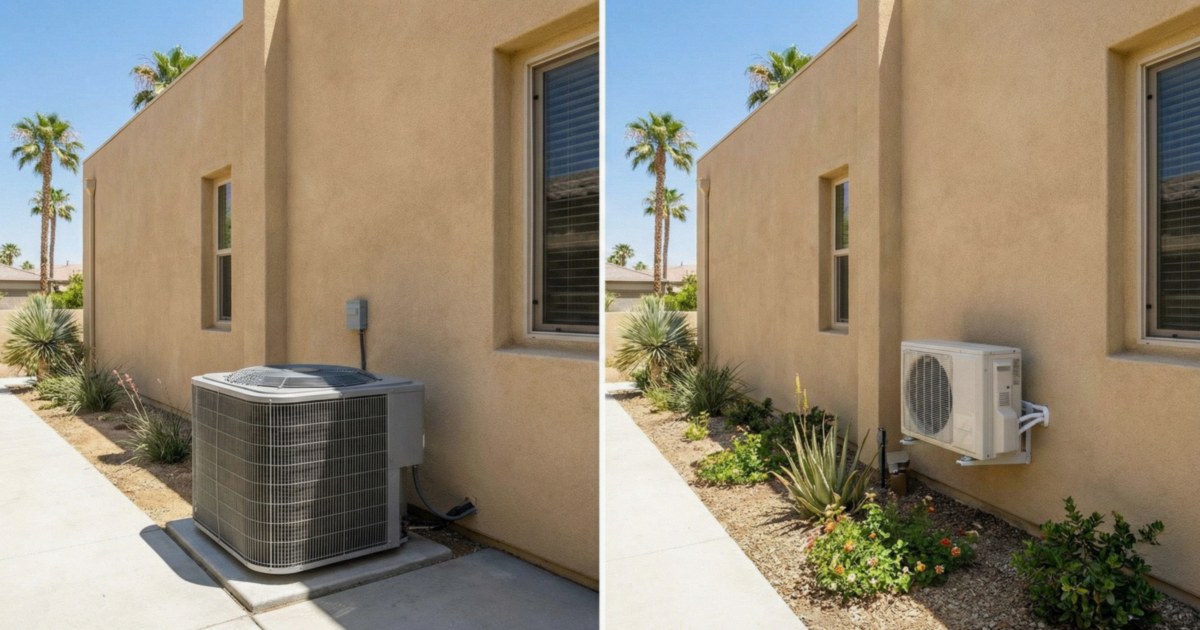
I get asked this question on nearly every HVAC estimate. The homeowner has either a failed central air system or a home that never had cooling, and they've seen ads for mini-splits and want to know if they're making a mistake by going the traditional route. The honest answer is that both systems have their place, and the right choice depends on five factors that vary by property.
Here's the full comparison, written for SoCal conditions.
The Core Difference
Central air conditioning uses a network of ducts to distribute cooled air throughout the house from a single air handler. One thermostat controls the whole system (though zoning upgrades exist). The outdoor condensing unit connects to an indoor air handler via refrigerant lines; the air handler connects to the duct system.
A ductless mini-split also uses an outdoor condensing unit connected to an indoor unit, but the indoor unit mounts directly in the room (on a wall, ceiling, or floor) and delivers conditioned air there without ducts. Multi-zone mini-split systems use one outdoor unit connected to 2-8 indoor units, each with its own thermostat and control.
Upfront Cost Comparison
Central air — installed cost:
- 2-ton system (for homes up to 1,100 sq ft): $3,500-6,000
- 3-ton system (1,100-1,800 sq ft): $4,500-7,500
- 4-ton system (1,800-2,500 sq ft): $5,500-9,000
- 5-ton system (2,500-3,500 sq ft): $7,000-12,000
These costs assume existing ductwork in acceptable condition. If the ducts need replacement or the home has no ducts, add $4,000-12,000 for ductwork alone.
Mini-split — installed cost:
- Single-zone (1 outdoor + 1 indoor): $1,800-4,500
- 2-zone system (1 outdoor + 2 indoors): $4,500-8,000
- 3-zone system: $7,000-12,000
- 4-zone system: $9,000-15,000
- 5-zone and larger: $12,000-20,000+
The gap closes quickly as zone count increases. A 4-zone mini-split that covers the main living areas of a 2,000 sq ft home costs roughly the same as central air — or more — when you factor in installation labor.
SEER2 Efficiency Comparison
SEER2 (Seasonal Energy Efficiency Ratio, updated standard as of 2023) measures cooling output relative to energy consumed. Higher SEER2 = lower operating cost.
The federal minimum efficiency standard for new split-system central air in California (the Southwest region) is 14.3 SEER2 for systems under 45,000 BTU (13.8 SEER2 for 45,000 BTU and above), effective January 1, 2023. Most new central air systems sold in SoCal are 16-18 SEER2. Premium variable-speed central air systems (Carrier Infinity, Trane XV20i) reach 20-22 SEER2.
Mini-splits, especially inverter-driven models, routinely hit 20-30 SEER2. The Mitsubishi Hyper Heat MZ-FH12NA is rated at 33 SEER2. Daikin Aurora and Fujitsu Halcyon models are in the 25-30 SEER2 range. This efficiency advantage is real — mini-splits consume less electricity per BTU of cooling at steady state.
However, in SoCal cooling-dominant climate zones, the efficiency advantage of a high-SEER2 mini-split over a 16-SEER2 central air system may save $100-250 per year on a typical 2,000 sq ft home. The payback period on the additional upfront cost is 8-15 years. It's a real benefit but not a slam-dunk financial justification on its own.
The biggest efficiency gain from mini-splits isn't the SEER2 rating — it's zoning. With central air and a single thermostat, you're cooling the whole house to maintain the bedroom temperature at 11 PM, even though nobody's in the living room. A multi-zone mini-split lets you set each room independently. In households where different parts of the home have very different occupancy patterns, the zoning benefit can easily exceed the SEER2 difference.


Installation Differences
Central air installation (existing ducts):
- Outdoor condensing unit placed on a pad or wall-mounted bracket
- Refrigerant line set run to the air handler location (attic, closet, or utility room)
- Electrical: 240V 30-60A circuit depending on tonnage
- Typical install time: 1-2 days
Central air installation (no existing ducts):
- Same as above plus all ductwork fabrication and installation
- Permits required for ductwork in most California cities
- Typical install time: 4-7 days, often more
- Significantly more invasive — ceiling and wall penetrations throughout the home
Mini-split installation:
- Each indoor unit requires a 3-inch penetration through the exterior wall for the line set
- Electrical: usually a dedicated 240V 15-30A circuit per zone
- No attic work or duct routing needed in most cases
- Typical 1-zone install: 4-8 hours
- 4-zone system: 2-3 days
Mini-split installation is less invasive for homes without ducts. The tradeoffs are visible wall units (some homeowners strongly dislike the look) and multiple small line set penetrations through exterior walls.
For a detailed look at mini-split installation in Southern California — including permit requirements, line set routing in stucco homes, and refrigerant options — see our mini-split installation guide for Southern California.
Decision Matrix by Situation
| Situation | Recommended System |
|---|---|
| Home has existing ducts in good condition | Central air — lower total cost, cleaner install |
| Home has no ducts, 1-2 rooms to cool | Single or 2-zone mini-split |
| Home has no ducts, whole-house cooling needed | Mini-split (vs. duct installation cost comparison) |
| Rental property or rental ADU | Mini-split — no duct work, tenant-controllable zones |
| Home addition or converted garage | Mini-split — standalone zone, no duct extension needed |
| Historic home or tile roof (invasive duct routing) | Mini-split |
| Budget under $6,000 for whole-house cooling | Central air with existing ducts |
| Maximum efficiency / zoning control priority | Multi-zone mini-split |
| HOA-restricted (exterior wall appearance) | Central air — avoids visible line sets and wall units |
Maintenance Comparison
Central air maintenance: annual tune-up ($80-150), filter replacement monthly during season, condenser coil cleaning every 1-2 years. Most homeowners can handle the filter; the rest is a once-a-year tech visit.
Mini-split maintenance: filter cleaning every 2-4 weeks (the filters are washable and accessible on the indoor units), annual outdoor unit cleaning, and professional coil and drain pan cleaning every 1-2 years. The filters in mini-split indoor units are accessible without tools and take 5 minutes — most homeowners handle it well once shown how.
Neither system has a meaningful maintenance advantage. Both require consistent filter attention and professional service every 1-2 years.
SoCal-Specific Considerations
Inland Empire and High Desert: Mini-splits rated for operation at 115-122°F are available (Mitsubishi Hyper Heat, Daikin Fit, Fujitsu Halcyon) and work well even in Redlands, Temecula, and Palm Springs heat. Verify the rated operating temperature before specifying — economy mini-splits sometimes top out at 109°F.
Coastal Areas: Mini-splits excel here. Coastal homes often have small conditioned footprints, and a 2-zone mini-split handles a 1,200 sq ft beach bungalow beautifully. Salt air corrosion affects both systems equally — annual coil cleaning is more important within 3 miles of the ocean.
Older Homes (pre-1980) without ducts: Running new ductwork through a 1960s ranch or a Craftsman bungalow is an expensive, invasive project. Mini-splits almost always pencil out better for these properties.
For related troubleshooting: if an existing central air system is running but not cooling, see our AC not cooling diagnostic guide before committing to a system replacement.
Is a mini-split cheaper than central air?▾
For a single room or addition, yes — a single-zone mini-split runs $1,800-3,500 installed. For whole-house cooling of a 2,000+ sq ft home, multi-zone mini-split systems cost $9,000-18,000, comparable to central air if you already have ductwork. If you need new ductwork, central air often costs more overall.
Do mini-splits work in Southern California's heat?▾
Yes, modern inverter mini-splits are rated to operate at up to 115-122°F outdoor temperature depending on the model. Mitsubishi, Daikin, and Fujitsu units are all widely installed and well-proven in the SoCal market. Verify the maximum operating temperature spec before specifying for Inland Empire or desert locations.
Need a repair professional?
Get free quotes from verified technicians in your area.
Find a Pro Near You