


The House Burned Down After Your Service Call. Now the Homeowner's Insurer Is Suing You.
Maria Solano
Former appliance warranty claims adjuster turned investigative repair journalist. Maria's 'What Went Wrong' teardown series has made her the most feared woman in the white-goods industry.
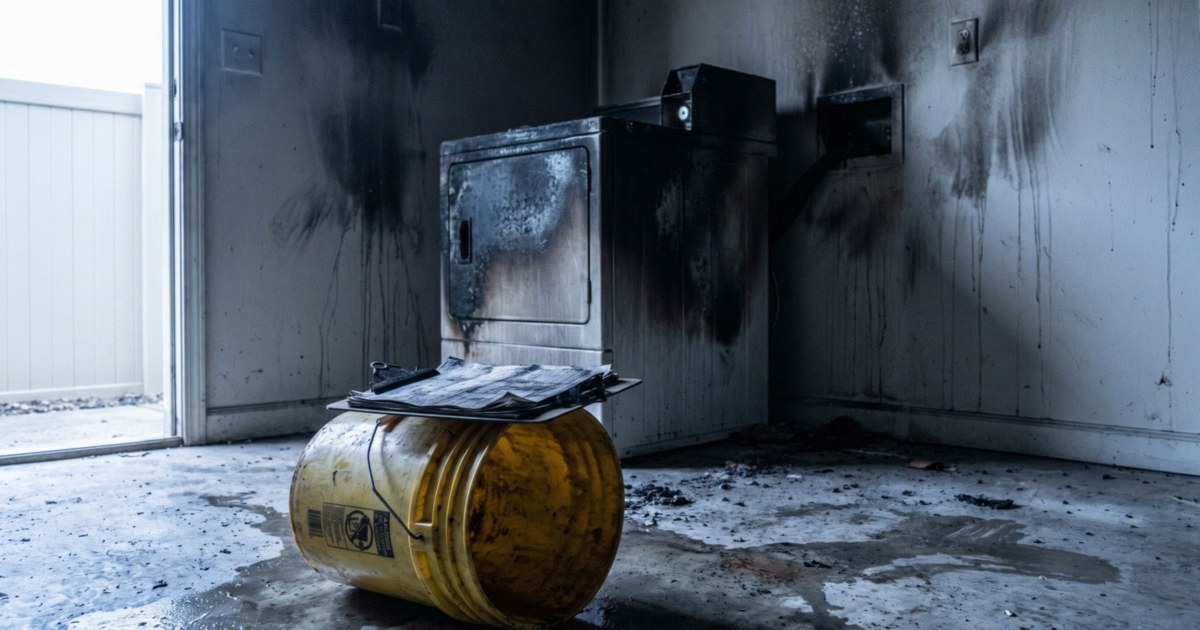
Your tech replaces a dryer heating element on a Tuesday. Six weeks later the house burns. The homeowner files a claim, the carrier pays it, and then a letter shows up at your shop from a law firm nobody there has heard of, telling you to preserve the dryer and everything within 10 feet of it. That letter is the front end of a subrogation claim, and it is one of the few ways a three-truck appliance shop ends up defending a number bigger than its annual revenue.
Subrogation is simple in concept. The insurer pays its policyholder, and having paid, it inherits whatever right the policyholder had to collect from whoever caused the fire. The case then gets filed in the insurer's name "as subrogee of" your customer, who may still like you and still be the named party on the complaint.
None of this is exotic. Dryers, ranges, water heaters and furnaces are among the appliances that most often draw fire subrogation claims, and every one of them sits on a working tech's route.
How a subrogation claim against a repair shop unfolds
The fire happens on a Friday night. By Monday the carrier has an origin and cause investigator at the scene, and part of that investigator's job is to identify a defendant with insurance. Appliances get tagged, photographed and hauled to a storage facility. Somewhere in the debris is your service sticker with a phone number on it.
Then comes the preservation letter, often months before any lawsuit. It will invite you to a joint inspection of the stored evidence. Go. Send someone technical, or send your carrier's expert, but do not ignore the invitation.
In Markel Insurance Company, as Subrogee of Chai Lifeline, Inc. v. Bottini Fuel, the dryer distributor was told shortly after the fire that its dryer might have caused it, and was invited to inspect the scene. It declined, declined again that October, and did not respond when the plaintiff offered one final inspection date. The second inspection went ahead without it. Years later the defendants argued the case should be thrown out because evidence had been lost, and the Appellate Division rejected that, writing that what they wanted could also have been "discover[ed] through a timely inspection" had they elected to conduct one.
Spoliation arguments are a fallback, not a plan.
Which part of your general liability policy responds
Once the work is finished and the van has pulled away, a fire at the customer's house is no longer an ongoing-operations question. Craig Stanovich, writing for the International Risk Management Institute in June 2019, described the products-completed operations aggregate as "the most the insurer will pay during the policy period" for bodily injury or property damage arising out of the products-completed operations hazard. That hazard reaches injury or damage that occurs away from your premises and arises out of work you have completed.
Two consequences follow. That aggregate sits separate from your general aggregate, so a bad year of ordinary premises claims does not eat the limit a fire claim needs. And the limit runs per policy period, while one residential total loss with contents and additional living expense can approach a $1 million occurrence limit by itself.
Stanovich, in a separate piece updated in September 2018, walked through the "your work" exclusion, which applies to damage arising out of your own completed work. The practical reading is the one every broker gives: the policy is not built to pay you to go back and correct defective work, though it may respond to damage that work causes to other property.
Both of those describe standard form language. Your policy may be endorsed, manuscripted or written on a non-standard form, and the answer moves with the carrier and the state. Ask your broker to read yours.
Georgia, 2002: the installer who didn't install the bad wire
Sewell Sales & Service, Inc. v. Travelers Indemnity of America, No. A02A0550, was decided by the Court of Appeals of Georgia on May 23, 2002, and is reported at 255 Ga. App. 531, 566 S.E.2d 346.
On September 13, 1991, a Sewell employee installed a new dishwasher in a condominium. He connected the machine to the branch wiring correctly, using a wire nut inside the junction box. But the first 18 inches of wire running from the dishwasher were an extension of the building's main wiring, and that connection had been crimped together outside a junction box by somebody, at some earlier point. Almost exactly four years later, on September 12, 1995, the crimped connection started a fire. It caused $160,000 of damage to structural elements owned by the condominium association and $60,000 of damage to the owner's real and personal property. Two Travelers entities paid those claims and sued on February 9, 1999, more than seven years after the installation.
Sewell's installer swore he never added the 18-inch segment and never saw the bad connection. The court agreed the insurers had nothing to contradict him, since the inference that "it is reasonable to infer that people do not re-wire properly working dishwashers" pointed just as well at whoever installed the original dishwasher. On that theory, partial summary judgment should have been granted.
The insurers' expert said, though, that even if the Sewell employee did not install the bad segment, "a qualified electrician should have noticed the faulty wiring and replaced it." That contradicted the installer's testimony, which created a jury question, so summary judgment was properly denied on that theory of negligence. Limitations analysis under OCGA 9-3-30 came out split as well, turning on something nobody had established: whether the unit owner or the association owned the wiring.
"Judgment affirmed in part and reversed in part," reads the disposition. Sewell did not win outright; it went back down to the trial court on the theory that its tech should have spotted somebody else's defect and refused to connect to it. Georgia's four-year rule is Georgia's, and limitation and repose periods differ a great deal between states, so do not assume a calendar defense exists where you operate.


New York, 2014: the tech who wrote it down and shut off the gas
The Markel decision came down on April 3, 2014, reported at 116 A.D.3d 1143, 983 N.Y.S.2d 637, on appeal from Supreme Court in Sullivan County. A summer camp in Glen Spey bought two gas dryers in the summer of 2001. Bottini Fuel connected them to existing gas lines and came back to service the one that never ran right. In August 2001 a fire destroyed the camp's dining facility, and the plaintiff's investigator concluded it originated in the area of that malfunctioning dryer.
Bottini got out of the case entirely because every reason was something a technician controls. The warranty claim failed as a matter of law, since "[n]o warranty attaches to the performance of a service." The negligence claim failed on the record.
Bottini's employee testified without contradiction that he tested the laundry room after connecting the lines and found no gas leaks. He found the dryer short cycling, called the manufacturer's technical support line for programming help, shut off the gas supply, and told camp representatives the dryer should not be used. Returning later, he found the gas turned back on and the dryer in use. He repeated the warning and shut the gas off again. A camp employee confirmed being told exactly that, and testified that he taped a warning sign to the machine.
The insurer's remaining argument was that Bottini had never produced service reports proving those warnings. The court called that theory "founded upon mere speculation and surmise," partly because the camp employee had already corroborated the warnings and partly because Bottini had produced reports covering two service calls within five days of the fire.
Somebody wrote enough down at the time that a judge could reconstruct the whole sequence 13 years later. Claims against the dryer distributor went forward, so somebody was still going to pay, just not the service company.
Waiver language on an invoice is not a shield by itself
Plenty of shops have a waiver of subrogation line buried in their paperwork, which is a reasonable thing to have but is not self-executing.
In Employers Mutual Casualty Company, as Subrogee of Custom Wood Products, Inc. v. Jayhawk Fire Sprinkler Company, Inc., No. 124,001, the Kansas Court of Appeals reversed a dismissal on January 12, 2024. The sprinkler work dated to 2013, the system failed in 2018, and the insurer paid $56,802 and sued. Jayhawk moved to dismiss based on waiver language appearing on a 2017 invoice. The appellate court held the district court should not have decided the motion on a document outside the petition, since the 2017 invoice was not central to a claim about 2013 work.
A waiver printed on the invoice you hand over after the work is done may not govern the job you already performed. If you want that protection, it belongs in the document the customer accepts before the tech opens the toolbox, which is the same argument for tightening the rest of your service contract clauses.
What to do in the first 48 hours
Call your own carrier before you call anyone else, including the customer's adjuster. Late notice is a real coverage defense, and "we were waiting to see whether it went anywhere" is a poor answer six months later.
Pull the file immediately and stop touching it. Service tickets, dispatch notes, the tech's photos, parts invoices, model and serial numbers, the phone log, text messages. Freeze all of it. If your field software purges attachments or overwrites records on a schedule, turn that off for this job today.
Get your tech's account in writing while the call is fresh, and ask for the boring details: what he found, what he told the customer, what he refused to do.
Say nothing about fault to the origin and cause investigator. That person is friendly, technically fluent, and building a file. Your carrier will assign its own expert, and that is who should be discussing causation. If a warranty administrator or property manager upstream on the job carries a waiver or additional insured requirement, locate those endorsements now; the mechanics are covered in the COI and additional insured guide.
The habits that decide these cases are boring
If your techs connect new equipment to old wiring, old gas lines or old venting, the line on the ticket reading "advised customer existing connection is not to code, customer declined repair" is worth more than any endorsement you can buy. The same discipline shows up in routine dryer work, which is why the venting checks in the dryer not heating walkthrough belong in this conversation.
These two decisions come from two states and are 24 and 12 years old. Treat them as illustrations, not as current law everywhere, and understand that neither one tells you what your policy covers. Coverage depends on your policy form, your endorsements, your carrier and your state, and nothing here promises that any particular claim will be paid. Have a licensed broker review your completed operations limits before you need them, and have an attorney in your state review your service agreement, particularly any waiver of subrogation language. If you are still sizing the program, the insurance cost estimator and the state requirements pages are a reasonable starting point.
Sources
Court of Appeals of Georgia. (2002). "Sewell Sales & Service, Inc. v. Travelers Indemnity of America," No. A02A0550, decided May 23, 2002; 255 Ga. App. 531, 566 S.E.2d 346. Opinion text via Caselaw Access Project
New York Supreme Court, Appellate Division. (2014). "Markel Insurance Company, as Subrogee of Chai Lifeline, Inc. v. Bottini Fuel," decided April 3, 2014; 116 A.D.3d 1143, 983 N.Y.S.2d 637. Opinion text via Caselaw Access Project
Court of Appeals of Kansas. (2024). "Employers Mutual Casualty Company, as Subrogee of Custom Wood Products, Inc. v. Jayhawk Fire Sprinkler Company, Inc.," No. 124,001, decided January 12, 2024. Opinion via FindLaw
Stanovich, C. (2019). "How the Limits Apply in the CGL Policy." International Risk Management Institute. IRMI expert commentary
Stanovich, C. (2018). "Some Common Coverage Misconceptions of the CGL Policy." International Risk Management Institute. IRMI expert commentary