


Maytag Dryer Not Heating: Bravos and Centennial Platform Diagnostic Guide
Terry Okafor
Master refrigeration tech and NATE-certified instructor who moonlights as the magazine's advice columnist. His 'Ask Big Terry' mailbag has been settling shop disputes and diagnosing mystery leaks since 2011.
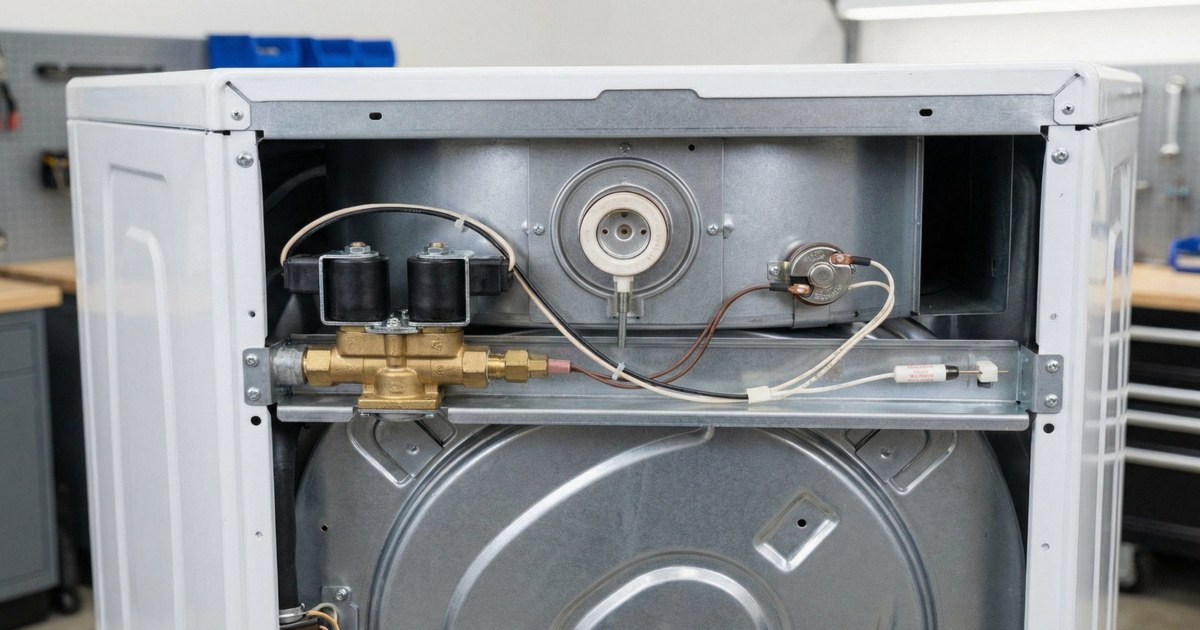
The Maytag Bravos and Centennial platform dryers are Whirlpool-built machines with the Maytag badge. Nearly all the heat-management parts are interchangeable with Whirlpool and Kenmore models, which is why techs treat them as members of the same family. They are — and that's good news on a no-heat call, because the diagnostic sequence and the part numbers are the ones you already know.
The thing that trips people up isn't an exotic design difference; it's expecting one. The thermal fuse sits on the blower housing, exactly where it lives on the rest of the Whirlpool family. On many Bravos and Centennial models it's reached through the lower front access panel beneath the door rather than the rear panel, so if you go straight to the back looking for it you can waste time. Know where to open the cabinet and the rest of the job is routine.
If you're working a general dryer-not-heating call, the dryer not heating guide covers the full diagnostic tree. This guide focuses on the Bravos and Centennial part numbers and access points so you can carry the right parts and open the right panel the first time.
Identifying Your Maytag Platform
The Bravos platform includes the MEDB, MEDX, and MED7 series dryers. The Centennial includes the MEDC and MEDB series at the lower price point. Both use fundamentally the same heating system architecture.
Check the model number on the door frame sticker. MEDB and MEDX = Bravos. MEDC = Centennial. Both use:
- Thermal fuse: 3392519 (mounted on the blower housing — same as Whirlpool)
- Cycling thermostat: 3387134 (mounted on blower housing — same as Whirlpool)
- High-limit thermostat: 3977767 (mounted on heater housing — same as Whirlpool)
- Thermal cut-off kit: 279816 (contains the high-limit thermostat + a thermal fuse)
- Gas valve coils: 279834 (2-coil pack — same as Whirlpool gas models)
- Igniter: 279311
Thermal Fuse: Location and Access
On the Maytag Bravos, the thermal fuse 3392519 is mounted on the blower housing. On many of these models the blower housing is reached through the lower front access panel beneath the door; on some you'll pull the rear panel (typically 8-10 screws around the perimeter) instead. Check your model's tech sheet or the parts diagram for the access point — but the fuse itself is on the blower housing, same as the rest of the Whirlpool family.
The fuse is a small white or cream-colored component with two wires and a plastic housing, clipped or screwed to the blower housing. If you're not finding it, confirm you've opened the right panel before assuming it's somewhere unusual.
Test continuity with your multimeter. A good thermal fuse reads near-zero ohms (continuous). A blown fuse reads open (OL). Replace on open reading.
On a Bravos that's had multiple thermal fuse failures, do this before you install the new fuse: pull the flex vent off the exterior and run a vent brush completely through the exhaust run while the cabinet is open, and check the blower wheel for packed lint. A thermal fuse is a symptom — it blows because something upstream restricted airflow and let the heater overheat. I've found clean-looking external vents hiding a lint-packed blower wheel. Clear the airflow path or you'll be back installing another fuse.
Heat-Management Parts: Replace Them Together When One Fails
The Whirlpool/Maytag family has three heat-management components: the thermal fuse, the cycling thermostat, and the high-limit thermostat. Replace them as a set when any single component fails.
The reasoning: these components are the same age. If the thermal fuse blew because of a borderline overtemperature event, the cycling thermostat that's supposed to prevent that overtemperature is suspect. If it tested "fine" on the day of the call, it may not test fine in three months.
Know what the part numbers actually cover. The thermal cut-off kit 279816 contains the high-limit thermostat and a thermal fuse — it does not include the cycling thermostat. The cycling thermostat is a separate part, 3387134. (The standalone thermal fuse is 3392519, which is what's already installed; the kit's fuse is a like-for-like replacement.) For a full heat-management refresh, buy the 279816 kit plus the 3387134 cycling thermostat — roughly $20-35 in parts against a $150+ callback labor charge. The math is clear.
Cycling thermostat location on Bravos: Clipped to the blower housing (same as Whirlpool). Remove one screw, disconnect two wires. Test continuity at room temperature: should be closed (near zero ohms). Open = failed.
High-limit thermostat location on Bravos: Mounted on the heater housing (electric models) or on the burner housing (gas models). Two wires, one or two screws. Same test — should be closed at room temperature.
Gas Models: Valve Coils and Igniter
Maytag Bravos gas dryers use the same ignition system as all Whirlpool-family gas dryers. The gas valve has two solenoid coils — a primary/boost coil and a secondary/hold coil. The Whirlpool 279834 two-pack covers both coils on Maytag gas models.
Igniter diagnosis: Start a heat cycle and observe the igniter through the lower access panel (kick plate). The igniter should glow orange-red and then the gas should light within 45-90 seconds. If the igniter glows but gas doesn't light:
- Wait through 2-3 cycles — coil failures often show up as "heats for a bit then stops" (heat-sensitive coil failure).
- Meter the igniter current with an amp clamp. Whirlpool-family glow-bar igniters need to draw roughly 3.0-3.2 amps to pull in the gas valve. Under about 3 amps while glowing = weak igniter that can't open the valve. A healthy draw (3+ amps) with no gas points to the coils.
Coil failure pattern: The classic heat-sensitive coil failure works when cold and fails when hot. The tell: dryer starts with heat, then stops heating after 5-10 minutes, then restarts heat after 10-15 minutes of cooling. Replace both coils as a set. Part 279834.


Airflow Restrictions That Keep Blowing Fuses
A thermal fuse is a symptom, not the disease. It blows because airflow through the heater was restricted and the exhaust temperature climbed past the fuse's rating. If you replace the fuse without finding the restriction, you'll be back. Work the airflow path:
1. The blower wheel accumulates lint. When the drum seal deteriorates, lint bypasses the screen and reaches the blower. A lint-packed blower wheel is an airflow restriction regardless of how clean the external vent looks. Check it whenever you have the cabinet open for a thermal fuse replacement.
2. Check the lint screen housing. If the lint screen housing has a crack or the screen doesn't seat fully, air bypasses the screen and sends lint directly into the exhaust path.
3. Clear the full exhaust run. The external flex vent and the wall/roof duct are the most common restriction. A long, crushed, or lint-loaded vent run raises back-pressure and exhaust temperature. Disconnect and inspect the whole run, not just the first few feet.
On a repeat thermal fuse call, budget the extra time to clear the entire airflow path before you button it up: pull and brush the external vent run, check the blower wheel for packed lint, and confirm the lint screen seats correctly. Replacing the fuse and walking away on a restricted machine is how you earn a "third fuse in a year" callback.
Electric Heating Element on Bravos
Bravos and Centennial electric dryers use the Whirlpool 3387747 heating element (same as most Whirlpool 29" dryers). The element is mounted on the back wall inside the drum housing — access from the back after removing the panel.
Pull wires, test resistance: normal is roughly 8-12 ohms. Open reading = failed element. Also check each terminal to the element housing for ground fault (should be infinite ohms). Any continuity to ground means the element sagged and is shorting to housing — that short can trip the thermal fuse on a secondary failure.
If the element fails on a machine with a history of thermal fuse problems, clean and inspect the airflow path before you consider the element swap complete. An overheating element is often downstream of a restriction, and a fresh element on a restricted machine will run hot too.
Control Board — Bravos-Specific Notes
Bravos and Centennial models with electronic controls use the Whirlpool W10174746 control board and its revisions. Before condemning the board on a no-heat complaint, confirm all safety device continuity is good (thermal fuse, both thermostats), the door switch is closing correctly, and on gas models, the coils and igniter are tested.
The Bravos control board relay failure pattern: the relay that drives the heater circuit can show intermittent failure — the dryer heats on most cycles but occasionally runs a full cool-down cycle with no heat. Customers describe it as "sometimes heats, sometimes doesn't." If all safety devices test good and you have the no-heat symptom intermittently, the board relay is the likely cause.
Quick-Reference: Bravos Part Locations
The Bravos and Centennial platform follows standard Whirlpool-family locations. The main thing to watch is the access panel, which varies by model.
| Component | Part | Location |
|---|---|---|
| Thermal fuse | 3392519 | Blower housing (front or rear access by model) |
| Cycling thermostat | 3387134 | Blower housing |
| High-limit thermostat | 3977767 | Heater housing |
| Thermal cut-off kit | 279816 | High-limit thermostat + thermal fuse |
| Heating element | 3387747 | Back wall of drum housing |
| Gas valve coils | 279834 | Lower burner assembly |
Where is the thermal fuse on a Maytag Bravos dryer?▾
On Maytag Bravos and Centennial dryers, the thermal fuse is mounted on the blower housing — the same location used across the Whirlpool and Kenmore family. On many of these models it's reached through the lower front access panel beneath the door, though some require pulling the rear panel; check your model's diagram for the access point. Test continuity — an open reading means it's blown.
What parts do I need for a Maytag Bravos dryer heat repair?▾
The Maytag Bravos and Centennial platform uses standard Whirlpool-family parts. The thermal cut-off kit 279816 contains the high-limit thermostat and a thermal fuse; the cycling thermostat is a separate part, 3387134, and the standalone thermal fuse is 3392519. For a full heat-management refresh, buy the 279816 kit plus the 3387134 cycling thermostat — roughly $20-35 in parts, which beats a callback when a companion component fails weeks later.
Why does my Maytag Bravos dryer keep blowing thermal fuses?▾
Repeated thermal fuse failures almost always mean restricted airflow, not a bad fuse. The usual culprits are a clogged or crushed external vent run, a lint-packed blower wheel, or a deteriorated drum seal that lets lint bypass the screen. When you replace the fuse, clear the entire exhaust run, check the blower wheel for packed lint, and confirm the lint screen seats correctly — otherwise the new fuse will blow too.
Need a repair professional?
Get free quotes from verified technicians in your area.
Find a Pro Near You