


How to Size an HVAC System: Manual J Load Calculations Explained

Terry Okafor
Master refrigeration tech and NATE-certified instructor who moonlights as the magazine's advice columnist. His 'Ask Big Terry' mailbag has been settling shop disputes and diagnosing mystery leaks since 2011.
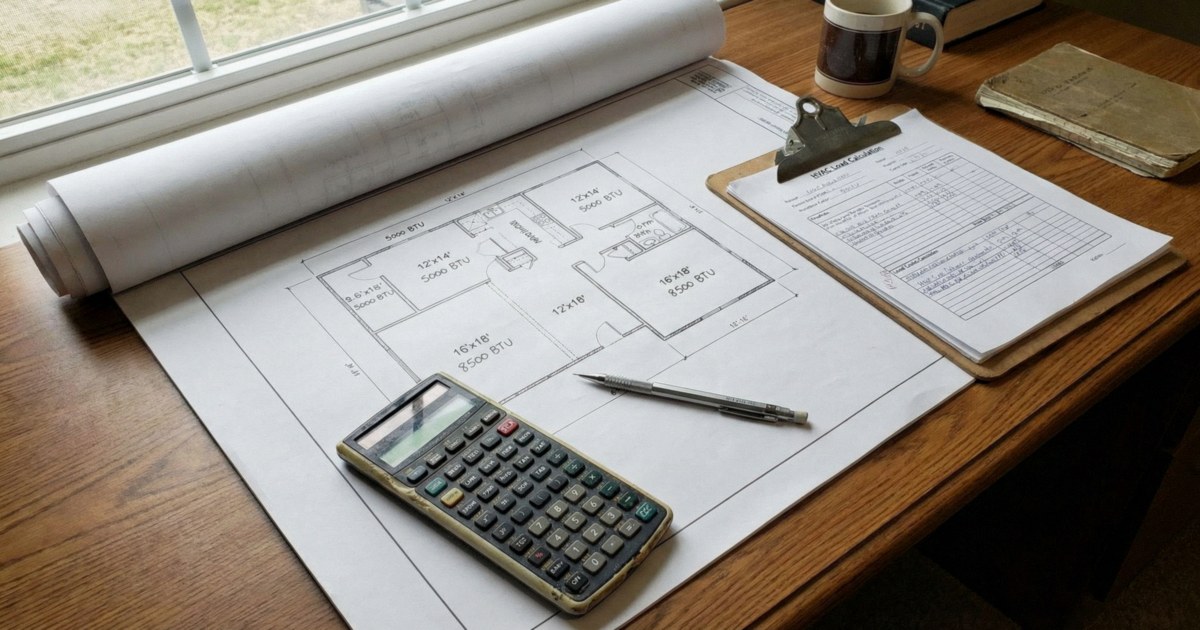
There's a piece of received wisdom in the HVAC trade that's been causing problems for decades: one ton of cooling per 500 square feet of living space. I understand why it exists. It's easy to remember, it's fast to apply, and it gets the tech out the door quickly. It's also routinely wrong, and the consequences — unhappy customers, excessive callbacks, equipment that wears out in eight years instead of fifteen — fall on you.
The correct answer is Manual J. Here's what it is, why it matters more in California than almost anywhere else, and how to actually do one without a four-year engineering degree.
What Manual J Actually Calculates
Manual J is the load calculation standard published by ACCA (Air Conditioning Contractors of America). The full name is "Residential Load Calculation, Eighth Edition." It calculates the heat gain and heat loss of a building in BTU per hour — the actual thermal load that your HVAC equipment needs to handle to maintain setpoint temperature.
The inputs include:
- Floor area and ceiling height — basic geometry, but it's total conditioned volume, not just square footage
- Insulation levels — R-values in the ceiling, walls, and floor; this is where the 500 sq ft rule starts falling apart
- Window area, type, and orientation — a south-facing wall of single-pane windows in the Inland Empire adds an enormous solar heat gain that square footage completely ignores
- Infiltration rate — how much unconditioned air leaks in through the building envelope; newer construction is much tighter than 1960s construction
- Internal gains — people, lights, appliances; varies by occupancy
- Local design conditions — outdoor design temperatures for your specific climate zone; California has 16 HVAC climate zones and they are meaningfully different from each other
The output is a cooling load in BTU/hr for summer conditions and a heating load in BTU/hr for winter conditions. Those numbers tell you the minimum equipment capacity needed to maintain the design indoor conditions (usually 75°F cooling, 70°F heating) when outdoor conditions are at their design extremes.
Why Southern California Makes This Especially Important
California's climate diversity is extreme for its geographic size. A home in Burbank hits 105°F in July. A home in coastal Santa Monica rarely exceeds 80°F. A home in Big Bear needs serious heating capacity. A home in the Coachella Valley needs the most aggressive cooling load you'll ever calculate in residential work.
The 500 sq ft rule doesn't know any of this. It gives you the same equipment size for Santa Monica and Palm Springs. That's not a small error — based on field experience, the difference in design cooling load between those two locations for the same floor plan can plausibly run 30-50%, though the exact figure depends entirely on the specific home's envelope, glazing, and orientation. Run the Manual J for the actual address.
California's Title 24 energy code also requires load calculations for permitted HVAC installations, and inspectors increasingly check for compliance. If you're permitted (and you should be), you need the calc anyway.
The Software: What to Use
You don't do Manual J by hand in 2026. You use software.
Wrightsoft Right-Suite Universal is the industry standard. It's comprehensive, ACCA-approved, and used by virtually every large HVAC contractor and engineer. It's also not cheap — subscriptions run $800-2,500/year depending on the tier. For shops doing significant installation volume, it pays for itself quickly in reduced callbacks and better equipment recommendations.
CoolCalc is the leading web-based option. It's cloud-based, no installation required, ACCA-approved for Manual J, and priced at around $50-100/month or per-project. The interface is more accessible than Wrightsoft for techs who don't do load calculations every day. For smaller shops or techs getting started with Manual J, CoolCalc is the most accessible on-ramp.
Elite Software RHVAC is another full-featured desktop option, similar capability to Wrightsoft at a slightly lower price point.
All of these generate a report that you can give to the customer, which is also a sales and trust-building document. A customer who can see that you calculated their specific house is getting a substantially different experience from one whose tech eyeballed it.
What Oversizing Actually Does to Your Equipment and Your Customer
When a system is oversized — and in residential HVAC, field oversizing commonly lands in the 20-40% range (an estimate from shop experience, not a published figure), because installers who use rules of thumb tend to round up — the following happens:
Short-cycling: The system reaches setpoint quickly because it has excess capacity. It shuts off. Indoor temperature drifts. It starts again. In extreme oversize cases, a system can complete a cycle in 5-7 minutes. Compressors are not designed for that duty cycle. Startup is the highest-stress moment for a compressor — the current spike at startup is 5-7 times the running current. A short-cycling compressor starts many more times per hour than a correctly sized one, and the cumulative stress shortens its life.
Poor dehumidification: Air conditioning dehumidifies the air by running it over a cold evaporator coil, which condenses moisture out of the air. This only happens while the system is running. A short-cycling oversized system doesn't run long enough to adequately dehumidify. In coastal and Valley markets with summer humidity, customers complain their house "feels cold and clammy" even when the thermostat reads 74°F. They turn the temperature down trying to feel comfortable. It doesn't help. The problem is dehumidification, not temperature.
Higher energy bills: More frequent startups, more standby losses, and inefficient part-load operation all increase energy consumption compared to a correctly sized system.
The callback: The customer calls at month three because the house is clammy, the bills are high, and the system seems to run constantly even though it's not that hot. This call is time-consuming and hard to resolve without replacing equipment or adding dehumidification. Neither outcome is fun to explain.
When you do your first Manual J for a house and compare it to what the previous contractor installed, you will often find the existing system is meaningfully oversized — in my experience frequently on the order of 30-50%, though it varies house to house. Use this diplomatically. The customer doesn't need to hear that the previous contractor did bad work — they need to hear that you're going to size their new system correctly so they don't have the same comfort and efficiency problems. That framing turns a technical finding into a sales differentiator.


Room-by-Room vs. Whole-House Calculations
A full Manual J calculates load for every room in the house, not just the whole house. This matters for duct design — the Manual D standard (also from ACCA) uses the room-by-room loads to calculate the duct sizes needed to deliver the right CFM to each room.
For simple single-zone systems in smaller homes, a whole-house calculation is often sufficient for equipment selection. For multi-zone systems, variable refrigerant flow (VRF) installations, or homes with significant room-to-room variation (large south-facing master bedrooms, finished basements), room-by-room is the right approach.
Mini-split installations almost always benefit from room-by-room Manual J — you're selecting multiple indoor units and you need the load of each zone to properly size each head. For more on mini-split specifics in Southern California, see our mini-split installation guide for Southern California.
The Business Case for Doing This Right
Contractors who do Manual J calculations charge for them — either as a line item or absorbed into a higher installation price that they can justify with the deliverable. Contractors who skip them compete on price alone and get every call about the clammy house.
The competitive positioning is clear. When you're in a home quoting an HVAC replacement and you pull out software and start measuring windows while your competitor eyeballed the equipment size from the driveway, you are demonstrating competence in real time. Most homeowners have had at least one bad HVAC experience. A tech who visibly does the math is differentiated from one who doesn't.
For the AC diagnostic side of the business — what to do when a system isn't cooling after installation — see our AC not cooling guide.
What is a Manual J calculation?▾
Manual J is the ACCA standard method for calculating the heating and cooling load of a residential building. It accounts for square footage, ceiling height, insulation levels, window area and orientation, infiltration rate, local climate data, and occupancy to produce a BTU-per-hour load number. That number tells you the minimum equipment capacity needed to maintain comfortable indoor temperatures when outdoor conditions are at their design extremes.
Why is the 'one ton per 500 sq ft' rule wrong?▾
The rule ignores insulation quality, window area and orientation, ceiling height, local climate zone, and infiltration rate. A well-insulated new-construction home in Burbank needs significantly less capacity than a 1960s house with single-pane windows in the same neighborhood. The rule of thumb routinely produces oversized systems that short-cycle, fail to dehumidify properly, and wear out faster than correctly sized equipment.
What happens if an HVAC system is oversized?▾
An oversized system short-cycles: it reaches setpoint quickly, shuts off, and restarts frequently. Short-cycling prevents proper dehumidification, increases compressor wear from repeated high-current startups, and raises energy bills. Customers typically complain their house feels clammy despite reaching temperature setpoint, or that the system runs constantly. These are hard callbacks to resolve after the fact.
How long does a Manual J calculation take?▾
With software like Wrightsoft or CoolCalc, a basic residential Manual J takes 45-90 minutes once you have the home's measurements, insulation values, and window specifications. The time investment pays off in reduced callbacks and stronger customer confidence. Most shops either charge a design fee or absorb the cost into an installation price that they can defend with documentation.
Need a repair professional?
Get free quotes from verified technicians in your area.
Find a Pro Near YouSources
- Air Conditioning Contractors of America (ACCA). "Manual J — Residential Load Calculation, 8th Edition." https://www.acca.org/standards/technical-manuals/manual-j
- Air Conditioning Contractors of America (ACCA). "Manual D — Residential Duct Design." https://www.acca.org/standards/technical-manuals
- California Energy Commission. "Building Energy Efficiency Standards (Title 24, Part 6)." https://www.energy.ca.gov/programs-and-topics/programs/building-energy-efficiency-standards