


Inverter Compressor Technology: How They Work and Why They Fail Differently

Terry Okafor
Master refrigeration tech and NATE-certified instructor who moonlights as the magazine's advice columnist. His 'Ask Big Terry' mailbag has been settling shop disputes and diagnosing mystery leaks since 2011.
When I started in this trade, diagnosing a bad compressor meant two things: check the start and run windings with a multimeter, and listen for the machine trying and failing to start. That worked because every compressor I touched was a single-phase induction motor with a start capacitor and a run capacitor. The diagnostic was simple.
That world is mostly gone now. LG, Samsung, Bosch, Whirlpool, and almost every mini-split manufacturer have moved to inverter compressors. The motors are fundamentally different. The failure modes are different. The diagnostic is different. And if you walk into an LG refrigerator job still thinking about start/run windings, you will waste time and misdiagnose the failure.
This guide covers how inverter compressors work, how they fail, and how to actually diagnose them on the major platforms you'll encounter in the field.
Conventional vs. Inverter: The Core Difference
A conventional single-phase compressor runs at one speed: full speed. When the thermostat calls for cooling, the compressor starts, runs at 100% power, and shuts off when the set point is reached. Start-stop-start-stop. This works, but it's inefficient. Every startup draws a surge of current. The refrigerator temperature oscillates above and below the set point between cycles.
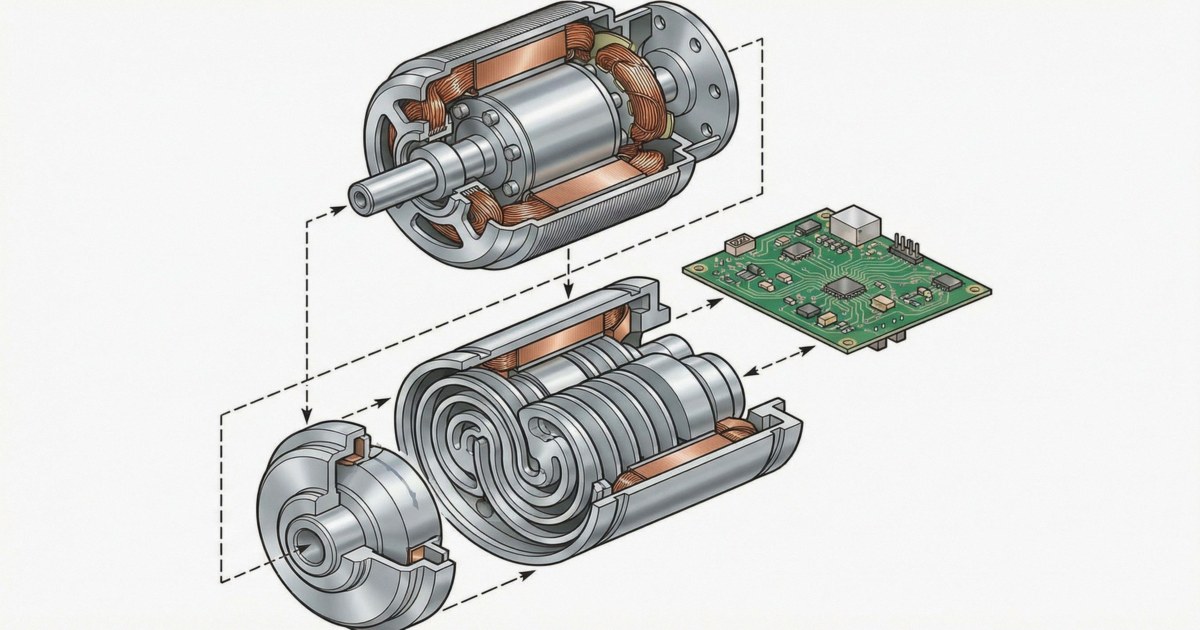
An inverter compressor uses a variable frequency drive (VFD) — essentially an onboard inverter board — to control the motor speed. Instead of full-on or full-off, the compressor modulates: running fast when cooling demand is high, running slow when demand is low, and almost never fully stopping under normal conditions.
The motor itself is a 3-phase brushless DC motor or a linear motor (in LG's specific implementation), driven by three separate phase outputs from the inverter board. This is categorically different from the single-phase motor in a conventional compressor.
Why it matters for diagnostics:
A conventional compressor has:
- Start winding (testable: higher resistance)
- Run winding (testable: lower resistance)
- Start relay and capacitor (testable)
An inverter compressor has:
- Three motor terminals connected to the inverter board (U, V, W phases)
- Balanced winding resistance between any two terminals (typically 2-8 ohms)
- Inverter drive electronics that control speed, current, and protection
You can test inverter compressor winding resistance, but it tells you very little. Equal resistance between U-V, V-W, and U-W indicates the motor windings are intact. But the compressor won't run without functional inverter board outputs. The board is the controller and the protector — and the board is where the vast majority of inverter compressor "failures" actually live.
Rule of thumb I've settled on after years of inverter compressor work: when a refrigerator with an inverter compressor stops cooling, the inverter board is the correct first suspect. Not the compressor itself. The motor components in these compressors are robust. The electronics are not. Replace the board before condemning the compressor in most cases.
LG Linear Compressor: The Most Common You'll See
LG's Linear Inverter Compressor (LIC) doesn't rotate. The piston moves back and forth linearly, driven by a linear motor. It's mechanically elegant — fewer moving parts, less friction, but the early implementations failed at high enough rates to trigger a major class-action settlement (see Sources).
The LG compressor failure pattern is well-documented: the linear motor's resonant spring mechanism fatigues. The compressor loses stroke efficiency, cooling output drops, and eventually the unit stops cooling. The freezer may still partially cool (because it's more tolerant of lower cooling capacity) while fresh food section warms up.
For the full LG linear compressor diagnostic, see our guide on LG refrigerator linear compressor failure. Here I'll focus on the inverter board side.
LG inverter board diagnosis:
On many LG refrigerators, the board that drives the compressor is the main control board (Main PCB Assembly) — it activates the compressor and fans rather than being a separate, standalone "inverter board." It's mounted in the compressor compartment at the base of the unit. On most LG French-door and bottom-freezer models, it's accessible by removing the lower back panel.
Error codes for LG inverter faults:
- Er dH / Er FF — fan or freezer fault, may be related to compressor output
- Er CF — condenser fan fault
- Er CO — compressor output fault (most direct inverter indication)
- Er rF / Er FS — refrigerant sensor errors that may accompany compressor failure
Test procedure for the inverter board:
- With power off, measure resistance between the three compressor terminals (labeled U, V, W on the board connector). Values should be equal within 1 ohm (typically 4-7 ohms per phase). Unequal readings indicate a shorted motor winding — the compressor itself is likely failed.
- With power on and the compressor commanded to run (through diagnostic mode), measure DC voltage at the inverter board output terminals. You should see a modulating DC voltage (not fixed AC). No output from the board with proper input voltage = failed inverter board.
LG part numbers are heavily model-specific, so always confirm against the label on the existing board. As one verified example, EBR65002703 is an LG refrigerator Main PCB Assembly (main control board) — the board that drives the compressor and fans. Don't trust a part number from a guide for your repair; look up the correct board for your exact model on a parts site like lgparts.com using the model number from the door tag.


Samsung Digital Inverter Compressor
Samsung uses a Digital Inverter Compressor in most of their current refrigerator lineup. Unlike LG's linear design, Samsung's is a conventional rotary compressor with variable frequency control. It's generally more reliable than LG's linear design — Samsung compressor failures are less common, though they do occur.
The more frequent failure on Samsung inverter refrigerators is the main control board failing to properly command the inverter circuit, rather than the inverter board itself failing. Samsung integrates the inverter function into the main control board on many models, which means one board covers both the general controls and the compressor drive.
Samsung diagnostic approach:
Check for error codes first. Access service mode by pressing two specific buttons simultaneously (varies by model — check the service manual). Common inverter-related codes:
- 8E — inverter EEPROM error
- PC Er — power circuit error related to compressor drive
- 22E — inverter circuit failure
Samsung inverter boards carry DA92-00xxxB part numbers — for example, the verified DA92-00215B and DA92-00111B inverter PCB assemblies, which control the variable-speed compressor on a range of RF-series models. The correct board is model-specific, so look up your exact model on Samsung Parts USA (samsungpartsusa.com) and confirm against the label on the existing board before ordering. On models where the inverter function is integrated into the main control board, the main board is the part to replace.
Inverter Compressors in Mini-Splits
Every modern mini-split system uses an inverter compressor. This is no longer a premium feature — it's the baseline. Daikin, Mitsubishi, LG, Carrier, Gree, Fujitsu: all use variable speed inverter technology in their current product lines.
Mini-split inverter failures manifest differently from refrigerator inverter failures:
- E1 / P1 codes on most brands — high-pressure protection. Can be refrigerant overcharge, condenser fan failure, or blocked condenser.
- E4 / F4 codes — high discharge temperature, often indicating low refrigerant or compressor efficiency loss.
- Compressor crankcase heater failure — in SoCal this is less critical due to mild weather, but systems stored or unused during cold snaps can have liquid slugging issues if the crankcase heater isn't working.
The inverter board (IPM — Intelligent Power Module) in mini-splits handles enormous thermal load. IPM failures in mini-splits are common, and they're temperature-sensitive. A system that trips out on a 105°F Inland Empire day but works fine in the morning may have an IPM that's thermally failing under load.
Mini-split inverter IPM boards are brand and model specific and run $250-600. This is where mini-split repair can get expensive relative to the system value.
Inverter Motors in Washers
The most recent expansion of inverter technology is into washing machine drive motors. LG Direct Drive washers and some Samsung washers use inverter-driven motors instead of traditional belt-and-pulley or direct-drive induction motors.
LG's Direct Drive uses a brushless DC motor mounted directly on the drum shaft. The inverter board drives it. Failure symptoms: drum won't spin, LE error code, grinding during spin.
Before condemning the inverter board on a washer:
- Check the Hall sensor (rotor position sensor) — this is a small magnetic sensor on the stator. LG part 6501KW2002A is the most common replacement. Hall sensor failure throws an LE code and is much cheaper than the inverter board.
- Check rotor/stator for magnet damage. If a magnet has separated from the rotor, it can jam the motor and destroy the stator windings.
LG DD washer boards are model-specific. As one verified example, EBR67466109 is an LG washer Main PCB Assembly (later revised to EBR67466116). Look up the correct board for your exact model on lgparts.com using the model number rather than ordering a part number from a guide.
The Diagnostic Rule for Inverter Systems
Working on any inverter compressor system, operate in this order:
- Pull error codes — the onboard diagnostics in inverter systems are far more informative than in conventional systems. Use them.
- Check mechanical basics — condenser dirty? Fan running? Refrigerant pressure? An inverter board won't save a system that's mechanically choked.
- Test motor windings — equal resistance across phases confirms the motor itself is intact.
- Evaluate the inverter board / IPM — measure input power, look for visual damage (blown capacitors, scorched traces), check output voltages under commanded load.
- Replace the board before the compressor — if everything points to the inverter electronics, replace the board. A compressor motor that measures good on windings is usually fine; the electronics are the weak link.
This approach reverses the conventional compressor diagnostic order (where the compressor was usually the suspect). In inverter systems, assume electronics first.
Sources
The LG linear-compressor class-action claim refers to Bentley, et al. v. LG Electronics U.S.A., Inc., No. 2:19-cv-13554-MCA-MAH (D.N.J.). The settlement covered owners of certain LG refrigerators manufactured Jan 1, 2014 – Dec 31, 2017 over allegations that the linear compressors were defective and prone to "No-Cooling" failures. Top Class Actions summary | Settlement final-approval order (classaction.org PDF)
What is an inverter compressor?▾
An inverter compressor uses a variable frequency drive (VFD) to control motor speed. Instead of running at one fixed speed and cycling on/off, an inverter compressor ramps up or down based on demand. This improves efficiency and reduces temperature swings, but it also means the traditional start/run winding diagnostic approach doesn't apply.
Why can't I test an inverter compressor with a multimeter like a conventional one?▾
Conventional compressors have separate start and run windings you can test with resistance measurements. Inverter compressors use a 3-phase motor driven by an inverter board. The windings are balanced and wired through the board, not directly accessible in the same way. Winding resistance testing has limited diagnostic value — the inverter board is almost always the failure point, not the motor itself.
Which brands use inverter compressors in refrigerators?▾
LG uses Linear Inverter compressors in most of their refrigerators from 2009 onward. Samsung uses Digital Inverter compressors across most of their current lineup. Bosch, Whirlpool, and GE have also moved to inverter compressors in mid-to-high-end models. In mini-splits, inverter (variable speed) compressors are now nearly universal.
Need a repair professional?
Get free quotes from verified technicians in your area.
Find a Pro Near You