


R-410A Phase-Down: What HVAC Technicians Need to Know for 2026-2027
Terry Okafor
Master refrigeration tech and NATE-certified instructor who moonlights as the magazine's advice columnist. His 'Ask Big Terry' mailbag has been settling shop disputes and diagnosing mystery leaks since 2011.
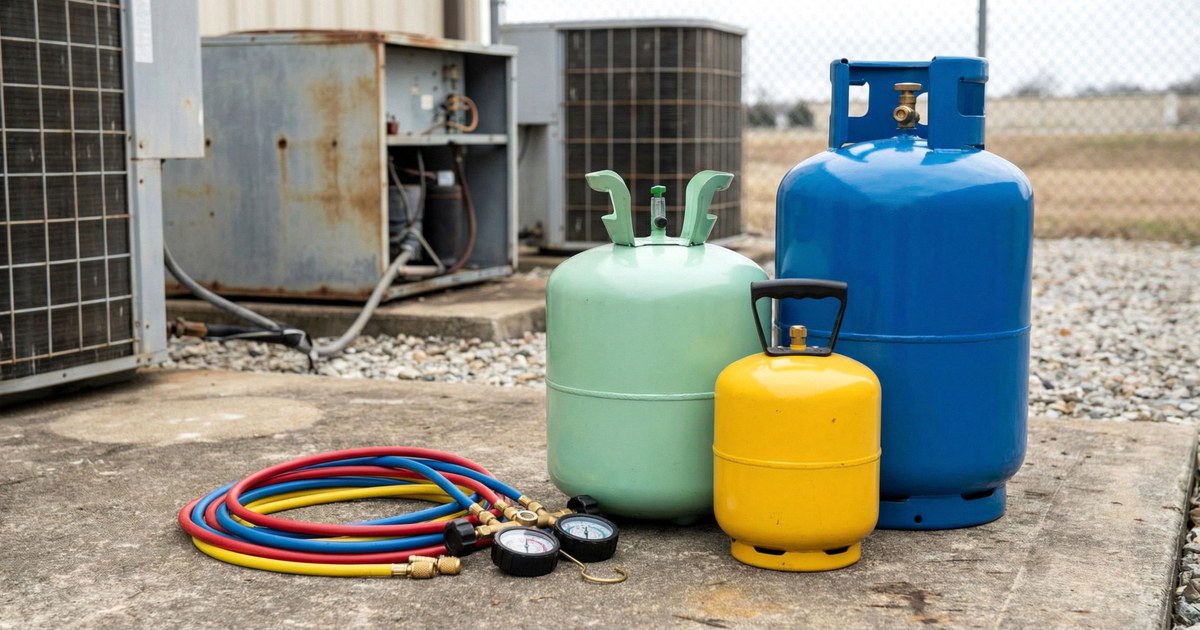
The refrigerant transition that's been discussed for years is no longer theoretical. As of January 1, 2025, new residential and light commercial HVAC equipment manufactured in the United States must use refrigerants with a Global Warming Potential below 750 — which effectively ends R-410A (GWP 2,088) in new equipment. If you're still running on the assumption that R-410A will be the standard for another decade, here's the update you need.
The AIM Act Timeline: What's Already Happened and What's Coming
The American Innovation and Manufacturing (AIM) Act of 2020 gave the EPA authority to phase down HFC refrigerants by schedule. Here's where things stand:
Already in effect (January 1, 2025):
- New residential air conditioning and heat pump equipment must use refrigerants with GWP below 750
- This means all new ducted and ductless split systems, packaged units, and heat pumps now use R-454B, R-32, or similar A2L alternatives
- R-410A equipment manufactured before this date continues to be sold and installed until distributor inventory is depleted (transition period extends through 2025-2026 for sell-through)
Coming in 2026-2027:
- Commercial refrigeration equipment phase-down continues (separate schedule from residential HVAC)
- Expected further tightening of production allowances for R-410A, which will push prices higher
- CARB (California Air Resources Board) has its own, stricter timeline that can accelerate effective dates in California. CARB regulations tend to precede federal deadlines by 1-2 years.
The bottom line: Any new system you're installing today is likely using R-454B or R-32. The installed base of R-410A equipment in California is enormous and will be serviced for the next 15-20 years — so R-410A knowledge and supply remain important. But you need to be qualified for A2L work now, not next year.
A2L Refrigerants: The Practical Differences
R-454B (sold by Chemours as Opteon XL41) and R-32 (Daikin's preferred refrigerant and widely used in mini-splits) are both classified A2L — meaning they have mild flammability. They are not like propane or butane. They have a high minimum ignition energy, a narrow flammability range, and a low burning velocity. They're substantially less dangerous than natural gas from a flammability standpoint, but they require procedures that R-410A did not.
The key operational differences:
No open flames during service. Brazing with a torch while R-454B or R-32 is present in the system requires an inert gas purge and a combustible gas detector present. The standard practice is to recover the refrigerant fully before any brazing work. On R-410A, many techs would braze with a small remaining charge. Not on A2L.
A2L-rated recovery machines required. Recovery machines for A2L must meet UL60335-2-91 or equivalent standard. They use explosion-proof motors and A2L-rated seals. Major brands — Robinair 34788NI, Fieldpiece MR45-INT, Yellow Jacket 95783 — have released compliant models. Most are $600-900.
A2L-rated manifold gauges. Existing R-410A manifolds can't be assumed safe for A2L work. They're not rated for the materials compatibility with the ester oils used in A2L systems, and some A2L refrigerants attack standard seals over time. Fieldpiece and Yellow Jacket both make A2L manifold sets in the $200-400 range, and digital manifold sets (Fieldpiece SM480V, Testo 550s) are compatible with A2L working fluids.
Refrigerant-specific leak detectors. R-454B and R-32 require detectors calibrated for those blends. Your existing R-410A detector may not alarm on R-454B at low concentrations. Fieldpiece SRL8 and Bacharach Informant 2 both support A2L detection.


R-410A Pricing: What to Expect
R-410A production allowances under the AIM Act are being reduced by approximately 40% from 2024 to 2028. Wholesale prices have already moved. As of spring 2026, wholesale R-410A runs approximately $12-18 per pound from major distributors — up from $6-10 just two years ago. Expect continued increases as production allowances tighten further.
Now is a good time to review your refrigerant handling procedure for R-410A systems. Every pound of R-410A vented instead of recovered is a pound you or your customer has to pay for on the recharge. Recovering thoroughly also becomes more economically significant as the price climbs. A system that loses 4 lbs of R-410A to venting during a service visit represents $60-80 in direct cost at current prices. At $25/lb — which is plausible by 2027 — that's $100 per incident.
For customers: the honest conversation is that R-410A systems will cost more to service over time, and that this is a genuine factor in the repair-vs-replace calculation for systems approaching the 10-12 year mark. See our AC not cooling guide for how to structure that refrigerant conversation during diagnostic visits.
Training and Certification
The EPA 608 certification covers refrigerant handling and has been updated to include A2L awareness. However, 608 certification alone doesn't provide the detailed practical training for A2L procedures. Industry training bodies — HVAC Excellence, RSES (Refrigeration Service Engineers Society), and ACCA — all offer A2L-specific courses that run 4-8 hours and cost $50-150. Most equipment manufacturers have also produced free tech training videos and bulletins specific to their A2L lines.
In California, CARB may establish state-specific technician requirements for A2L work as the transition progresses. Watch the CARB website and your trade association newsletters for updates.
The minimum baseline for 2026:
- EPA 608 certification current (if it expired, renew it — no re-exam required for most)
- A2L awareness training completed through one of the above providers
- A2L-rated recovery machine on the truck
- A2L-compatible leak detector
Working on new equipment installations or refrigerant-involved service calls without these qualifications isn't just a regulatory risk — it's a safety risk if you're applying R-410A procedures to A2L equipment.
Talking to Customers About the Transition
Most homeowners don't know anything about refrigerant regulations, and they don't need to. But when the conversation about system age and replacement comes up, the refrigerant factor is relevant context.
What to say: "Refrigerant costs for systems like yours are going up over the next few years as the older refrigerant is phased out. For a system that still has 5+ years of good life, the repair still makes sense. But for one that's 12-15 years old and needs a significant repair, the refrigerant cost trajectory is one more reason the new system math gets better."
That's the whole conversation. It doesn't require a lecture on HFC regulations — just honest, practical context that helps the customer make a better decision.
Can I still service R-410A equipment in 2026?▾
Yes. Servicing existing R-410A equipment with R-410A refrigerant remains legal and will for the foreseeable future. The AIM Act limits new production of R-410A and new equipment using it — it does not restrict servicing installed equipment. R-410A supply remains available but prices are rising as production allowances decrease.
Do I need new equipment to work on A2L refrigerants?▾
Yes. A2L refrigerants require recovery machines, manifold gauges, and leak detectors rated for A2L. These tools cost $850-1,500 as a kit. Most manufacturers have released compliant product lines. You also need A2L safety training before working on new equipment — the brazing and handling procedures differ from R-410A practice.
Need a repair professional?
Get free quotes from verified technicians in your area.
Find a Pro Near You