


EPA 608 Refrigerant Handling Compliance: The Complete Reference for HVAC Technicians
Terry Okafor
Master refrigeration tech and NATE-certified instructor who moonlights as the magazine's advice columnist. His 'Ask Big Terry' mailbag has been settling shop disputes and diagnosing mystery leaks since 2011.
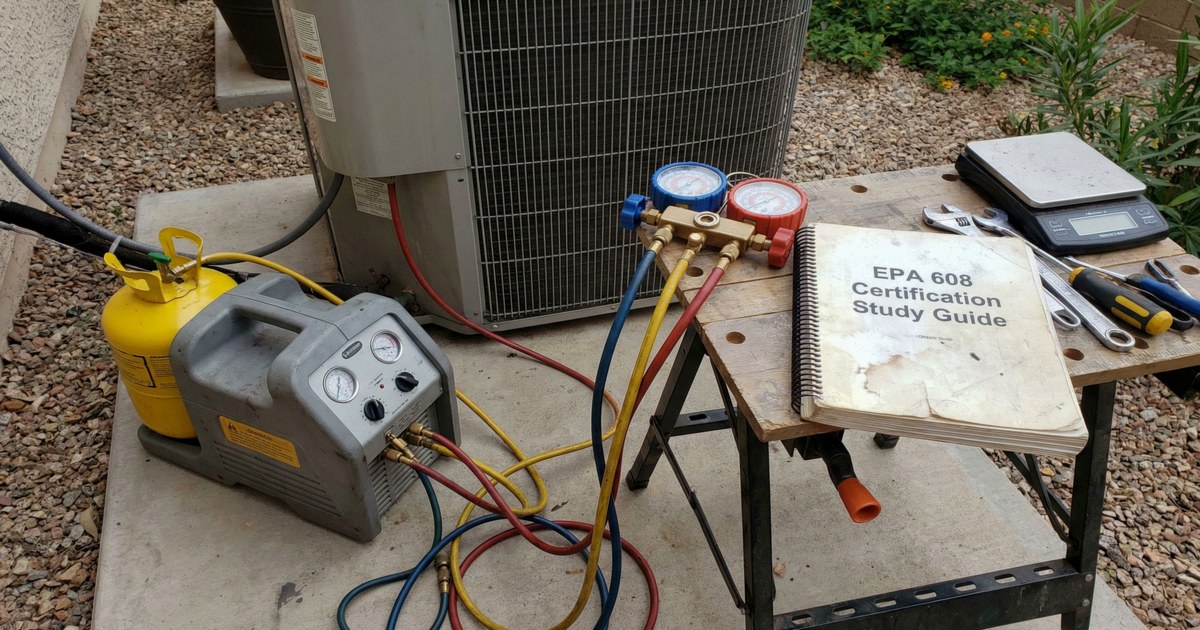
Section 608 of the Clean Air Act has governed refrigerant handling since 1992. The core framework hasn't changed, but the refrigerants have — and as R-410A phases down and A2L refrigerants like R-454B and R-32 phase in, some practices that were fine before carry new requirements. This guide is a complete field reference, not an exam study guide. It's for working techs who want the rules straight without the regulatory padding.
What's New for 2026
Three shifts make 2026 the year compliance gets re-examined at most shops:
- Most new residential split-system equipment now ships with R-454B or R-32 from the factory. Stocking A2L-rated recovery equipment is no longer optional for shops doing new-install commissioning or warranty work. See our R-410A phase-down breakdown and the EPA's walked-back installation ban and the AIM Act threshold drop to 15 lbs.
- California's annual refrigerant reporting under the CARB Refrigerant Management Program (RMP) tightened — the threshold for "high-GWP system" reporting now captures more comfort-cooling systems than it did in 2024. Details in the California section below.
- EPA enforcement is paying closer attention to recovery cylinder hydro testing and disposable-cylinder reuse. Multi-shop inspection sweeps in 2025 cited these violations more than any other compliance item. The Audit Findings section near the end of this guide lists what inspectors actually wrote up.
For a broader view of the refrigerant transition, see the 2026 EPA refrigerant transition update.
Who Needs 608 Certification
Any person who opens a refrigerant circuit — even to add refrigerant — must hold an EPA Section 608 certification. This is federal law, not California state law, and there is no grandfathering based on experience.
The four certification types:
- Type I: Small appliances (manufactured and charged with 5 lbs or less of refrigerant — household refrigerators, window ACs, most portable ACs). Closed-book exam.
- Type II: High- and very-high-pressure systems (R-410A, R-22, R-404A, R-134a, and most equipment used in residential and commercial HVAC/R). Practical exam required at a certified test site. Type II is sufficient for high-pressure equipment of any charge size — there is no separate certification tier for large high-pressure systems. A Type II tech is legally cleared to service a 200-lb supermarket rack as well as a residential split system, so long as the equipment is high-pressure.
- Type III: Low-pressure systems (R-11, R-113, R-123 — centrifugal chillers, commercial). Less common in residential/light commercial work.
- Universal: Covers all three types. Holding Universal is best practice for any tech doing full-spectrum HVAC/R work, but it is not a legal requirement — the law only requires that you hold the certification type matching the equipment you're servicing. Most working HVAC techs choose Universal for convenience and to avoid certification-mismatch questions on the job.
The certification has no expiration date. Once certified, you're certified — but you must use certified recovery equipment and follow current regulations, which do change.
Technician certification number: Your certification comes with a unique number. When performing work on systems with 50+ lbs of refrigerant, this number goes in the service record.
The Venting Prohibition
This is the absolute rule of Section 608. There are no exceptions.
Knowingly venting any regulated refrigerant is illegal. This covers all HFCs (R-410A, R-32, R-454B, R-134a, R-407C), all HCFCs (R-22), and all CFCs. It also covers blends containing any of these refrigerants.
The penalty: under the current inflation-adjusted Clean Air Act figures (40 CFR 19.4, effective January 2025), civil judicial penalties (CAA 42 U.S.C. 7413(b)) run up to $124,426 per violation, and administrative penalties (42 U.S.C. 7413(d)(1)) run up to $59,114 per day of violation. These amounts are adjusted annually for inflation. The EPA has actual enforcement actions on record. This isn't theoretical.
"Knowingly venting" is the key phrase. If you open a system and refrigerant escapes because the system had already leaked down to near-zero pressure, that's different from purging a system into the atmosphere. But in practice, if you're opening a circuit, you run recovery first. Every time.
The de minimis exemption: Refrigerant releases from "good faith" attempts to recover are technically exempt — meaning the small amount that comes out when you disconnect hoses quickly or the trace amount in recovered vacuum is not a violation. But this is not a loophole for skipping recovery on charged systems.
I've seen techs make a judgment call that "this system is basically empty anyway" and skip the recovery machine. Don't. Even a system that's low enough to read atmospheric on your gauges may still contain refrigerant vapor. Recovery takes 10 minutes. The liability for skipping it is not worth it under any scenario.
Recovery Requirements by System Size
The amount of refrigerant you must recover before opening a system depends on the system type and the recovery equipment you're using.
Required recovery efficiency for high-pressure systems (R-410A, R-22):
| System charge size | Required recovery level (to final recovery vacuum) |
|---|---|
| < 200 lbs and manufactured before 1/1/1993 | 80% recovery |
| < 200 lbs and manufactured after 1/1/1993 | 90% recovery |
| 200 lbs or more | 90% recovery |
In practical terms, "90% recovery" is typically measured as achieving a 0 PSIG recovery vacuum and then 10 additional minutes of recovery after reaching 0. For residential equipment (which is virtually always under 200 lbs), the standard is recovery to 0 PSIG on the gauges.
Recovery equipment certification: Your recovery machine must be certified under ARI 740. Recovery machines made before November 1993 may not meet current standards. Check your machine's certification if it's old equipment.
Non-certified recovery equipment: You cannot use uncertified equipment for recovery. This includes DIY or improvised rigs. Use certified equipment from Appion, Yellow Jacket, Ritchie, or comparable manufacturers.
Record-Keeping Requirements
Systems containing 50 lbs or more of refrigerant require formal maintenance records:
- Date of service
- Type and quantity of refrigerant added
- Leak inspection results (date and result, for systems with a leak rate exceeding the annual EPA thresholds: 10% of charge per year for comfort cooling, 20% for commercial refrigeration, 30% for industrial process refrigeration)
- The technician's name and EPA certification number
- Name and address of the person who performed the service
These records must be retained for three years at the facility, or for three years by the owner of the equipment if serviced at their location.
For systems under 50 lbs: Federal regulations don't mandate technician-level records. Keep records regardless of system size as a business practice — they protect you when a customer disputes a service call, and they're required by California (see CARB section below).
Refrigerant purchase records: Wholesalers and distributors are required to verify EPA 608 certification before selling HFC refrigerants (including R-410A) in containers larger than 2 lbs. Have your certification number available when ordering. Small cans (2 lbs and under of HFCs sold for DIY use) are sold without certification requirements, but these are consumer-grade products not suited for professional recovery work.
California-Specific Requirements (CARB Refrigerant Management Program)
If you operate in California, federal Section 608 is the floor — not the ceiling. The California Air Resources Board's Refrigerant Management Program (RMP), authorized under AB 32, adds annual reporting, lower thresholds, and steeper penalties than federal rules.
What CARB adds on top of federal 608:
- Lower reporting threshold: CARB's RMP captures systems with 50 lbs or more of high-GWP refrigerant. The owner — not the servicing tech — is responsible for annual reporting through the CARB-RMP online portal. As a service contractor, you don't file the report, but the customer needs your service data to file theirs. Provide a clean service record after every job.
- Annual leak-rate audit: Comfort cooling and refrigeration systems with charges of 200 lbs or more require an annual leak-rate audit. This is a customer obligation but typically performed by the servicing contractor.
- Stricter leak repair timelines: Federal 608 allows 30 days to repair a leak that exceeds threshold. California requires repair within 14 days for systems above 50 lbs once a leak rate has been confirmed.
- Mandatory leak inspections at intervals based on system size — every three months for systems with 200+ lbs of high-GWP refrigerant, every 12 months for systems with 50-199 lbs.
- Refrigerant-specific reporting: R-410A (GWP 2,088), R-404A (GWP 3,922), and R-507A (GWP 3,985) all trigger CARB reporting. The new A2L refrigerants — R-32 (GWP 675) and R-454B (GWP 466) — have lower GWPs but still fall under reporting if the system charge exceeds threshold.
Penalties: CARB can assess civil penalties for refrigerant violations in addition to federal EPA penalties, and the state has actually levied them — recent settlements with grocery chains have run into the millions of dollars. For the current per-day and per-violation penalty figures, see the CARB Refrigerant Management Program for California-specific requirements. Recovery cylinder violations and missing service records are among the most common cited issues in California audits.
For shops working with rental property managers and landlords, also note California AB 628 rental appliance law and the broader California right-to-repair law, which interact with refrigerant compliance when a manufacturer's repair restriction conflicts with state mandates.
Cylinder Storage and Handling
DOT regulations govern refrigerant cylinder storage, and the violations in this area are the ones that catch shops on surprise inspections.
Required practices:
- Store cylinders in a cool, dry, well-ventilated area. No direct sunlight, no heat sources, no areas that get above 125°F.
- Store cylinders upright (vapor valve at top) unless the cylinder is specifically designed for liquid recovery and positioned accordingly.
- Cylinders must be secured against falling — chained or strapped to a wall, rack, or vehicle.
- Do not fill recovery cylinders above 80% of their rated capacity. The hydrostatic pressure of refrigerant exceeds cylinder limits when overfilled and heated.
- Cylinders must be re-certified (or removed from service) after 5 years for DOT specification cylinders. The re-certification date is stamped on the collar.
- Do not fill a recovery cylinder from another recovery cylinder. Cylinders must be filled from systems only.
- Label all recovery cylinders with the refrigerant type. Using an unlabeled cylinder is a violation.
- Never use a cylinder that's been dropped, dented, or shows signs of damage.
Disposable cylinders: Refrigerant sold in disposable "one-time-use" cylinders must be disposed of properly — punctured to prevent reuse, then recycled as metal. It is illegal to refill a DOT-39 (disposable) cylinder. Don't do it.
The most common cylinder violation I see at shops is old, unmarked gray recovery cylinders that have been in service for 10+ years with no re-certification stamp. Pull those out. The re-certification is typically done by a certified hydrostatic testing facility — check with your refrigerant supplier for referrals. A cylinder that fails a hydro test gets destroyed, and that's the right outcome.


A2L Refrigerants: What Changes
The transition away from R-410A is the biggest change in refrigerant compliance in a generation. R-410A's phase-down under the AIM Act began in 2025. The replacements — primarily R-454B (sold as Puron Advance, Opteon XL41) and R-32 — are classified as A2L refrigerants.
A2L means mildly flammable. The "2L" classification (ASHRAE Standard 34) indicates a lower flammability limit greater than 3.5% by volume and a burning velocity of 10 cm/s or less. In plain terms: A2L refrigerants won't ignite easily, but they can ignite under the right conditions. This matters on the job.
What changes with A2Ls:
Recovery equipment: Standard A1-rated recovery machines (for R-410A) are not certified for A2L use. You need A2L-rated recovery equipment. Manufacturers including Appion, Yellow Jacket, and Ritchie have released A2L-compatible machines. Check your equipment certification before working with R-454B or R-32.
Leak detection: A2L-certified leak detectors are required. Not all current R-410A leak detectors are A2L-rated. Confirm yours is.
Ventilation: Work areas must be adequately ventilated when working on A2L systems. No different from standard practice in enclosed spaces, but more strictly required and observed.
Ignition sources: No open flames, no welding arcs, no unprotected electrical arc sources within the work area when there's a risk of refrigerant release. Standard safety practice applies more strictly.
Equipment compatibility: Systems designed for A2L refrigerants use A2L-compatible components (compressors, valves, metering devices). Do not add R-32 or R-454B to an R-410A system — this is not a "drop-in" replacement and creates a mixed-refrigerant situation that violates equipment certifications and creates safety risks.
What doesn't change: The venting prohibition, recovery requirements, record-keeping requirements, and certification requirements all apply to A2Ls exactly as they apply to A1 refrigerants. The rules don't get easier; they get more specific.
A2L Recovery Equipment by Manufacturer
The major recovery machine manufacturers have all released A2L-rated equipment. A2L-rated machines are typically dual-rated for A1 refrigerants as well, so a single new tool covers both R-410A and R-454B/R-32 work.
These are the units we see in the field most often. Verify the model you buy carries the manufacturer's explicit A2L certification — earlier model-number variants of these machines may not be A2L-rated even where the model name is similar.
A2L Phase-In Timeline
| Equipment category | Federal A2L-mandatory date | Notes |
|---|---|---|
| New residential split-system AC (under 65,000 BTU/hr) | January 1, 2025 | Most major OEMs shipping R-454B from 2025 model year |
| New residential heat pumps | January 1, 2025 | Includes ducted and ductless |
| Light commercial split systems (65k-135k BTU/hr) | January 1, 2026 | Phase-in by OEM model release |
| Packaged AC and rooftop equipment | January 1, 2026 | Some models earlier voluntarily |
| New chillers | January 1, 2025 | A2L or alternative low-GWP class |
Service and repair on existing R-410A equipment continues indefinitely — there's no requirement to retrofit or replace a working R-410A system. But new equipment installed after the mandatory date must use A2L refrigerants. Don't try to substitute R-410A into an A2L-designated system or vice versa; the equipment certifications and lubricant specifications are not compatible.
For the full picture on the refrigerant transition timeline and what it means for shop operations, see our 2026 EPA refrigerant transition update and the recent EPA R-410A installation rule walk-back.
Leak Rate Requirements for Comfort Cooling and Refrigeration
Under EPA 608, the annual leak-rate threshold that triggers the repair clock depends on the equipment type. For appliances with a full charge of 50+ lbs of refrigerant, the current thresholds are:
- Comfort cooling (HVAC): 10% of the total charge per year
- Commercial refrigeration: 20% of the total charge per year
- Industrial process refrigeration: 30% of the total charge per year
These thresholds were lowered from the older 15%/35%/35% values under the updated rule. When a system's annual leak rate exceeds its threshold, the leak must be repaired within 30 days of discovery (industrial process refrigeration gets a 120-day extension where repairs require custom-fabricated parts or extensive system isolation).
If the leak cannot be repaired within the required window, a retrofit or retirement plan must be implemented within 1 year.
Calculating leak rate: (amount of refrigerant added over 12 months ÷ total system charge) × 100 = leak rate percent. If you've added 6 lbs to a 40-lb comfort-cooling system in a year, that's 15% — above the 10% comfort cooling threshold, so the 30-day repair clock has started.
This rule applies per system, not per customer or per installation. A commercial building with multiple systems tracks leak rates per system.
Audit Findings: What EPA Inspectors Actually Cite
These are the violations that consistently show up in EPA Section 608 enforcement actions and CARB audits, based on published enforcement records and our reporting:
-
Expired hydro-test stamps on recovery cylinders. The single most common violation. DOT specification cylinders must be re-tested every 5 years. Inspectors check the stamp on the collar. An expired cylinder in active service is a strict-liability violation regardless of whether the cylinder has been used recently.
-
Refilled disposable (DOT-39) cylinders. Refilling a one-time-use cylinder is illegal under DOT regulations and inspectors actively look for this. The giveaway: a DOT-39 cylinder with a service-truck address sticker or a refrigerant other than what the cylinder is labeled for.
-
Missing certification numbers in service records. For systems with 50+ lbs, the tech's EPA certification number must be in the service record. Records that say "service performed by John Smith" without the certification number are non-compliant.
-
Unlabeled or cross-labeled recovery cylinders. A cylinder originally labeled for R-410A used to recover R-32 — or worse, used to recover an unidentified refrigerant. Cross-contamination plus mislabeling.
-
Recovery records that don't reconcile. If you bought 50 lbs of refrigerant in a year and your service records account for only 20 lbs of refrigerant added to customer systems, an inspector is going to ask where the other 30 lbs went. Keep purchase records and service records that match.
-
Missing or late leak-repair documentation. When a leak rate exceeds the applicable threshold — 10% for comfort cooling, 20% for commercial refrigeration, 30% for industrial process refrigeration — the 30-day repair clock starts. Inspectors check whether a follow-up service record exists within 30 days.
-
Certification-type mismatch on the equipment being serviced. The law requires that you hold the certification type matching the equipment — Type II for high-pressure, Type III for low-pressure. Type II is sufficient for a high-pressure system of any charge size, including a 200-lb supermarket rack, so Universal is not legally required there. The genuine finding is a mismatch: a Type-II-only tech servicing a low-pressure centrifugal chiller (which requires Type III), or an uncertified person opening any circuit. Holding Universal sidesteps these mismatch questions entirely.
-
California-specific: Missing or late annual CARB-RMP filings, system inventories that don't match facility records, and missing quarterly leak inspections on 200+ lb systems.
The way most shops fail an audit is paperwork, not technique. The work was probably done right. The records just don't prove it. Build a service record template that captures every required field — date, refrigerant type, quantity, certification number, system ID, leak inspection result — and make every tech fill it out before they leave the site. Five extra minutes per call, hours of audit relief later.
Summary: Compliance Checklist
Before any refrigerant service:
- Hold valid EPA 608 certification for the equipment type
- Recovery equipment is ARI 740 certified (and A2L-rated if working with R-32/R-454B)
- Cylinder is labeled, within re-certification date, and properly stored
- Recovery cylinder is not over 80% capacity
During service:
- Recover before opening the system — every time, no exceptions
- Achieve 0 PSIG recovery vacuum plus 10 minutes on residential equipment
- A2L: ventilate work area, no ignition sources
After service:
- For 50+ lb systems: complete service record with refrigerant quantity added, tech certification number, date
- Retain records three years minimum
- Check leak rate for 50+ lb systems and flag if over threshold
- California shops: ensure customer has data needed for annual CARB-RMP filing
Related Guides
- R-410A Phase-Down: What HVAC Technicians Need to Know for 2026-2027
- Inverter Compressor Technology: How They Work and Why They Fail Differently
- Common HVAC Electrical Failures: Contactors, Capacitors, Relays, and More
- Advanced Multimeter Techniques for HVAC
- Ductless Mini-Split Troubleshooting: Fault Codes, Frozen Coils, and Communication Errors
- Track all appliance and HVAC recalls in one place
Do I need EPA 608 certification to work on refrigerant systems?▾
Yes, for any work that opens a refrigerant circuit. This is federal law with no grandfathering or state exemptions. Universal certification covers all system types and is recommended for any tech doing full HVAC service work. The certification has no expiration date.
What are the venting prohibition rules under EPA 608?▾
Knowingly venting any regulated refrigerant — including R-410A, R-22, R-32, and R-454B — is illegal and carries civil penalties of up to $124,426 per violation (civil judicial, CAA 42 U.S.C. 7413(b)) or up to $59,114 per day of violation (administrative, 42 U.S.C. 7413(d)(1)) under the current 40 CFR 19.4 figures. You must recover refrigerant before opening any charged system, even if the system appears nearly empty. There are no exceptions for "small amounts" on charged systems.
How do A2L refrigerants change my work practices?▾
A2L refrigerants (R-454B, R-32) require A2L-rated recovery equipment, A2L-rated leak detectors, adequate ventilation during service, and elimination of ignition sources in the work area. Standard A1 recovery machines (used for R-410A) are not certified for A2L use. The venting prohibition and record-keeping requirements remain unchanged.
What records am I required to keep under EPA 608?▾
For systems with 50+ lbs of refrigerant: date of service, refrigerant type and quantity added, tech certification number, and leak inspection results if the system exceeds the annual leak rate threshold. Records must be kept three years. California's Refrigerant Management Program has additional requirements — track records for all systems regardless of charge size.
Sources
- U.S. EPA. "Stationary Refrigeration Leak Repair Requirements" (Section 608). https://www.epa.gov/section608/stationary-refrigeration-leak-repair-requirements — leak-rate thresholds (10% comfort cooling / 20% commercial refrigeration / 30% industrial process), 50-lb applicability, and 30-day repair timeline.
- U.S. EPA. "Section 608 Technician Certification Requirements." https://www.epa.gov/section608/section-608-technician-certification-requirements — Type I/II/III/Universal scope; Type II covers high- and very-high-pressure appliances of any charge size.
- U.S. EPA. "Stationary Refrigeration – Prohibition on Venting Refrigerants" (Section 608). https://www.epa.gov/section608/stationary-refrigeration-prohibition-venting-refrigerants — venting prohibition under the Clean Air Act.
- U.S. EPA. "Enforcement Actions under Title VI of the Clean Air Act" — civil penalty amounts per 40 CFR 19.4 (effective Jan 2025): up to $124,426 per violation civil-judicial (CAA 42 U.S.C. 7413(b)) and up to $59,114 per day administrative (42 U.S.C. 7413(d)(1)), inflation-adjusted annually. https://www.epa.gov/ozone-layer-protection/enforcement-actions-under-title-vi-clean-air-act — see also the CFR table at https://www.law.cornell.edu/cfr/text/40/19.4
- California Air Resources Board. "Refrigerant Management Program (RMP)." https://ww2.arb.ca.gov/our-work/programs/refrigerant-management-program — California-specific 14-day leak repair deadline, inspection frequencies, 200-lb reporting threshold, and penalty provisions.
- U.S. EPA. "Sales Restriction" (Section 608) — certification required to purchase regulated refrigerants. https://www.epa.gov/section608/sales-restriction
- U.S. EPA. "Technology Transitions Program" (AIM Act) — HFC phase-down and A2L transition. https://www.epa.gov/climate-hfcs-reduction/technology-transitions
Need a repair professional?
Get free quotes from verified technicians in your area.
Find a Pro Near You