


Samsung Refrigerator Not Cooling: Model-Specific Diagnosis for RF and RS Series

Terry Okafor
Master refrigeration tech and NATE-certified instructor who moonlights as the magazine's advice columnist. His 'Ask Big Terry' mailbag has been settling shop disputes and diagnosing mystery leaks since 2011.
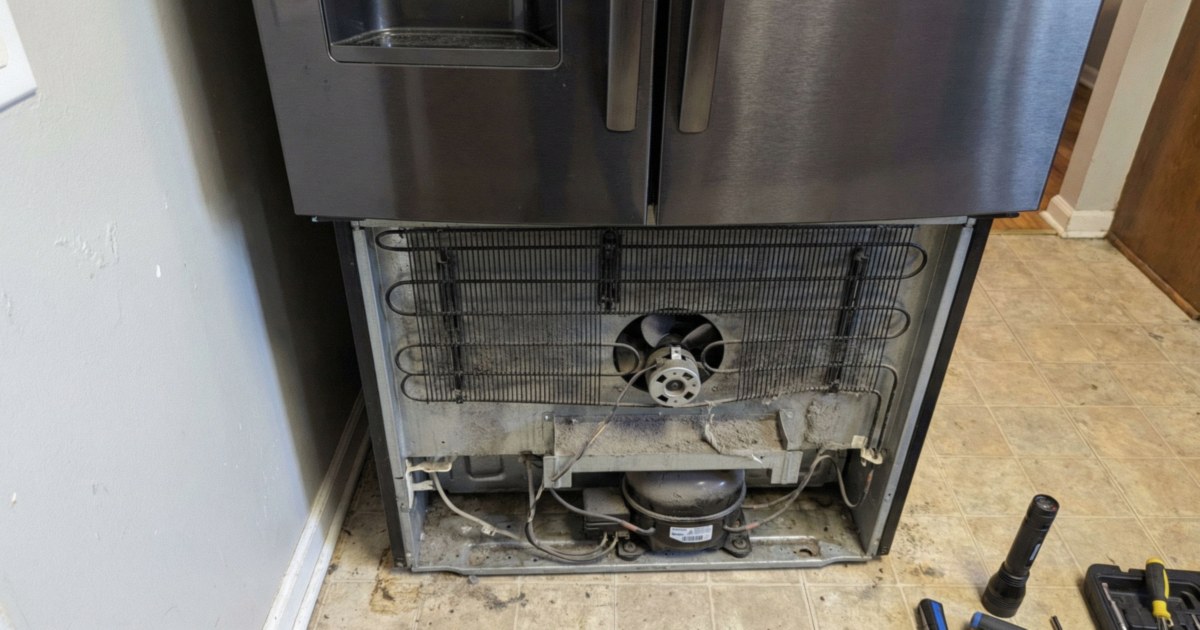
Samsung is one of the highest-volume refrigerator brands on the road, and their cooling failures follow patterns that are genuinely different from generic refrigerator troubleshooting. If you're working a Samsung not-cooling call, the generic guide that says "check the condenser coils and the door gaskets" will often send you down the wrong path. Samsung's specific failure modes — particularly on their French door and side-by-side configurations — have characteristic symptoms and characteristic fixes.
This guide covers the RF28, RF23, RS, and RT series patterns. For a general refrigerator not cooling guide covering all brands, see refrigerator not cooling.
The Forced Defrost Reset: Always Try This First
Samsung's most common cooling failure mode isn't a failed part — it's a defrost system that's allowed the evaporator coils to ice over completely. When the coils are encased in ice, airflow through them drops to near zero, and the fridge section goes warm while the freezer stays cold.
Before you order anything, run a forced defrost cycle. Here's how to access it by model group:
RF28, RF22, RF23, RF24 (French door, touch control panel): Hold the "Freezer" and "Fridge" buttons simultaneously for 8-10 seconds until the display shows "0" or "OF OF". Then press the Freezer button to cycle through diagnostic modes. You're looking for "Fd" or "dF" on the display. Press any button to confirm and start forced defrost. The compressor stops and the defrost heaters run. Leave it running for 20-30 minutes.
RF28R, RF29B, and newer RF series with LCD display: Press and hold the two left-side panel buttons (typically Ice Type and Child Lock) for 8 seconds. The display will change to a service mode screen. Use the left button to cycle to the defrost option.
RS (side-by-side) series: Hold Energy Saver and Freezer buttons for 8 seconds. Display will show diagnostic mode. Cycle to the "Fd" defrost mode.
RT (top-mount) series and older models without touch panels: Unplug the refrigerator. Remove the rear panel inside the freezer compartment. The evaporator coils are visible. If they're encased in solid ice, use a hair dryer to melt the ice manually (protect the drain pan below). This achieves the same result as a forced defrost without the button combo.
After forced defrost, let the refrigerator run for 4-6 hours before evaluating whether cooling has returned. If cooling is restored after forced defrost, the refrigerator will ice up again within days to weeks unless you find and fix the defrost system failure.
When you do a forced defrost and find a massive ice block on the evaporator coils — I'm talking solid ice from top to bottom, half an inch thick — that tells you the defrost system has been failing for weeks. The customer's complaint about "not cooling as well as it used to" probably started a month ago, and they waited until it was completely warm to call. Check the defrost heater and defrost thermostat before declaring victory on the forced defrost.
Evaporator Fan Motor: Most Common Real Hardware Failure
If forced defrost restores cooling but the fridge ices up again within a week, or if forced defrost doesn't help and the freezer temperature is normal, the evaporator fan motor is the most likely culprit.
The evaporator fan is mounted in the freezer compartment (usually behind the rear panel). It pulls air across the evaporator coils and circulates it to both the freezer and the fresh food compartment. When it fails, the freezer may maintain temperature from refrigerant contact alone while the fridge goes warm.
Test: Remove the rear freezer panel. Listen for the fan when the door switch is depressed (or use a magnet to hold the door switch closed). No noise = motor failed. Grinding or squealing = bearing failure.
The evaporator fan on Samsung French door refrigerators has a known issue with the blade frosting in place. If the coils are iced up, the blade can freeze to the housing. After forced defrost, confirm the blade spins freely before condemning the motor.
Part numbers:
- RF28HMEDBSR / RF28HDEDBSR: DA31-00146E (evaporator fan motor, lower evap) and DA31-00146F (upper, flex zone models)
- RF23HCEDBSR: DA31-00146E
- RF22HPEDBS: DA31-00146E
- RS25 side-by-side: DA31-00334C
- RT18/RT21 top-mount: DA81-05121A
Defrost System: Heater, Thermostat, and Timer
When forced defrost restores cooling temporarily, the defrost system components are your primary targets.
Defrost heater (DA47-00244T and related): The heater melts ice from the evaporator coils during automatic defrost cycles. Test resistance — a good heater reads continuity (a finite resistance value); an open reading means it's failed. Compare the reading against the resistance spec in the model's service manual. On some RF models, the heater assembly is integrated with the defrost thermostat as a single harness.
Defrost thermostat / bimetal: The bimetal thermostat opens the heater circuit when the evaporator temperature exceeds approximately 50°F, preventing overheating. Test continuity at room temperature — it should be closed (conducting). If it's open at room temperature, it's failed in the open position and needs replacement.
Defrost sensor / thermistor: Samsung uses a separate defrost sensor on newer models. It monitors evaporator temperature and tells the main board when to initiate defrost. A failed sensor gives the board wrong temperature data, causing defrost to either run too infrequently or not at all. Test: remove the sensor and check resistance at room temperature — should be approximately 5,000-15,000 ohms depending on the model. Compare to the service manual spec.
Part numbers:
- Defrost heater DA47-00244T (RF28/RF23 series)
- Defrost thermostat / bi-metal DA47-00243K (covers multiple RF models)
- Defrost sensor DA32-10105R (RF28/RF23 series)


Condenser Fan Motor
The condenser fan pulls air through the condenser coils at the bottom rear of the refrigerator. It runs whenever the compressor runs. If it fails, the condenser can't reject heat, compressor head pressure rises, and cooling capacity drops off.
On Samsung French door models, the condenser fan is in the compressor compartment at the bottom rear. Access by removing the rear lower panel (4-6 screws). The fan blade should spin freely and the motor should run whenever the compressor is running.
A failed condenser fan often presents as intermittent cooling — the refrigerator cools adequately when the kitchen is cool but loses capacity in warm weather, because a higher ambient temperature demands more condenser heat rejection capacity that the failed fan can't provide.
Part numbers:
- DA97-15765C: condenser fan motor assembly for RF28 French door series (RF28HDEDBSR, RF28HFEDBSR, RF28R72xx, and many related variants)
- DA97-20025A: condenser fan motor for newer RS/RF models (RS22T5201SR, RF27T5241SR, RS27T5200SG and related)
Note: Always confirm the condenser coils are clean before replacing the fan. Samsung condenser coils collect lint and pet hair — if they're caked, even a good fan can't move enough air through them. Use a vacuum and a coil brush before the service call is over.
Main Control Board Failures: RF28 and RF23 Patterns
The main control boards on the RF28HMEDBSR and related RF28 French door models have a documented failure pattern. The relay or triac that drives the compressor start relay can fail, causing the compressor to stop cycling even though the board appears powered and the display is functional.
The symptom: the refrigerator gradually loses cooling over days to weeks. Temperatures rise slowly rather than all at once. The compressor is not running (confirm by listening at the back — no compressor hum) but the fans may still be running. The display works normally.
Before condemning the board, confirm:
- Compressor start relay (the small plug-in relay on the compressor side terminal) isn't failed — shake it and listen for a rattle (broken winding). This is a $15-25 part and worth replacing first.
- Compressor overload protector isn't tripped — clip-on device on the compressor. Test continuity.
- 120V power is reaching the compressor terminals — if the board is the problem, you won't see voltage at the compressor during a cooling call.
If all of the above are confirmed and the board isn't sending voltage to the compressor, the board is the cause.
Part numbers:
- DA92-00591A: main control board for RF28HMEDBSR (match the board number printed on the existing board; superseded by DA94-02663D on later revisions)
- DA94-02663D: updated replacement that supersedes DA92-00591A on later RF28HMEDBSR builds
Samsung board part numbers change between production runs. The number on the parts diagram in the service manual may not match what's installed in the field if the board has been superseded. Pull the installed board and match the number printed directly on it. Samsung main boards are frequently revised and some variants will not work as drop-in replacements for other variants even in the same model series.
The Compressor Question
Samsung's Twin Cooling Plus and standard R-600a systems do see compressor failures in the field, typically well outside the warranty period. Unlike LG's linear compressor failures — which were covered under a class-action settlement that extended compressor warranties to 10 years (see Sources) — Samsung compressor failures are generally out-of-warranty repairs paid by the customer.
Compressor replacement on a Samsung French door refrigerator runs $500-900 total including parts and labor. A new comparable refrigerator starts at $1,200-1,800. Unless the unit is less than 8 years old and in otherwise excellent condition, the cost-benefit on Samsung compressor replacement is marginal.
For the full repair vs. replace framework, see appliance repair vs. replace.
For Samsung-specific ice maker issues — a related but separate failure mode — see our dedicated Samsung fridge ice maker fix guide.
Diagnostic Order for Samsung Not Cooling
- Forced defrost — 30 minutes plus 4-6 hour evaluation. Identifies ice blockage and defrost system failures.
- Evaporator fan — Listen and check rotation. Most common mechanical failure.
- Defrost heater and thermostat — If forced defrost helped but cooling failed again.
- Condenser fan and coils — Clean coils first, then test fan.
- Start relay and overload — Quick test before condemning the compressor or board.
- Main control board — Last resort after all mechanical components are confirmed.
Why is my Samsung refrigerator not cooling but the freezer works?▾
This pattern almost always points to an evaporator fan failure or a defrost system failure that's caused the evaporator coils to ice over. Try the forced defrost button combination first — if cooling returns after defrost runs, the defrost heater or thermostat is the real fix. If forced defrost doesn't help, check the evaporator fan motor.
How do I put my Samsung refrigerator in forced defrost mode?▾
On most RF series, hold the Freezer and Fridge buttons simultaneously for 8-10 seconds until the display changes, then press Freezer to cycle to the "Fd" or "dF" option. Confirm and let it run 20-30 minutes. On RS side-by-side, hold Energy Saver and Freezer for 8 seconds. Older models without touch controls: unplug the unit and manually remove ice from the evaporator coils.
What is the main board failure pattern on Samsung RF28 and RF23 refrigerators?▾
The relay or triac driving the compressor on the DA92-00591A and related boards can fail, causing the compressor to stop cycling while the display and fans continue working. Cooling drops off gradually over days to weeks. Check the start relay and overload protector first — they're cheap and common. If those are fine, confirm voltage at the compressor terminals during a cooling call. No voltage = board failure.
How much does it cost to repair a Samsung refrigerator that's not cooling?▾
Evaporator fan: $175-275. Defrost heater/thermostat: $150-225. Condenser fan: $150-250. Main control board: $300-550. Compressor: $500-900 total, which often isn't economical compared to replacement. Most cooling problems caused by fans and defrost components fall in the $150-275 range.
Sources
- LG linear compressor class-action settlement (extending compressor warranty coverage to 10 years for affected models): Consumer Reports, "LG Settles Class-Action Lawsuit Over Refrigerator Compressors." consumerreports.org
- Part numbers verified against Samsung Parts USA, PartSelect, and AppliancePartsPros OEM listings (condenser fan DA97-15765C, main board DA92-00591A, defrost bi-metal DA47-00243K, evaporator fan DA31-00146E / DA31-00334C, defrost heater DA47-00244T, defrost sensor DA32-10105R).
Need a repair professional?
Get free quotes from verified technicians in your area.
Find a Pro Near You