


CFD Study: A3 R-290 Formed Flammable Zones in Auto AC Leaks — A2L R-1234yf Did Not
Maria Solano
Former appliance warranty claims adjuster turned investigative repair journalist.
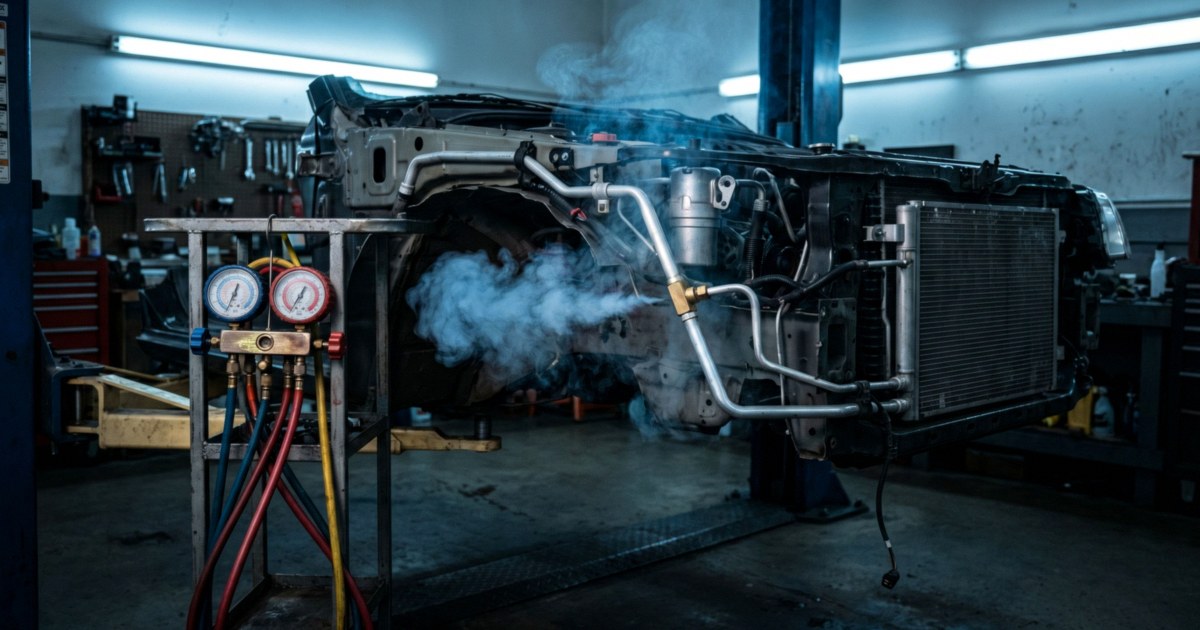
The International Journal of Refrigeration published a 2024 CFD study that simulated what happens when R-1234yf (A2L) or R-290 (A3) leaks inside an automotive AC passenger compartment. Linlin Wang, Yu He, Jiabao Ren, Dan Wang, Baomin Dai, and Zhe Zhang modeled evaporator-outlet leaks and mapped concentration over time in three dimensions.
Here is the result that matters, and it runs against a lot of the casual framing you see about A2Ls: in the tested scenarios, R-1234yf concentrations stayed below its lower flammability limit of 6.2% in the passenger compartment. R-290, by contrast, exceeded its 2.1% LFL at every monitoring point.
So the short version for technicians: in this specific leak geometry, the A2L did not form a flammable zone, and the A3 did.
What the paper simulated
The leak point in every case sat on the surface of the evaporator outlet inside the AC box, aligned with the HVAC supply direction. That is a realistic location for a real-world failure, but it is one location. The study did not sweep across every possible leak site in the compartment, which is a point worth remembering if you see the paper cited as a general "A2L cars are safe" conclusion. It isn't. It's a careful simulation of one failure mode.
Wang and colleagues varied charge size and ventilation conditions and tracked the concentration field until it dispersed. For R-1234yf, peak concentration in the passenger zone stayed under 6.2% across the tested cases. For R-290, peak concentration cleared 2.1% across the monitoring grid, meaning any spark or hot surface in the compartment during that window sat inside a flammable envelope.
The practical physics line up with what training instructors already say. R-1234yf is A2L: mildly flammable, with a relatively high LFL and low burn velocity. R-290 is A3: fully flammable, with an LFL roughly a third as high and a much more aggressive combustion profile. The simulation puts numbers on what the safety classifications imply.


What this means for residential and commercial techs
Most of the U.S. residential HVAC transition is to A2L refrigerants: R-454B and R-32. R-290 is showing up in commercial reach-in coolers, some heat pumps at small charges, and a growing slice of European residential equipment. The Wang paper is automotive, but the A2L-vs-A3 contrast is directly relevant to the service procedures diverging between the two classes.
For A2L work: the study is a data point supporting the procedures you already know. A2L-rated electronic leak detectors, no brazing on charged lines, no open flame in the work area, and active ventilation before any hot work. The CFD result that R-1234yf stayed sub-LFL in the tested passenger compartment is reassuring but not a license to skip any step.
For A3 work: treat the enclosure as the primary variable. Wang and colleagues' finding that R-290 exceeded its LFL throughout the cabin confirms that small, semi-sealed spaces are the worst case for A3. A service tech working on a reach-in cooler in a walk-in pantry or a packaged heat pump in a utility closet has the most dangerous version of the problem this paper modeled.
For A3 service in any small enclosure, open the space and force airflow well before introducing any ignition source. The Wang 2024 CFD work shows R-290 building flammable concentrations across the full compartment at normal charge sizes. That's not a warning you can ventilate away after the fact.
The limits of the study, and where we're extrapolating
The paper focused on evaporator-outlet leaks in an automotive cabin. It did not systematically vary leak hole location across the compartment, so claims along the lines of "leak location matters more than leak rate" go beyond what these authors published. Other CFD work has made that point; this one didn't.
Our extrapolation, not the paper's: residential mini-split indoor heads, packaged units in utility closets, and small commercial refrigeration cabinets behave more like automotive passenger compartments than like open ducted central AC plenums. The Wang numbers don't transfer directly (charge sizes, enclosure geometries, and supply airflows all differ), but the pattern does. A2L behavior in a small enclosure is closer to "stays under LFL with normal ventilation" than to "unmanageable." A3 behavior in the same enclosure is closer to "flammable envelope, full stop." California's mix of R-454B residential rollout and R-290 light commercial will put both classes on the same service truck inside five years.
If your shop hasn't done a manufacturer A2L training yet, it's time. Daikin, Carrier, and Mitsubishi all run sessions, and most of them now cover A3 procedures as a separate module rather than a footnote.
For more on the transition, see our EPA refrigerant transition update and our R-410A deadline coverage.
Source
Wang, Linlin, Yu He, Jiabao Ren, Dan Wang, Baomin Dai, and Zhe Zhang (2024). "Simulation of diffusion of combustible refrigerants R1234yf and R290 leakage in automotive air conditioning." International Journal of Refrigeration. https://www.sciencedirect.com/science/article/abs/pii/S0140700724003232
Need a repair professional?
Get free quotes from verified technicians in your area.
Find a Pro Near You