


Near-Isothermal Desiccant Exchangers With MOFs Cut Dehumidification Energy 65-85%

Terry Okafor
Master refrigeration tech and NATE-certified instructor.
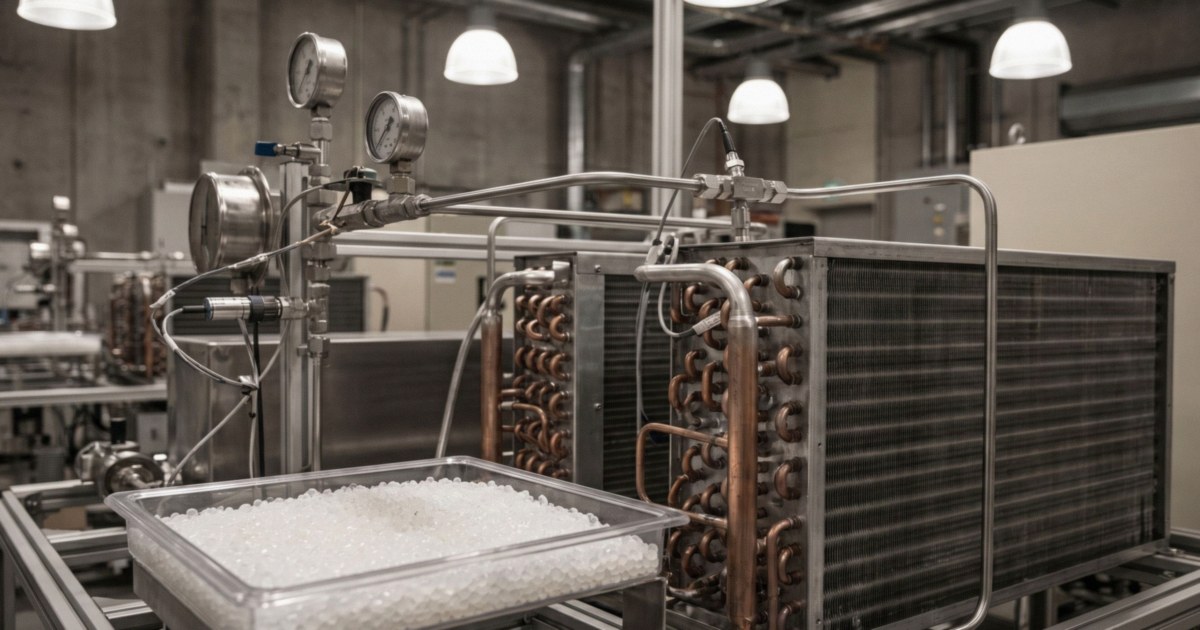
A Journal of Building Engineering paper by Socci and colleagues, published in 2025, ran a head-to-head between conventional cooling-coil dehumidification and a near-isothermal desiccant-coated heat exchanger across varied outdoor conditions. The winners, by 65 to 85% in energy terms at a sensible/latent ratio of 0.5, were the desiccant systems using metal-organic framework (MOF) coatings.
The specific MOF tested was MIL-100(Fe). Silica gel and zeolite showed improvements too, just smaller ones.
For contractors working California's coastal strip or anywhere humidity is the problem that the cooling coil can't handle efficiently, this is worth tracking. The physics is clean. A cooling coil pulls water out of the air by cooling it below dew point, which wastes energy on sensible overshoot. A near-isothermal desiccant exchanger pulls water directly and rejects the heat of adsorption to a separate loop, so it doesn't have to chase the same cold-plate temperature.
Where this technology actually shows up
Coastal retrofits are the first candidate. Light commercial buildings in Long Beach, San Diego, and along the Central Coast routinely see latent-heavy load profiles where a conventional system runs overcooled air just to hit the dehumidification target. That's wasted energy, and customers with high-humidity complaints know it.
Data centers are another obvious target. Humidity control in a data center is tight, and a 65 to 85% energy cut on the dehumidification side adds up fast across 8,760 hours a year.
Humid-climate residential retrofits in the Southeast have also been kicking tires on desiccant systems for years, but the combination of MOF performance and near-isothermal operation could be what finally makes the economics work at residential scale.
Keep an ear out for product announcements from manufacturers with MOF research programs. A few specialty dehumidifier builders have hinted at MOF-coated desiccant wheels at recent trade shows, and early adopters will have a story to tell customers that competitors can't match.


Realistic timeline
MOF production costs have been falling, but these materials are still more expensive than silica gel. Most of the 2025 commercial product announcements still use silica gel or zeolite desiccant wheels. MOF-based equipment for HVAC is largely in pilot phase.
That said, the performance delta from the Socci study is big enough that it's going to pull product development. Expect early commercial units in the data center and specialty dehumidification markets within a few years, followed by a slower walk into light commercial.
The near-isothermal design approach is the other half of the story. Even non-MOF desiccants show improvements when the exchanger architecture keeps the adsorbent closer to isothermal operation. That's a hardware design choice worth asking about the next time a manufacturer pitches a new dehumidification product.
For related coverage, see our piece on EPA refrigerant transition and DOE efficiency standards for 2027.
Source
Socci, L., et al. (2025). "Desiccant thermally controlled dehumidification in HVAC systems: Energy and exergy analysis, evaluation of different materials." Journal of Building Engineering. https://www.sciencedirect.com/science/article/pii/S2352710225000403
Need a repair professional?
Get free quotes from verified technicians in your area.
Find a Pro Near You