
IoT Sensors and Machine Learning Could Extend Appliance Life and Reshape Repair Shop Economics
Terry Okafor
Master refrigeration tech and NATE-certified instructor.
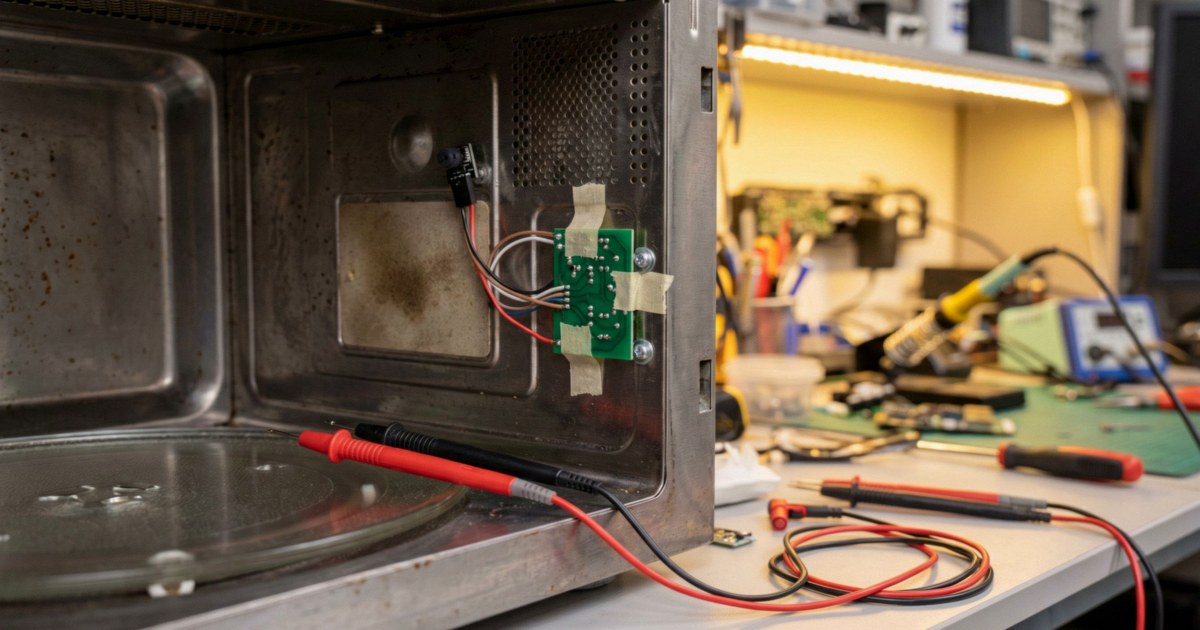
Stick a cheap sensor inside a microwave, feed the data into a Random Forest model, and you can predict with reasonable accuracy what an appliance is still worth and whether the unit should be reused, repaired, remanufactured, or sent down a cascade path. That's the upshot of a 2024 Heliyon paper that builds a working IoT-and-machine-learning prototype for residual-value prediction and circular-economy disposition.
The research isn't really about microwaves specifically — the microwave is a test bed. Researchers embedded IoT telemetry into the unit, trained Random Forest, Gradient Boosting, and Decision Tree models on operational data, and used them to predict residual value and sort each appliance toward one of four end-of-life pathways: reuse, repair, remanufacturing, and cascade. Of the three models, Random Forest delivered the best accuracy.
That is where the paper stops. It is a technical lifecycle-assessment and prediction study; it does not propose a repair-shop business model, an OEM-shop revenue-share arrangement, or a policy call for manufacturers to standardize telemetry. The business implications below are our own analysis, drawn from the paper's technical findings rather than stated by its authors.
What the Data Could Unlock
Here is the practical line we read into the methodology: predictive telemetry could turn a one-time repair into a recurring service relationship. If a sensor in a five-year-old dishwasher signals that the drain pump is showing anomalous current draw, an OEM platform could route a work order to the nearest authorized shop before the customer calls. The shop arrives with the right part already on the truck. The customer avoids three days of annoyance. The manufacturer avoids a warranty claim routed through a call center.
This direction isn't hypothetical industry-wide — several major appliance makers have publicly explored connected-appliance diagnostics and predictive-service features in recent years. We're not aware of a vendor-confirmed pilot tied to this specific academic model, so treat the link between the research and any particular OEM program as our framing, not a claim from the paper.


What a Repair Shop Should Notice
Three things stand out, again as our read rather than the paper's recommendations.
First, the prediction models aren't proprietary sorcery. Random Forest and Gradient Boosting are commodity algorithms running in libraries like scikit-learn. Any OEM that wanted to deploy this would have no moat on the modeling side — the moat is the sensor data. So shops that build strong OEM service relationships now could become the endpoint for that data pipeline, a defensible position.
Second, the framework explicitly categorizes outcomes into reuse, repair, remanufacturing, and cascade. A shop willing to handle more of those pathways captures more of the flow. A shop that only fixes in-warranty units misses the remanufacturing and reuse traffic, which is often where the margin hides.
Third, the economics change for stocking. Predictive telemetry lets a shop see failures coming a week or two out, which flips parts inventory from reactive to scheduled. That's a real working-capital improvement for owners running on thin margins.
A quick reality check: residential appliances are the hardest sell for embedded IoT because cost pressure is brutal. Commercial kitchen and light commercial equipment are where pilots are likelier to land first. Light commercial HVAC, reach-in refrigeration, commissary ovens — these units already ship with controllers that could host a sensor stack with a firmware push.
For this to scale to third-party shops, manufacturers would need to standardize telemetry formats so independents can plug in. That standardization hasn't happened. When and if it does, the shops that built OEM relationships and invested in diagnostic software would be positioned for recurring revenue that today's break-fix shops can't touch. To be clear, that standardization scenario is our forecast — the paper makes no such call.
For related coverage, see our piece on AI predictive maintenance for appliance service and the smart appliance diagnostics story.
Source
Iqbal, A., Akhter, S., Mahmud, S., & Noyon, L. M. (2024). "Empowering the circular economy practices: Lifecycle assessment and machine learning-driven residual value prediction in IoT-enabled microwave oven." Heliyon, 10(19), e38609. https://doi.org/10.1016/j.heliyon.2024.e38609
Need a repair professional?
Get free quotes from verified technicians in your area.
Find a Pro Near You