


Five R-410A Replacements Go Head to Head: R-290 Takes Efficiency, R-454B Takes Emissions
Dale Resnick
A 30-year veteran of residential HVAC who's crawled through more attics than he can count. Dale writes the 'Duct Tape & Beyond' column and believes every compressor tells a story if you listen close enough.
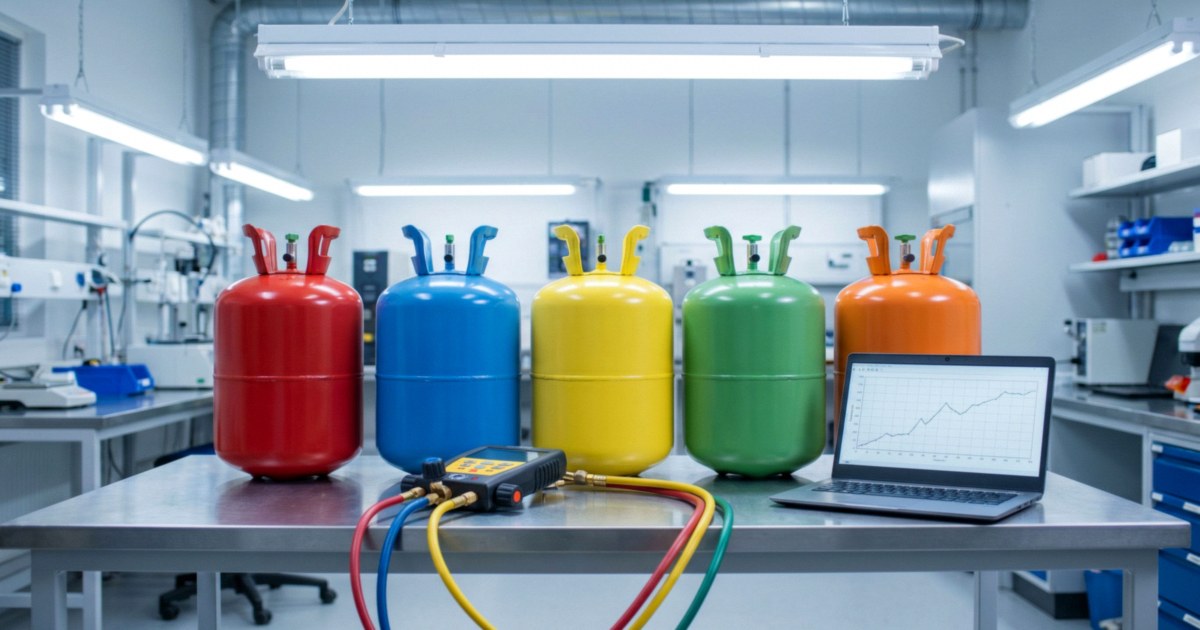
A 2025 study in Springer's International Journal of Air-Conditioning and Refrigeration did something useful for everyone arguing about the HFC phasedown: it ran five of R-410A's would-be successors through the same energy, exergy, and environmental analysis and published the scoreboard. The lineup was R-32, R-290, R-454B, R-454C, and R-513A. The lead author is Ali M. Ashour, heading a six-person team.
The thermodynamic winner was propane. R-290 hit a COP of 7.91 at the study's optimal operating point against 7.49 for R-410A, a 5.6% edge, and posted the highest exergy efficiency of the group at 0.52 with the lowest losses across components. Before anyone writes in: those are cycle-analysis figures at the paper's specific test conditions, not nameplate ratings you'll see on a condenser. The ranking is the point, and the ranking is real.
R-454C brought up the rear. Its COP landed at 5.80, well below the field, and its exergy efficiency bottomed out at 0.40.
Then the environmental analysis flipped the podium. On Total Equivalent Warming Impact, which counts both refrigerant leakage and the emissions from the electricity the system burns, R-454B came out cleanest at 13.3 metric tons CO2e, about 16% under R-410A. R-290 landed at 14.8 tons. And R-454C finished dead last at 18.4 tons despite carrying the lowest GWP of any blend in the test.
Sit with that last one for a second.
A refrigerant with a GWP around 148 produced the worst lifetime climate result of the group, because its efficiency penalty means more power-plant emissions over every year of operation. The number printed on the cylinder isn't the whole climate story. TEWI counts the meter.
What the Scoreboard Means for Your Truck
The OEMs already placed their bets, and this paper mostly validates them. Carrier and Trane went R-454B for residential equipment; Daikin and Goodman went R-32. Both choices look defensible here: R-454B takes the emissions crown outright, and R-32 ran roughly even with R-410A on efficiency while cutting GWP by about two thirds. The R-454B result lines up with field-side findings too, like the data center retrofit where R-454B delivered higher EER than the R-410A baseline.
R-290's win comes with the asterisk techs already know. It's an A3, and charge limits keep it out of US ducted splits. You'll meet it in window units, portable ACs, and European monobloc heat pumps, where the charge stays small and stays outside. R-513A, the lone A1 in the lineup, ran mid-pack on everything, which is roughly the deal you accept for nonflammability.
None of this changes which cylinder ends up on your truck. The OEMs decide that. What it changes is how you explain the transition to a customer staring at a quote, and how you read the regulatory fight; the EPA's HFC phasedown timeline has its own drama this year. If you're still getting your shop squared away on A2L handling, tools, and recovery practice, our R-410A phasedown guide for technicians covers the checklist.
My read after 30 years of refrigerant transitions, R-22 included: this one's going fine. The replacements work. Two of them beat the incumbent on the metrics that matter, and the worst performer in the study isn't in any major US residential line anyway. The phasedown argument is political. The engineering argument, per this paper, is settled.
Source
Ashour, A.M., Ali, H.M., Kadhim, S.A., Hammoodi, K.A., Rashid, F.L., Sathyamurthy, R. (2025). "Energy, exergy, and environmental analysis of five low-GWP refrigerants considered as alternatives to R410A for air conditioning systems." International Journal of Air-Conditioning and Refrigeration, 33(18). https://link.springer.com/article/10.1007/s44189-025-00087-x
Need a repair professional?
Get free quotes from verified technicians in your area.
Find a Pro Near You