


Advanced Multimeter Techniques for HVAC and Appliance Diagnostics

Terry Okafor
Master refrigeration tech and NATE-certified instructor who moonlights as the magazine's advice columnist. His 'Ask Big Terry' mailbag has been settling shop disputes and diagnosing mystery leaks since 2011.
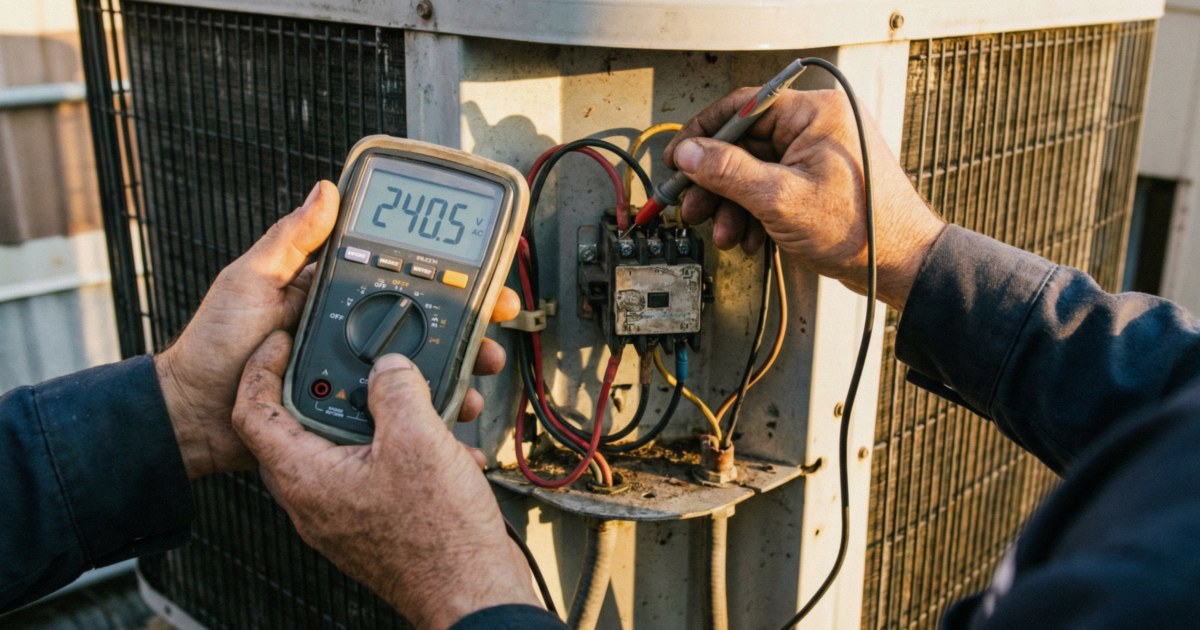
Voltage, resistance, continuity. Most appliance and HVAC techs spend their entire career using a multimeter in these three modes. Meanwhile, the meter clipped to their belt has six more functions that would solve problems faster, more accurately, and without the guesswork that leads to unnecessary parts swaps.
This guide covers the meter functions that separate diagnostic techs from parts-swappers: capacitance (microfarads), AC amp clamp, temperature probes for superheat and subcooling, and millivolt measurement for thermocouples and flame sensors. Each section includes real-world diagnostic scenarios from field work.
The relevant diagnostic context for HVAC systems is in our AC not cooling troubleshooting guide, which covers system-level diagnosis this guide augments.
The Right Meter for Advanced Diagnostics
You cannot do all of this with a $30 multimeter. The functions covered here require:
- Capacitance measurement — Most meters $60+ include this. Look for ranges of 10 nF to 100 µF minimum.
- AC amp clamp capability — Either built into the meter (Fluke 376, Klein CL800) or a separate clamp probe that connects to the meter's input jacks.
- Temperature probes (K-type thermocouple) — Most mid-tier meters accept K-type thermocouple probes. The Fluke 87V with a Type-K probe is the standard in this industry.
- Millivolt range — Any true-RMS meter in the $60+ range has this. You need true-RMS for accurate readings on non-sinusoidal signals.
My current field setup: Fluke 117 as the daily driver and a Fluke 376 amp clamp when I'm doing HVAC work. The 376 does both current and power factor. If you're buying one meter for everything, the Fluke 87V with a K-type probe accessory gets you 90% of what's covered here.
Capacitor Microfarad Testing
Run capacitors are the single most common failure on residential central AC systems and heat pumps. A $15-30 part causes an enormous number of no-cooling calls every summer. But here's what most techs don't know: a capacitor can fail partially — still holding a charge, still showing some capacitance — while being sufficiently degraded to cause intermittent starting failures, slow fan operation, and compressor hard-starts.
The only way to catch partial capacitor failure is to measure the actual microfarad value and compare it to the rated value on the label.
How to Test a Run Capacitor (MFD Test)
Safety first: Capacitors store energy. A 40 µF capacitor at 440V holds enough charge to cause a serious injury. Before you touch terminals, you must discharge the capacitor.
Safe discharge method: Using insulated leads, connect a 20,000 ohm / 5-watt resistor across the capacitor terminals for 10-15 seconds. Do not use a screwdriver to short the terminals — that destroys the capacitor and can damage nearby components. Most techs carry a discharge resistor in their tool kit for exactly this.
Test procedure:
- Disconnect the capacitor from the circuit entirely.
- Set the meter to capacitance mode (CAP or the capacitor symbol).
- Connect the meter leads to the capacitor terminals.
- Read the value. Wait 5-10 seconds for the reading to stabilize.
- Compare to the rated value printed on the capacitor label.
Tolerance: The standard is ±6% for most HVAC run capacitors. More than 10% below the rated value = replace. I personally replace at 8% because the labor cost of a callback exceeds the cost of a slightly borderline capacitor.
Dual-run capacitors (most common in residential AC): These have three terminals — C (common), HERM (compressor), and FAN. Test C-to-HERM for the compressor rating and C-to-FAN for the fan rating. Both values are printed on the label (e.g., "35+5 MFD" means 35 for the compressor and 5 for the fan).
If you measure a dual-run capacitor and the FAN value is low but the HERM value is normal, you have a partially failed capacitor. The fan motor runs slowly, which the customer describes as "AC runs but doesn't seem to cool as well as it used to." The compressor is fine. The unit is running short on airflow. Replace the capacitor. I catch one of these per week in summer.
Amp Clamp Diagnostics for Motors
An amp clamp (current clamp) measures AC current without breaking the circuit. You clamp the jaws around a single conductor, and the meter reads the magnetic field generated by current flow. This gives you real-time current draw on any motor — compressor, condenser fan, evaporator fan, wash pump, drain pump, blower motor.
Reading Motor Current: What the Numbers Mean
Every motor has a Full Load Amperage (FLA) rating on its nameplate. This is the maximum current the motor should draw under rated load conditions. Compare your measured value to the nameplate:
- At or below FLA: Motor is running normally under its present load.
- 10-20% above FLA: Motor is working harder than rated — possible mechanical binding, dirty blower wheel, undersized motor, or starting capacitor issue.
- More than 20% above FLA: Overloaded motor. High risk of thermal cutout or winding failure. Find the mechanical cause before the motor burns out.
- Significantly below FLA on a loaded motor: An open winding is common. The motor is running on reduced windings and is underpowered. May also indicate a capacitor not providing correct phase shift.
- Zero or near-zero amps on a motor that should be running: Motor not energized — check the control circuit, not the motor itself.
Real Diagnostic Scenario: Condenser Fan "Not Spinning"
Customer complaint: "AC doesn't cool. The outdoor unit is running but the fan looks like it's barely turning."
Without an amp clamp: You'd visually observe the slow fan, test the capacitor (finds it partially bad at 15% low), replace the capacitor. Fan spins up. Done? Maybe.
With an amp clamp: After replacing the capacitor, clamp around the fan motor lead. FLA on the nameplate says 1.2A. You're reading 1.6A — 33% over FLA. That's not a capacitor-only issue. The motor bearings are worn and it's dragging. Replace the motor too, or come back in 6 weeks when it seizes completely.
This is the difference between a one-trip repair and a callback.
Compressor Amperage Diagnostics
Compressors are the most expensive component in an HVAC system. Before you condemn one, measure its current draw:
Startup current (LRA — Locked Rotor Amperage): Compressors draw 4-8x FLA at startup for a fraction of a second. Your meter's peak-hold function captures this. Compare to the LRA value on the nameplate. High LRA on startup is normal; if the unit trips a breaker every time, add a hard-start kit (a capacitor/relay assembly that gives the compressor a boost at startup).
Running amperage: Should be at or below the RLA (Rated Load Amperage) on the nameplate under normal operating conditions. Compressors running above RLA when properly charged and with a clean coil may have an internal mechanical problem.


Temperature Probes: Superheat and Subcooling
A Type-K thermocouple probe attached to your multimeter gives you temperature measurement capability that integrates with your gauge readings to calculate superheat and subcooling. This is fundamental refrigeration system analysis, and it's faster and more accurate than a dedicated thermometer in many field situations.
Superheat Measurement
Superheat is the temperature of refrigerant vapor above its saturation point at the current suction pressure. It's measured at the suction line at the outdoor unit.
How to measure:
- Connect manifold gauges and read suction pressure.
- Convert suction pressure to saturation temperature using a P-T chart (or a refrigerant PT app on your phone).
- Use the temperature probe on your meter to measure the actual line temperature at the suction service port or as close to the outdoor unit as possible.
- Superheat = Actual line temperature − Saturation temperature at suction pressure.
Target values (TXV systems): 8-14°F superheat is normal for most TXV-equipped systems. Target values (fixed orifice/piston systems): Use the manufacturer's charging chart, which accounts for indoor wet-bulb and outdoor dry-bulb temperature. Typically 10-18°F.
High superheat = system undercharged or restriction. Low superheat (below 5°F) = system overcharged or TXV stuck open. Risk of liquid slugging the compressor.
Subcooling Measurement
Subcooling is the temperature of refrigerant liquid below its saturation point at the current high-side pressure. Measured at the liquid line.
How to measure:
- Read high-side pressure from manifold gauges.
- Convert to saturation temperature using P-T chart.
- Measure actual liquid line temperature with the temp probe.
- Subcooling = Saturation temperature at high-side pressure − Actual liquid line temperature.
Target values: Most systems target 10-15°F subcooling.
High subcooling = overcharged (on TXV systems), or liquid line restriction. Low or zero subcooling = undercharged, or flash gas at the TXV inlet.
The combination of superheat AND subcooling tells you more than either measurement alone. High superheat + low subcooling = undercharged. High superheat + high subcooling = liquid line restriction. Low superheat + high subcooling = overcharged. Low superheat + low subcooling = system iced over or severe airflow problem. This two-measurement approach narrows the diagnosis to one quadrant before you open a refrigerant cylinder.
Millivolt Measurement: Thermocouples and Flame Sensors
Thermocouples and flame rods generate very small electrical signals. Your meter's millivolt range measures these directly.
Thermocouple Testing (Standing Pilot Systems)
Thermocouples are found on standing pilot furnaces, water heaters, gas dryers with pilot ignition, and older gas ranges. A thermocouple is a bi-metallic probe: two different metals welded at the tip. When the pilot heats the tip, a thermoelectric voltage is generated. This millivoltage holds the gas valve's safety solenoid open.
Normal thermocouple output: 17-35 mV DC. Below 17 mV is the generally accepted cutoff — the gas valve's solenoid requires at least 15-17 mV to remain energized. A borderline thermocouple may hold the valve open when the furnace is warm but fail on a cold start.
Test procedure:
- Disconnect the thermocouple from the gas valve terminal.
- Set meter to DC millivolts (mVDC).
- Connect the positive probe to the thermocouple's tip lead, negative to the body.
- Light the pilot and hold the reset button for 30-45 seconds.
- Read the millivolt output after the probe has heated for 45-60 seconds.
- Values below 17 mV = replace the thermocouple. Values 25-35 mV are normal.
A new thermocouple is a $8-20 part. Always test before replacing — a cold or weakly lit pilot produces a low reading that mimics a bad thermocouple. Make sure the pilot is fully engulfing the thermocouple tip before you condemn the part.
Flame Sensor Testing (Hot Surface Ignition Systems)
Modern furnaces, boilers, and some dryers use a flame rod (flame sensor) instead of a thermocouple. The flame sensor is a metal rod that sits in the burner flame. When flame is present, the rod becomes conductive due to ionization — this is how the control board detects a lit flame.
The common failure mode is a carbon-coated or oxidized rod that doesn't conduct the flame ionization signal properly. The board doesn't "see" the flame and shuts down the gas valve as a safety measure.
Millivolt test for flame sensor integrity: Set your meter to AC microvolts (µVAC) if available, or the lowest AC voltage range. In flame-on condition, connect one probe to the flame sensor rod terminal and the other to chassis ground. You should read 2-8 microamps of rectified AC (some meters display this as microvolts on the AC range — use current mode if your meter supports it via the µA input).
More practically: disconnect the flame sensor, clean the rod with fine steel wool or emery cloth, reconnect, and observe whether the fault clears. If the furnace now lights and holds the flame, the sensor was fouled. If it still fails after cleaning, test the rod for continuity to ground (should be open) and replace if shorted.
Putting It Together: Five Field Scenarios
Scenario 1: AC unit fan runs slowly, customer says "doesn't cool like it used to." Amp clamp on fan motor shows 1.8A vs. 1.2A FLA. Capacitance test shows 3.8 µF vs. rated 5 µF (24% low). Replace capacitor, recheck — motor now draws 1.4A, still above FLA. Motor bearing dragging. Replace motor on same visit. One trip.
Scenario 2: Furnace runs, pilot lights, but main burner shuts off after 3 seconds. Millivolt test on thermocouple: 14 mV. Below 17 mV cutoff. Replace thermocouple, $12 part. Done.
Scenario 3: Heat pump not heating. Suction pressure 75 PSI, saturation temperature 28°F. Suction line temp probe reads 55°F. Superheat = 27°F. System severely undercharged. Find and fix leak before adding refrigerant.
Scenario 4: Compressor won't start, fan runs fine. Amp clamp at startup captures 0.3A — far below the 48A LRA on the nameplate. Compressor not actually starting, barely drawing current. Add hard-start kit. LRA jumps to 45A, compressor starts. Soft compressor that couldn't overcome starting torque.
Scenario 5: Mini-split outdoor unit fan not running. Capacitor tests at 8.1 µF vs. rated 8 µF — fine. Amp clamp on fan motor: 0 amps. Motor not getting power. Check control board output. Find burned contact on board relay. Replace board. Motor starts; clamp now shows 0.9A vs. FLA 0.8A — borderline high but acceptable.
These five scenarios all required non-standard meter functions. All of them were solved in one visit.
Can a multimeter test capacitor microfarads?▾
Yes, if your meter has a capacitance function (labeled CAP or with the capacitor symbol). Discharge the capacitor completely before connecting the meter — a charged capacitor stores dangerous energy. Compare the measured value to the rated microfarad on the label. Anything more than 10% below the rated value means the capacitor is degraded and should be replaced. Partial capacitor failure causes intermittent symptoms that won't appear during a simple voltage test.
How do you use an amp clamp to diagnose a motor?▾
Clamp the meter around a single current-carrying wire to the motor (not both wires in the same clamp — they cancel each other out). Compare measured amperage to the FLA (Full Load Amperage) on the motor nameplate. Running significantly above FLA indicates mechanical binding, a failing bearing, or a failing winding. Running significantly below FLA on a motor under load often indicates an open winding or a capacitor not providing correct phase shift for starting.
What is a thermocouple millivolt test and when do you need it?▾
A thermocouple generates a small millivoltage (typically 25-35 mV) when heated by a pilot flame. This voltage holds the gas valve's safety solenoid open. A multimeter in DC millivolt mode connected to the thermocouple output measures this directly. Under 17 mV is the service threshold — the valve solenoid won't hold reliably below this value. This test applies to standing pilot furnaces, water heaters, gas dryers with standing pilots, and older gas ranges.
Need a repair professional?
Get free quotes from verified technicians in your area.
Find a Pro Near You