

If Your Truck Gets Broken Into Tonight, Which Policy Pays? Tools & Equipment Coverage for Contractors

Michael Senderovich
Michael Senderovich, MBA, is president of Six-Thirteen Business Insurance, a commercial brokerage that places coverage for contractors and tradespeople across California, Texas, the Carolinas, Missouri, Colorado, and Louisiana. He has spent more than a decade in commercial lines and holds an MBA from the University of Redlands.
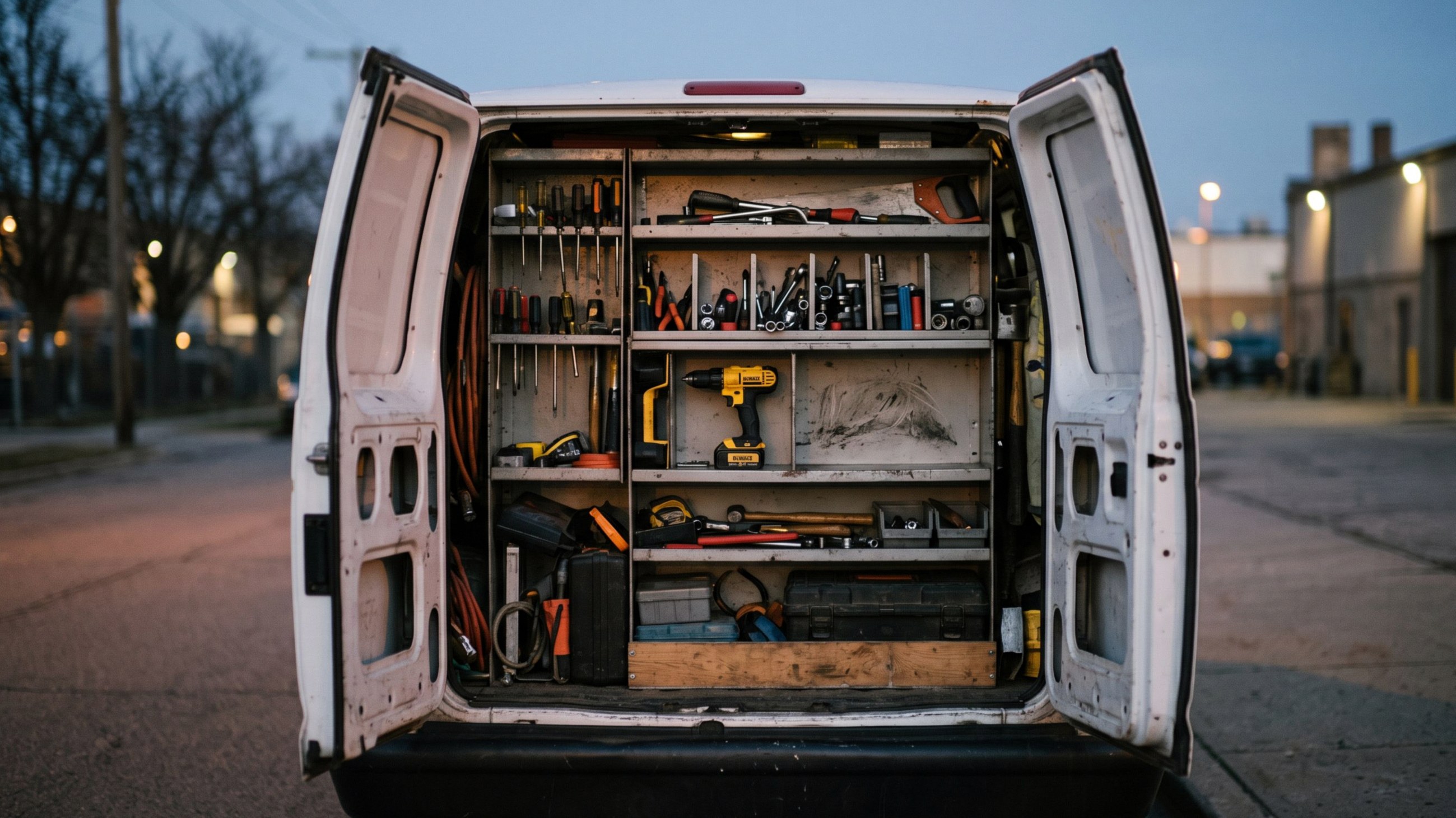
Picture the call you don't want. It's 6 a.m., you're headed to the first job, and the side door of the van is peeled open and the racks are empty. Recovery machine, gauges, drills, the good vacuum pump, gone. First thought after the anger: I have insurance, I'm covered. Then you find out which policy you were counting on, and it isn't the one you think.
Your general liability policy will not replace a single one of those tools. Here's why, and what actually does.
Why General Liability Doesn't Help Here
General liability is third-party coverage. It exists to pay when you injure someone or damage someone else's property, a customer trips over your cord, a torch scorches a wall, a leak you caused floods a downstairs unit. That's what GL is for, and it's essential.
But your tools are your property, not a third party's. GL doesn't cover your own stuff, and a stolen tool crib is your own stuff. So the policy you renew every year for the injury and damage exposure has nothing to say about the empty van. Different risk, different policy.
Inland Marine: The Policy That Follows Your Tools
The coverage that pays is inland marine, usually sold to trades as "contractor's tools and equipment" coverage. The name is a historical quirk (it goes back to insuring cargo that moved over land), but what it does is straightforward: it covers your owned tools and equipment against loss.
The important word is "mobile." Inland marine is built for property that moves, which is exactly how a service contractor works. It covers your tools:
- At the shop
- In transit between jobs
- On the job site
- Sitting in the van overnight
And it covers a real list of causes: theft, vandalism, accidental damage, transit and collision damage, and weather losses. The break-in scenario, the tool that gets dropped off a roof, the gear that rides in a truck that gets rear-ended, the equipment a storm ruins on an open site. That's the coverage's home turf.
Keep a running inventory with make, model, serial number, and a photo of every tool over a couple hundred dollars. When you file an inland marine claim, that list is the difference between a fast payout and an argument. Update it every time you buy something worth insuring.
What It Costs
This is the part that surprises contractors who assume the coverage is expensive. It isn't.
For a small shop carrying under about $10,000 in scheduled tools, inland marine coverage often starts around $15 a month. As a general rule, pricing commonly runs about 1 to 3 percent of the insured equipment value per year. Insure $10,000 of gear and you're often looking at somewhere in the low hundreds annually, depending on your deductible, your location, and your claims history.
Those figures are typical ranges, not a quote. Actual pricing depends on your limits, deductible, and loss history, and a shop with a theft claim on record will pay more than one without.
The deductible is a lever worth thinking about. A higher deductible drops the premium, which is fine if you'd never bother filing a claim for a $200 drill anyway. But set it too high and the coverage stops responding to the losses you actually have, which tend to be a handful of tools at a time, not the whole van. Pick a deductible that's above your nuisance losses and below your real ones. For a lot of small shops that's a couple hundred dollars, not a couple thousand.
One more piece to raise with your broker: replacement cost versus actual cash value. A policy that pays actual cash value depreciates your five-year-old recovery machine before it pays you, so you get a used-tool check toward a new-tool purchase. Replacement cost coverage pays what it takes to buy the equivalent new. It costs a little more and it's usually worth it, because the whole point of the coverage is getting you back to work, not settling for the depreciated value of gear you still needed.


Scheduled vs. Blanket: How to Structure It
There are two ways to insure tools, and most shops use a mix of both.
Scheduled coverage lists items individually, each with its own stated value. You'd schedule the higher-value gear, the recovery machine, the good gauges, the leak detector, the expensive cordless kit, because if one of those walks, you want it insured at a value you set, not argued over.
Blanket coverage insures a category of smaller items under one limit without naming each piece. Your hand tools, your everyday drivers and wrenches and meters, are a natural fit. Nobody wants to schedule a hundred hand tools, and you don't have to.
The practical setup for a working contractor is usually both: schedule the expensive equipment, blanket the rest under a single limit that reflects what a full kit is worth to replace. Talk through the split with your broker so the blanket limit is high enough to actually rebuild your kit, not just cover half of it.
The most common mistake here is underinsuring the blanket. A tech looks at the shelf, thinks "a few thousand dollars of hand tools," and sets the limit there. Then the van gets emptied and the real replacement bill, at today's prices, for a full working kit of meters, drivers, cordless gear, hoses, and gauges, comes in at two or three times the number. Price the kit the way you'd price it if you had to walk into the supply house tomorrow and rebuild it from nothing. That's the limit that gets you back on the road.
If you rent or borrow equipment, ask specifically how it's handled. A recovery machine you rented for a big commercial job, or a tool borrowed from another shop, may not sit inside a policy written for your owned equipment. Some inland marine policies extend to rented or leased tools, some don't, and some make it an add-on. Don't assume. The time to find out is when you pick up the rental, not when it's damaged.
One more piece of housekeeping. Track what's in your kit the way you track parts, because both are inventory that costs you money when it goes missing. Our guide on managing parts inventory in a repair shop covers the same discipline on the parts side. And since tools coverage rides alongside your liability program, our HVAC general liability cost guide shows where each policy fits in the total picture.
So, which policy pays when the van gets hit tonight? Not general liability. Inland marine. If you don't carry it, that's the gap to close before the next early-morning phone call.
Sources
- Insureon. "Contractor's Tools and Equipment Insurance." insureon.com
- Procore. "Inland Marine Insurance." procore.com