


Managing Parts Inventory for an Appliance Repair Shop: What to Stock, What to Order
Maria Solano
Former appliance warranty claims adjuster turned investigative repair journalist. Maria's 'What Went Wrong' teardown series has made her the most feared woman in the white-goods industry.
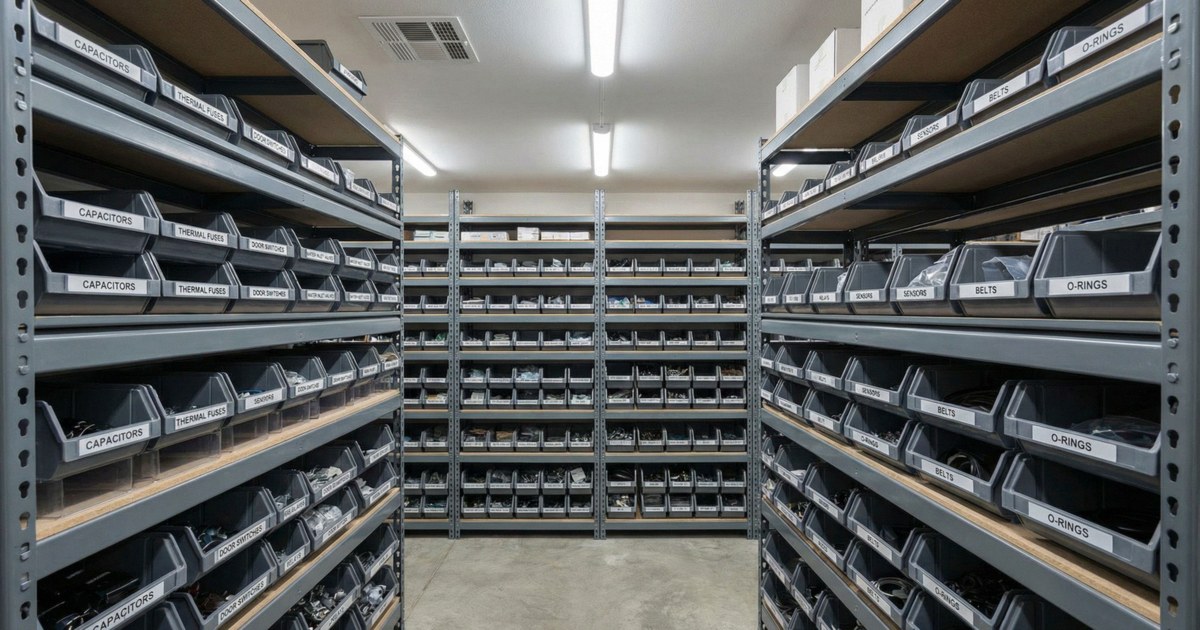
The two-trip job is the profit killer that no one talks about in the context of growing a repair business. You drive to the call, diagnose correctly, order the part, drive back to install it. The customer waits. Your schedule compresses. The trip that should have billed at a normal labor rate now costs you two service call windows.
The solution isn't to stock everything — that ties up cash and creates its own management problem. The solution is to understand which parts cover the most failure modes across the most common brands, and to stock those. Everything else, you order strategically.
The 80/20 Rule for Parts Inventory
In a typical appliance repair shop serving a mixed market of brands and appliance categories, roughly 20% of parts cover about 80% of service calls. The other 80% of parts — the model-specific, low-failure-rate items — get ordered per job.
The discipline is in correctly identifying your 20%. It varies by market. A shop in a neighborhood full of Samsung and LG appliances has a different core list than a shop that works heavy Whirlpool territory. But there's a foundation of parts that applies universally.
The 20 Parts That Cover 80% of Calls
This is the truck stock list for a general appliance repair shop in Southern California. These parts cover the most common failures on the brands with the highest call volume:
Dryer parts (most common single-category call):
- Whirlpool thermal fuse 3392519 — covers Whirlpool, Kenmore, Maytag, Amana, Roper. Stock 3-4.
- Samsung thermal fuse DC47-00016A — covers most DV series. Stock 2.
- LG thermal fuse 6931EL3003D — covers DLE/DLEX series. Stock 2.
- Whirlpool heating element 3387747 — the most common electric dryer element in the field. Stock 1-2.
- Whirlpool gas valve coil kit 279834 — two-coil kit covering the vast majority of gas Whirlpool/Kenmore/Maytag dryers. Stock 2-3 kits. $12 each.
- Dryer thermostat/fuse kit 279816+3392519 — cycling thermostat, high-limit, and thermal fuse. Kit covers most callbacks.
Washer parts: 7. Whirlpool door lid switch 3949238 (top-load) — covers a huge swath of Whirlpool/Kenmore/Maytag top-loaders. Stock 2. 8. Washer drain pump filter (universal flat-style) — not model-specific but covers most front-load coin trap cleanings. 9. Washing machine inlet valve (generic 2-valve, 3/4" hose thread) — covers basic fill valve failures on most brands.
Refrigerator parts: 10. Refrigerator start relay — Whirlpool WPW10416065 (covers most Whirlpool/Maytag top-mount), Samsung 6750C-0004P, LG EAU61843003. Stock one each. These are the #1 reason a compressor "won't run" on a call-out. $8-20 each. 11. Refrigerator overload protector (generic PTC-style, size-matched to compressor) — pairs with the start relay. Stock 2-3. 12. Defrost thermostat (generic L-55 bimetal, clip-type) — covers a wide range of Whirlpool/GE/Amana defrost systems. 13. Condenser fan motor blade — keep a spare blade, not usually the motor. Fan blades crack and strip.
Dishwasher parts: 14. Dishwasher door latch assembly (Whirlpool WPW10107820) — covers most Whirlpool/Maytag/KitchenAid dishwashers. Door latch failures are far more common than people think. 15. Dishwasher check valve flapper (universal style) — covers drain check valve failures on many brands.
HVAC / general: 16. Capacitor — run capacitor assortment: 35/5 MFD, 45/5 MFD dual-run capacitors. These cover 80% of AC condenser "won't start" calls. $15-30 each. 17. Contactor (2-pole, 24V coil, 40A) — covers most residential central AC condensers. $15-25. 18. Furnace hot surface igniter (universal silicon nitride, mini plug-in style) — covers many Carrier/Lennox/Goodman if you keep the model-specific adapters.
Consumables / accessories: 19. Refrigerator door gasket adhesive / push-in clip kit — not a gasket (those are model-specific), but the mounting hardware that lets you reattach a gasket without replacement. 20. Assorted wire nuts, spade connectors, terminal crimps, electrical tape — you know why.
Buy thermal fuses and start relays in bulk if your account with your distributor allows it. The Whirlpool 3392519 thermal fuse costs $4-5 in a 10-pack from Marcone. You're putting one on almost every dryer call. Buying them five at a time from a retail parts store at $12 each is a margin killer.
Vendor Relationships: Marcone, Reliable Parts, and Local Distributors
Marcone Appliance Parts (marcone.com) is the largest appliance parts distributor in North America. Their catalog depth is exceptional — if it was ever made as a service part, Marcone probably has it. Their prices are competitive but not always the lowest. Their real value is in their inventory depth and the reliability of their sourcing. Account pricing (net 30) is available and standard for established shops. Southern California techs are mostly served by the Ontario and Commerce, CA distribution centers.
Reliable Parts (reliableparts.com) has strong western US and Canadian distribution. Their website is better than Marcone's for part lookups, and they sometimes have better pricing on Samsung and LG parts specifically. Worth having an account with both and checking prices on higher-cost parts.
Local independent distributors: Every major metro has at least one. In the LA area, Southern California Appliance Parts and similar independents can do same-day will-call pickup when you're between Marcone stock. The ability to grab a part same-day and complete a job in one trip has real dollar value — calculate it as a same-day surcharge you don't have to charge the customer.
Direct from manufacturer: Some brands — notably Bosch/Siemens through BSH's parts portal, and Sub-Zero/Wolf through their dealer network — are best sourced directly. The pricing is controlled and the part authenticity is guaranteed. Essential for warranty-adjacent work or premium appliance calls.
For a deeper dive on building supplier relationships beyond just parts purchasing, see our guide on building a parts supplier network in SoCal.


Core Charges and Return Policies
Understanding core charges before you order is basic hygiene. A core charge is a deposit you pay when ordering a reman (remanufactured) part — compressors, motors, control boards. You get the core charge back when you return the defective part.
The mistake new shops make: failing to track core returns and leaving money on the counter. A $75 core charge on a compressor that you forgot to return is just a $75 loss. Set up a system: core returns live in a labeled bin in the shop, and every Thursday you process returns.
Return policies to know:
- Marcone: 60-day return on most items, unopened. Electrical components (boards, motors) are returnable if unused. Opened electrical components: often no return. Know this before you open the bag.
- Reliable Parts: similar 60-day policy. Model-specific parts that you special-ordered for a canceled job are the ones that hurt — check their return policy on special orders before you order.
- OEM direct: most have a 30-day return window with restocking fees (10-15%). Special orders are generally final sale.
The practical implication: on high-cost parts (control boards, inverter boards) where your diagnosis might not be 100% certain, order from whoever has the best return policy for that category. It's worth a few dollars more per part.
Inventory Tracking Without Expensive Software
You don't need a $300/month inventory management system to run parts inventory for a small shop. A spreadsheet does the job.
What the spreadsheet needs:
- Part number
- Description
- Quantity on hand
- Reorder point (when to order — typically 1 unit)
- Reorder quantity (how many to order — typically 2 for high-velocity parts)
- Unit cost (your actual cost, not list)
- Primary vendor
The process: After each service call, update the spreadsheet before you leave the customer's driveway. One row, five seconds. Every Monday morning, filter for items at or below the reorder point and place the week's parts order.
The only failure mode for this system is skipping the update step. Build it into your call close-out routine: write the ticket, update the parts log, then drive away.
Google Sheets works well for this because you can access it from your phone in the field, and if you have employees or a second tech, they can see the same sheet. There is no software that is meaningfully better than a well-maintained spreadsheet for a one-to-three tech shop.
What to Order Per-Job (Never Stock)
Anything model-specific and infrequently needed should be ordered per call:
- Control boards (too expensive, too model-specific)
- Compressors (order only when confirmed failure, after repair vs. replace decision)
- Drum bearings and tub assemblies (model-specific, expensive)
- Door gaskets (every model is different)
- Inner and outer drum tubs
- Specific heating elements for less-common models
- Drain pumps (except for your highest-volume brand)
- Ice maker assemblies
The test: if a part costs more than $50 and you use it less than twice a month, order per job.
For how this fits into the broader picture of running a repair business — from first customers to scaling — see our guide to starting an appliance repair business in California.
What parts should every appliance repair tech stock on the truck?▾
The core list for Southern California: Whirlpool/Samsung/LG thermal fuses, Whirlpool 3387747 heating element, Whirlpool 279834 gas valve coils, refrigerator start relays (Whirlpool, Samsung, LG), washer lid switch 3949238, AC run capacitors (35/5 and 45/5 MFD), AC contactor (2-pole, 40A), furnace igniter, and dishwasher door latch hardware. These cover the majority of high-frequency calls across the most common brands.
Should I use Marcone or Reliable Parts?▾
Both. Have accounts with both and use each for its strengths. Marcone has better catalog depth; Reliable Parts sometimes has better pricing on Samsung and LG. Add a local distributor for same-day will-call. The ability to complete a job on the first trip has real financial value that exceeds small price differences between vendors.
How do I track parts inventory without expensive software?▾
A Google Sheets spreadsheet with part number, description, quantity on hand, reorder point, and primary vendor is sufficient for a one-to-three tech shop. Update it after every service call. Review it every Monday and place replenishment orders. Consistency is more important than the tool.
Need a repair professional?
Get free quotes from verified technicians in your area.
Find a Pro Near You