


Fleet Management for Appliance Repair Shops: Going From 1 to 5 Vans
Maria Solano
Former appliance warranty claims adjuster turned investigative repair journalist. Maria's 'What Went Wrong' teardown series has made her the most feared woman in the white-goods industry.
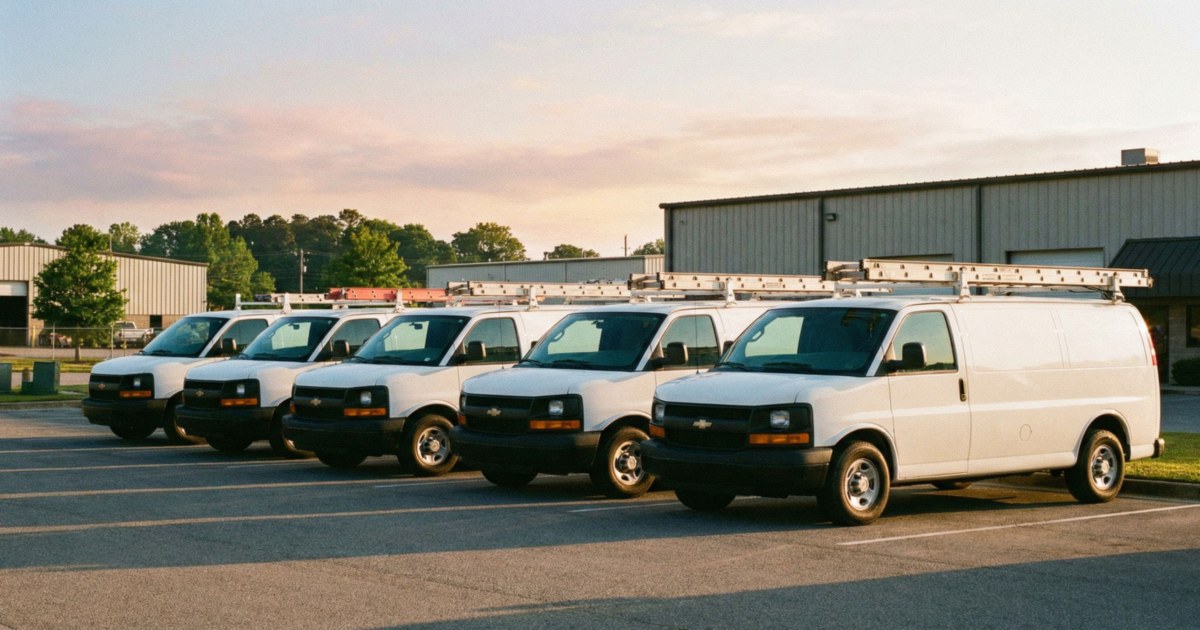
I've watched dozens of appliance repair shops attempt this transition. A handful do it smoothly. Most go through at least one painful year where they're paying for trucks and techs but the administrative infrastructure can't support the volume. The van is the easy part. The hard part is everything you have to build around it before you buy it.
This guide covers the full picture: vehicle selection, per-truck inventory, GPS and route optimization, fuel management, maintenance schedules, and insurance. Everything you need to make van number two (and three, and four) a profit center instead of a liability.
Before you buy that second van, read our guide to starting and scaling an appliance repair business in California for the revenue benchmarks that indicate you're ready.
Vehicle Selection: Transit vs. Sprinter vs. NV200
The three vans that dominate appliance repair in Southern California are the Ford Transit, Mercedes-Benz Sprinter, and Nissan NV200. They are not interchangeable, and the choice you make shapes your operating costs for the next 5-10 years.
Ford Transit 250 Medium Roof — The Workhorse
The Transit 250 medium-roof is the most practical appliance repair van on the market right now. Here's why it wins:
- Interior height of 74.5 inches — you can stand most refrigerators upright. Top-mount and French-door units up to about 70" tall. Slide them in the side or rear doors.
- Payload up to 2,560 lbs — enough for a full day of parts including washers and refrigerators being transported for shop repair.
- Repair network — Ford dealers are everywhere in California. Parts are cheap and available same-day. Sprinter parts can be 3-day waits.
- Purchase cost — a clean used Transit with 60-80K miles is $18,000-28,000. A comparable Sprinter is $25,000-40,000.
- Insurance cost — Transits are cheaper to insure. Sometimes significantly so.
The Transit's weaknesses: the 3.5L EcoBoost has timing chain issues around 120-150K miles if not maintained. Budget for a timing chain service around that mileage. The base engine (3.5L TiVCT naturally aspirated) avoids this but has less power for loaded highway driving.
Mercedes-Benz Sprinter 2500 — The Premium Option
If you're doing Sub-Zero, Wolf, Miele, and Thermador work — high-end appliances for high-end clients — a Sprinter sends a message that a Transit doesn't. The interior height (up to 79 inches on high-roof) is genuinely useful for very tall commercial refrigerators. Cargo capacity is comparable to the Transit.
The calculus changes with fleet size. One or two Sprinters at a premium shop? Justifiable. A five-van fleet of Sprinters? Maintenance costs and parts delays will eat you. The Sprinter runs on diesel (or more recently the 2.0L gasoline), and diesel service is an additional specialization your shop or your fleet maintenance vendor needs.
Cost premium over Transit: roughly $10,000-15,000 per van, new or used. Factor that into your per-job cost.
Nissan NV200 — Light-Duty Only
The NV200 is a compact cargo van suitable for tech-only work: diagnostics, smaller parts, warranty calls where you're not transporting appliances. The interior height is 53 inches. Nothing full-size appliance-related stands upright in it.
Where it fits: a second or third van staffed by a tech doing electrical repair, smaller appliances (microwaves, dishwashers, ranges), or warranty work where the customer's appliance never moves. It's cheaper to buy ($14,000-20,000 used), cheaper to insure, and easier to park in tight neighborhoods.
Don't buy one as your primary fleet vehicle if you plan to handle refrigerators and washers.
The cheapest van decision is not the cheapest van. I've seen shops buy NV200s to save $5,000 per vehicle and then spend $8,000 on callbacks and customer complaints because the tech couldn't bring the right parts and couldn't transport the unit for a shop repair. Buy the right tool for the job once.
Per-Truck Inventory and Organization
Every van in your fleet should carry the same core inventory. Standardization is what makes fleet operations work — when a tech calls in sick, another tech can take their van without hunting for parts.
Core Inventory Per Van
Electrical and controls (both in every van):
- Thermal fuses — Whirlpool 3392519, Samsung DC47-00016A, LG 6931EL3003D
- Whirlpool thermostat kit (279816 + 3392519)
- Gas valve coil pack — Whirlpool 279834
- Run capacitors — 35/5 MFD, 45/5 MFD, 55+5 MFD dual-run
- Contactors — 30A single-pole, 40A single-pole
- Inlet valve solenoids — 2-pack of common Whirlpool, Samsung, LG
Mechanical:
- Drain pump — Maytag/Whirlpool W10730972, Samsung DC31-00054A
- Door gaskets — top 3 SKUs for your most common service brands
- Drain hose — 6-foot universal plus 2-3 brand-specific
- Supply hose kit (braided stainless, various lengths)
Tools (permanently in each van, not shared):
- Multimeter (Fluke 117 or equivalent)
- Amp clamp
- Refrigerant manifold gauge set
- Vacuum pump (each van needs its own — never share)
- Leak detector
- Cordless drill + bits
- Socket set, nut drivers, Torx set
- Appliance dolly rated to 1,000 lbs
Consumables:
- Wire connectors (12-16 AWG, 16-20 AWG, butt connectors)
- Electrical tape, heat shrink
- Thread sealant (Rector Seal or equivalent)
- Contact cleaner, dielectric grease
- Zip ties, velcro straps
Initial per-van parts value: $800-1,500. You'll turn this inventory over in 3-4 months on a busy route. Track what gets used; the parts that move fast should be double or triple stocked.
Shelving and Organization
A disorganized van costs you 30-45 minutes per day in hunting time. At 220 working days a year, that's 110-165 hours — the equivalent of two to three weeks of billable work per van per year.
The two systems that work best for appliance repair:
Ranger Design or Weather Guard aluminum shelving — Purpose-built cargo van shelving systems. Bin shelves on the driver's side, deep shelf for large parts on the passenger side, floor track for the appliance dolly. Roughly $1,800-2,800 installed. Worth every dollar.
Sortimo or Bott modular drawer systems — Higher initial cost ($3,000-4,500) but the drawer organization reduces hunt time to near zero. Popular with shops doing high-volume warranty work where part rotation is critical.


GPS Tracking and Route Optimization
Once you have two vans on the road, you need GPS tracking. Not for surveillance — for dispatch efficiency, customer ETAs, and liability protection.
GPS Systems Worth Considering
Verizon Connect / Fleetmatics — The full-featured enterprise option. Live tracking, driver behavior (harsh braking, speeding), maintenance alerts, integration with dispatching software. Cost: $35-55 per vehicle per month. Overkill for a 2-van shop, appropriate for 4+.
Samsara — The current favorite among mid-sized service fleets. Clean interface, strong mobile app for techs, dashcam integration, IFTA reporting if you cross state lines. $35-50/vehicle/month. Works from 2 vehicles up.
Bouncie — The budget option for small fleets. $8/vehicle/month. Basic GPS, trip history, geofence alerts. No dashcam, no driver behavior analytics. Fine for 2-3 vans if you're watching costs closely.
Google Maps / Apple Maps with shared location — Free, but not a fleet solution. Only use this as a temporary measure while you evaluate real GPS.
At minimum, use a GPS system that lets your office dispatcher see all vans on a single map view in real time. The ROI on dispatch efficiency alone — knowing which tech is 10 minutes away versus 45 — pays for the system within the first month.
Route Optimization
Manual dispatching works at 2 vans and breaks at 4. When you hit 3 vans and are booking 8-10 jobs per van per day, route optimization software saves 30-60 minutes of drive time per tech per day.
Tools to evaluate: ServiceTitan (full shop management + dispatch + routing), Housecall Pro (good mid-market option), and OptimoRoute (routing-only, pairs with your existing scheduling system). The first two are the industry standard in appliance repair.
Fuel Cards and Cost Control
Fuel is your second-largest operating cost after labor on a fleet. Without fuel cards, you have no visibility into what each van is spending or whether it's being used appropriately.
WEX Fleet Cards — The industry standard. Accepted at 95%+ of fuel stations nationwide. Purchase controls by vehicle, driver, and fuel type. Reporting by vehicle. Cost: free card, no annual fee, pay at pump.
Comdata — Similar feature set, stronger in trucking, works fine for vans.
Fleet-specific station cards (Shell, Chevron) — Lock you into one network. Avoid unless you have a compelling discount arrangement.
Set purchase controls from day one: fuel only (no car washes, no c-store), specific fuel type, daily dollar limits per card. This eliminates the 10% shrinkage that shows up when you don't have controls.
Track fuel economy per vehicle. A Transit that suddenly drops from 16 MPG to 12 MPG has something wrong — low tire pressure, a dragging brake, a tune-up overdue. Catching it early saves a breakdown.
Maintenance Schedules
A breakdown in the field costs you the repair cost plus a missed revenue day plus a scramble to cover the customer. A 5-van fleet losing one vehicle for a day costs $800-1,500 in missed revenue. Proactive maintenance is not optional at fleet scale.
Minimum maintenance schedule per vehicle:
- Oil change every 5,000 miles (use full synthetic; change interval can go to 7,500 with synthetic but 5K is safer in city stop-and-go)
- Tire rotation every 7,500 miles
- Brake inspection every 15,000 miles (more frequent if techs report anything)
- Transmission service at 60,000-mile intervals
- Serpentine belt at 90,000 miles
- Coolant flush at 100,000 miles
Assign each vehicle a scheduled date range (not just mileage) so the maintenance doesn't all pile up at once. Keep a simple spreadsheet per vehicle with date, mileage, and service performed.
Who does the work: For a 2-3 van fleet, find a reliable independent shop with a fleet account. For 4+, evaluate whether an annual contract with a Jiffy Lube or Valvoline fleet service saves money on routine work while a specialty shop handles the bigger jobs.
Build a maintenance reserve fund. Take $0.08-0.10 per mile driven and set it aside per vehicle. A Transit at 30,000 miles per year generates $2,400-3,000 in reserves annually — enough to cover most repairs without disrupting cash flow. I've seen shops with four great vans and no maintenance reserve lose two trucks in the same month when a timing chain and a transmission hit simultaneously.
Insurance: Commercial Fleet Policy
A solo tech's personal auto policy will not cover a commercial van used for business. If you're running even one van for your business and a tech gets in an accident, a personal auto policy denial could be the end of the company.
What you need:
Commercial auto insurance — Covers the vehicles, drivers, and cargo (your parts and tools). For a single van in Southern California, expect $150-250/month. At 3+ vans, move to a fleet policy — typically $160-260 per vehicle per month, but with better coverage terms.
General liability — Covers damage to a customer's property or person. $1-2 million per occurrence. Cost: $100-200/month.
Cargo / inland marine — Covers your parts and tools in transit. Standard commercial auto does NOT cover cargo adequately. A $5,000 tool theft from a parked van is not covered under basic commercial auto. Inland marine fills that gap. Cost: $50-100/month for a small fleet.
Workers' compensation — Required in California once you have any employees. No exceptions. The penalty for non-compliance is severe. Cost varies significantly by class code and payroll, but budget $8-15 per $100 of payroll for appliance repair technician classification.
Get quotes from carriers that specialize in service trade fleets: Progressive Commercial, Nationwide, State Auto, and local independent brokers who carry multiple markets. The right broker will understand your operation and write coverage that actually protects you.
The Infrastructure You Need Before Van Two
The most common mistake shops make when scaling: they buy the van before they have the systems to support it. You need these in place before the second van hits the road:
- Dispatching software — Housecall Pro, ServiceTitan, or even a well-organized Google Calendar shared between dispatch and techs. Manual text message dispatching breaks at two vans.
- Inventory tracking — A system that knows what's on each van. Whiteboard, spreadsheet, or software — but something.
- Standard job documentation — Every tech should create a job record in the same format. No exceptions. You'll need this for warranty claims, callbacks, and customer disputes.
- A billing system — Not just invoices. A system where you know which jobs are open, which are invoiced, and which are overdue. Quickbooks Simple Start at minimum.
- A second dispatch person (or dedicated time) — The owner cannot drive a van AND run dispatch. One of these is a $200/day liability. Figure out which one before you hire the second tech.
Growing a fleet is one of the more rewarding milestones in this business. It's also where the most cash flow problems, employee problems, and operational chaos tend to occur. Go deliberately.
Need a repair professional?
Get free quotes from verified technicians in your area.
Find a Pro Near You