


Furnace Not Turning On: Complete Diagnostic Guide for Gas and Electric

Terry Okafor
Master refrigeration tech and NATE-certified instructor who moonlights as the magazine's advice columnist. His 'Ask Big Terry' mailbag has been settling shop disputes and diagnosing mystery leaks since 2011.
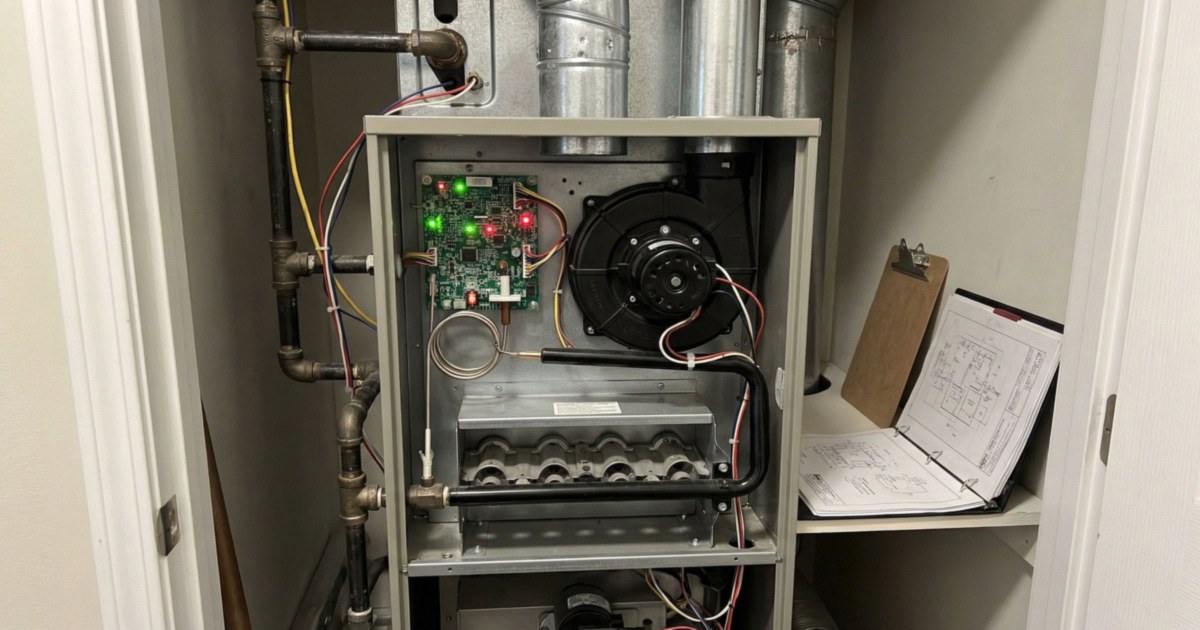
A furnace not turning on is the call that comes in at 11 PM in January. The customer is cold, they want an answer fast, and half the time the fix takes less than 30 minutes once you're on site. I've been doing HVAC work since before variable-speed ECM motors existed, and the diagnostic tree for a no-heat call hasn't changed that much. Modern furnaces added electronic controls and self-diagnostics, which actually makes the job easier — if you know how to read them.
Start with the LED flash codes. This should be the first thing you do on any modern furnace no-heat call before you touch a meter.
Step 0: Read the LED Fault Code
Every gas furnace made in the last 25 years has a diagnostic LED on the control board. It flashes a coded sequence when the furnace locks out. The code legend is printed on a sticker on the inside of the access door — the door you remove to access the burner and heat exchanger.
Count the flashes. The LED will flash a number, pause, flash again, pause, and repeat. Some boards use two-digit codes (3-1, 3-3, 4-1). Write it down, match it to the legend, and you've already narrowed your diagnosis to one system.
Important: flash codes are not standardized. They vary by brand, by control-board manufacturer, and even between model years of the same furnace. A 3-flash code does not mean the same thing on a Goodman as it does on a Carrier. Never diagnose off a remembered code chart — always read the legend sticker on the inside of your specific furnace door.
The table below is illustrative only — it reflects a pattern common on some Carrier/Bryant boards and is shown to demonstrate the format. Confirm every code against your own unit's legend:
| Flashes (illustrative) | Possible Meaning |
|---|---|
| 2 | System lockout (no ignition after retries) |
| 3 | Pressure switch stuck open |
| 4 | High-limit switch open |
| 5 | Flame sensed with no call for heat |
| 6 | Polarity reversed / grounding issue |
| 7 | Low flame signal / dirty flame sensor |
If the LED is off completely and the thermostat is calling for heat, you have a power supply issue — check the circuit breaker and the furnace door switch first.
Step 1: Thermostat and Power
Before you pull panels, confirm the basics.
Thermostat check:
- Set to Heat mode, not Cool or Auto
- Setpoint is above current room temperature (by at least 3°F)
- Check the display — a blank thermostat means no power (dead batteries on battery-powered models, tripped breaker on hardwired)
- If the thermostat has a screen, confirm it's sending a signal: set the fan to On. If the blower runs, 24V control power is present and the furnace is getting a signal from the stat. If nothing happens, check the transformer.
Power check:
- The furnace has a dedicated circuit breaker, usually labeled "Furnace" or "Air Handler" in the panel. Reset it fully (off, then on) even if it looks like it's not tripped — a half-tripped breaker looks on but isn't supplying power.
- There's also a power switch on the furnace itself, usually on the side of the unit or near the flue. It looks like a standard light switch. Find it and confirm it's on.
- The door switch: if the access panel is slightly ajar, the door switch cuts power to the furnace. Press the panel fully closed and try again.
The door switch causes more "furnace not turning on" calls than you'd expect. Dust bunnies accumulate on the switch actuator and prevent full engagement even when the door looks closed. If the furnace was running fine until the filter was changed, the door wasn't fully latched after the filter check. This is a two-second diagnosis that saves 20 minutes of troubleshooting.
Step 2: The Igniter — Cause #1 on Gas Furnaces
The hot surface igniter (HSI) is the single most common failure point on a gas furnace no-heat call — in my experience it is behind a large share of them, though I'm not aware of a published industry figure to cite. It's a silicon carbide or silicon nitride element that glows red-hot (1700-2000°F) to ignite the gas. Over time, it becomes fragile and eventually cracks or stops drawing enough current to ignite the burner.
Diagnosis: Watch the ignition sequence through the burner viewport or with the access panel open. Sequence should be: inducer motor starts → 15-30 second prepurge → igniter glows → gas valve opens → flame lights. If the igniter doesn't glow at all, it's open circuit. If it glows but gas doesn't light, check the gas valve and flame sensor next.
Test with a multimeter: resistance on a cold HSI should be 40-90 ohms for silicon carbide, 10-30 ohms for silicon nitride. An open reading (OL/infinite) means it's broken.
Part numbers by brand:
- Carrier/Bryant — LH33ZS004 (silicon nitride hot surface igniter; OEM for Carrier, Bryant, Payne, Day & Night and a direct replacement for LH33ZS001/002/003). Match the physical style to your unit before ordering.
- Lennox — Lennox has used multiple igniter styles over the years; match the physical style for your series. The 41K56 and 56W61 are common Lennox hot surface igniters. (Note: 63W54 / B45714-01 should be confirmed against your unit's parts list before ordering.)
- Trane/American Standard — IGN00104 / IGN00145 (Trane igniter part numbers carry the IGN prefix). Confirm voltage and physical style against your model.
- Goodman/Amana — B1401015S (SiC) or the silicon-nitride conversion kit that supersedes it. Goodman's control board often controls igniter timing — confirm the board is sending voltage (120V) to the igniter before condemning the igniter.
- Rheem/Ruud — 62-22868-93 (SiC, supersedes 62-22868-01 and is the most common Rheem/Ruud hot surface igniter). The silicon-nitride option is 62-103541-01. Match the physical style.
Handle silicon carbide igniters with clean gloves or a cloth. Skin oils on the surface create hot spots that crack the element prematurely. Silicon nitride is less fragile, but the same handling practice applies. I keep nitrile gloves in the parts kit specifically for igniter swaps.
Step 3: The Flame Sensor
The flame sensor is a metal rod that sits in the burner flame. It passes a small DC current (microamps) through the flame to verify ignition. When the signal drops below the minimum threshold, the control board shuts the gas valve and locks out the furnace.
A dirty flame sensor is the second most common cause of furnace lockout. The ceramic insulator accumulates a film of oxide over time, reducing the microamp signal. The furnace will attempt to light (you'll see or hear the click/ignition), run for 5-10 seconds, then shut off. This repeats two or three times before the board locks out.
Cleaning the flame sensor: Pull the sensor (one screw, one wire), and lightly polish the rod with fine steel wool or 400-grit emery cloth. Do not use sandpaper or anything abrasive enough to remove material. Reinstall and test. This repair is often all it takes — I've been doing this procedure for 20 years and it works probably 85% of the time.
If cleaning doesn't resolve the issue, test microamp signal with a multimeter in series with the flame sensor circuit. Minimum signal varies by manufacturer but is typically 0.5-1.0 µA. Under 0.5 µA with a clean rod = replace the sensor.
Part numbers:
- Carrier/Bryant: LH680013 (straight rod) / LH680534 (bent rod)
- Lennox: 69W43 (confirm against your unit's parts list)
- Trane/American Standard: SEN01114 (replaces SEN00337/SEN00441/SEN00491 and similar SEN-prefix sensors)
- Goodman: B1172606 (often cross-referenced to 0130F00010)
- Rheem: 62-23543-01


Step 4: Pressure Switch Faults
The pressure switch verifies that the inducer motor is running and producing adequate draft before allowing the gas valve to open. It's a diaphragm switch that measures negative pressure in the vent system. When it fails or is blocked, the furnace won't attempt ignition.
Pressure switch faults are the third most common cause of no-heat calls and the most frequently misdiagnosed. Before you condemn the switch, check:
- Inducer motor running? The inducer should start within seconds of a heat call. If it's not running, the switch is fine — you have an inducer motor problem (see below).
- Condensate drain blocked? 90%+ AFUE furnaces produce acidic condensate. If the drain is clogged, condensate backs into the pressure switch tubing and blocks the diaphragm. Disconnect the tubing and blow it clear. This is embarrassingly common in the first few years of high-efficiency furnace ownership.
- Pressure switch tubing cracked or disconnected? The small rubber tubing from the inducer housing to the switch cracks with age. A leak in the tubing = no pressure signal to the switch. Inspect it.
If all of the above check out and the inducer is running, test the switch. With the inducer running, the switch should close and show continuity across its terminals. If it stays open with the inducer running normally, the switch is bad.
Part numbers:
- Carrier/Bryant: HK06NB019 (common, covers several series — match rated pressure)
- Lennox: 10L34 / 100172-01
- Trane: SWT03822 / SWT03084
- Goodman: 0130F00010 / 0130F00010S
- Rheem: 42-25166-01
Step 5: Inducer Motor (Draft Inducer)
The inducer motor — also called the draft inducer or combustion air inducer — creates the negative pressure that vents combustion gases and signals the pressure switch. If it fails, the furnace will not attempt ignition and the pressure switch will not close.
Signs of a failed inducer: you can hear the furnace try to start (click of the control board), but no motor sound follows. Or the motor hums without spinning (capacitor failure on PSC inducer motors). Or the motor runs but the pressure switch stays open (blocked wheel, weak motor).
Inducer motors are brand-specific and often model-specific. This is one of the more expensive parts on a furnace.
Part numbers:
- Carrier/Bryant: HC27CB118 / HC27CB119 (covers many 80% AFUE units). Variable-speed current models use different assemblies.
- Lennox: 7021-11412 (G61MP and EL296V series)
- Trane: MOT09065 / MOT09252
- Goodman: 0131M00002S / 0131M00002P
- Rheem: 70-24157-03 / 70-24157-01
On PSC-type inducer motors (non-variable-speed), check the capacitor before condemning the motor. A failed start capacitor causes the motor to hum without spinning. The capacitor is a $10-20 part; the motor is $150-400. Test capacitance before ordering the motor. Carrier, Trane, and Lennox variable-speed ecm inductors don't have a separate capacitor — the electronics are integrated.
Step 6: Blower Motor
The blower motor circulates heated air through the duct system. If it fails, the furnace may actually light and run, but it will quickly shut down on the high-limit switch because heat has nowhere to go. You'll see a 4-flash code on most control boards.
PSC blower motors (single-speed and multi-tap): check capacitor first, same as inductors. Test capacitance. A 5 µF or 7.5 µF capacitor that reads 20% low will let the motor run but not up to speed, causing heat buildup and high-limit tripping.
ECM blower motors (variable-speed): these are more complex. They have a separate module (control board) that drives the motor. When they fail, you either get no blower response or erratic speed. Test by checking 24V control signal from the furnace board to the ECM module. No signal = furnace board. Signal present but no motor = ECM module or motor.
Rheem and Goodman use the Genteq/Regal-Beloit ECM series widely. Carrier and Trane use Bryant/American Standard-specific ECM assemblies. Part specificity is high here — get the motor model number off the nameplate before ordering.
Gas vs. Electric: Key Differences
Gas Furnace Sequence of Operation
- Thermostat calls for heat
- Control board powers up
- Inducer motor starts (prepurge)
- Pressure switch confirms draft
- Hot surface igniter energizes (15-30 second heat-up)
- Gas valve opens
- Flame sensor confirms ignition
- Blower delay (60-90 seconds) then blower starts
- Thermostat satisfied → gas valve closes → blower post-purge
Electric Furnace Sequence
Electric furnaces use sequencers — bimetal switches that stagger the heating elements on at startup to prevent a voltage spike. An electric furnace with no heat but a running blower usually has a failed sequencer or a broken element.
Electric element resistance check: a standard 5kW element reads approximately 10 ohms. An open reading means the element is broken or the limit switch in series with it has tripped. Check element limits before condemning the element itself.
Diagnostic Order — Quick Reference
Work this list in order. It's ranked by probability and speed:
- LED flash code — 30 seconds. Tells you exactly where to look.
- Thermostat and door switch — 5 minutes. Rules out the obvious.
- Circuit breaker reset — 2 minutes.
- Igniter test (gas) — 10 minutes. The #1 cause of no-heat.
- Flame sensor cleaning (gas) — 15 minutes. Second most common.
- Pressure switch and tubing (gas) — 10 minutes.
- Inducer motor — Listen for it. If it's not running, it's the cause.
- Blower motor / capacitor — Check after everything above.
- Control board — Last resort.
For related HVAC diagnostics, see our AC not cooling guide for the cooling side of the system. If you're working on a heat pump instead of a conventional furnace, see our guide on heat pump vs furnace in Southern California for the diagnostic differences.
Why won't my furnace turn on?▾
The most common cause on gas furnaces is a failed hot surface igniter — in our experience it's the single biggest source of no-heat calls. Before anything else, read the LED flash code on the control board inside the access door. It will point you to the failed system. Other common causes: dirty flame sensor causing lockout, tripped pressure switch, inducer motor failure.
What do the LED flash codes on my furnace mean?▾
The LED on the control board flashes a sequence when the furnace locks out. Count the flashes, then match to the legend sticker on the inside of the furnace door. Common codes: 2 flashes = system lockout after failed ignition, 3 flashes = pressure switch fault, 4 flashes = high-limit switch open, 7 flashes = weak flame signal (clean the flame sensor).
How much does it cost to repair a furnace that won't turn on?▾
Most repairs run $150-350. An igniter replacement is $175-275 all-in. Flame sensor cleaning is $100-150. Pressure switch replacement is $150-250. Inducer motor replacement is $350-600. Control board replacement is the most expensive at $400-700 total.
Can I reset my furnace myself?▾
Yes. Set the thermostat to Off, wait five minutes, then set it back to Heat with the setpoint above room temperature. If there's a reset button on the burner assembly, press it once and wait. Do not press it repeatedly — this puts unburned gas into the heat exchanger. If the furnace doesn't fire after one reset and a 30-minute wait, it needs a service call.
Need a repair professional?
Get free quotes from verified technicians in your area.
Find a Pro Near You