


Dryer Not Heating: Complete Diagnostic Guide for Every Fuel Type
Terry Okafor
Master refrigeration tech and NATE-certified instructor who moonlights as the magazine's advice columnist. His 'Ask Big Terry' mailbag has been settling shop disputes and diagnosing mystery leaks since 2011.
A dryer not heating is the single most common dryer service call. I'd estimate it makes up 60% of the dryer work that comes through our shop. The customer usually says the same thing: "It runs fine, clothes just come out wet." The drum spins, the motor's good, but there's no heat. On electric dryers, you're chasing the heating circuit. On gas dryers, you're chasing the ignition system. But both fuel types share three of the five most likely failure points, so the diagnostic tree overlaps more than you'd expect.
Here's the full walkthrough, starting with the part that fails more than everything else combined.
The Thermal Fuse — Check This First, Every Time
The thermal fuse is a one-shot safety device. When the exhaust temperature exceeds its rated limit (usually 196°F on Whirlpool/Kenmore, 250°F on some Samsung and LG models), it blows and cuts the heating circuit. The motor circuit stays intact. Drum spins, no heat. Textbook symptom.
On most dryers, the thermal fuse is mounted on the blower housing or the exhaust duct inside the rear panel. Pull the back off, find it, and test continuity. An open reading means it's blown. No guesswork here.
The part itself costs almost nothing. The Whirlpool 3392519 fits most Whirlpool, Kenmore, Maytag, and KitchenAid dryers made in the last 20 years. Samsung uses the DC47-00016A on most of their DV series. LG uses 6931EL3003D across their DLE and DLEX lines.
A blown thermal fuse is a symptom, not a root cause. If you replace the fuse without checking the vent system, you'll be back in two months. Before you install the new fuse, pull the vent hose off the back and run the dryer for 30 seconds. Stick your hand behind it. Strong airflow? The clog is in the house ductwork, not the dryer. Weak airflow? Check the internal lint path — blower wheel, lint chute, and the felt seal around the drum. I keep a vent brush kit on the truck for exactly this reason. Clears the callback before it happens.
Common culprits behind a blown fuse: crushed flex vent behind the dryer (especially after the unit gets pushed back against the wall post-install), bird nests in exterior vent hoods, and lint buildup inside 25-foot duct runs. In Southern California, I also see a lot of dryer vents that run through unconditioned attic space. The longer and more convoluted the run, the higher the exhaust temperature.
Why Your Dryer Stopped Heating: The Heating Element (Electric Models)
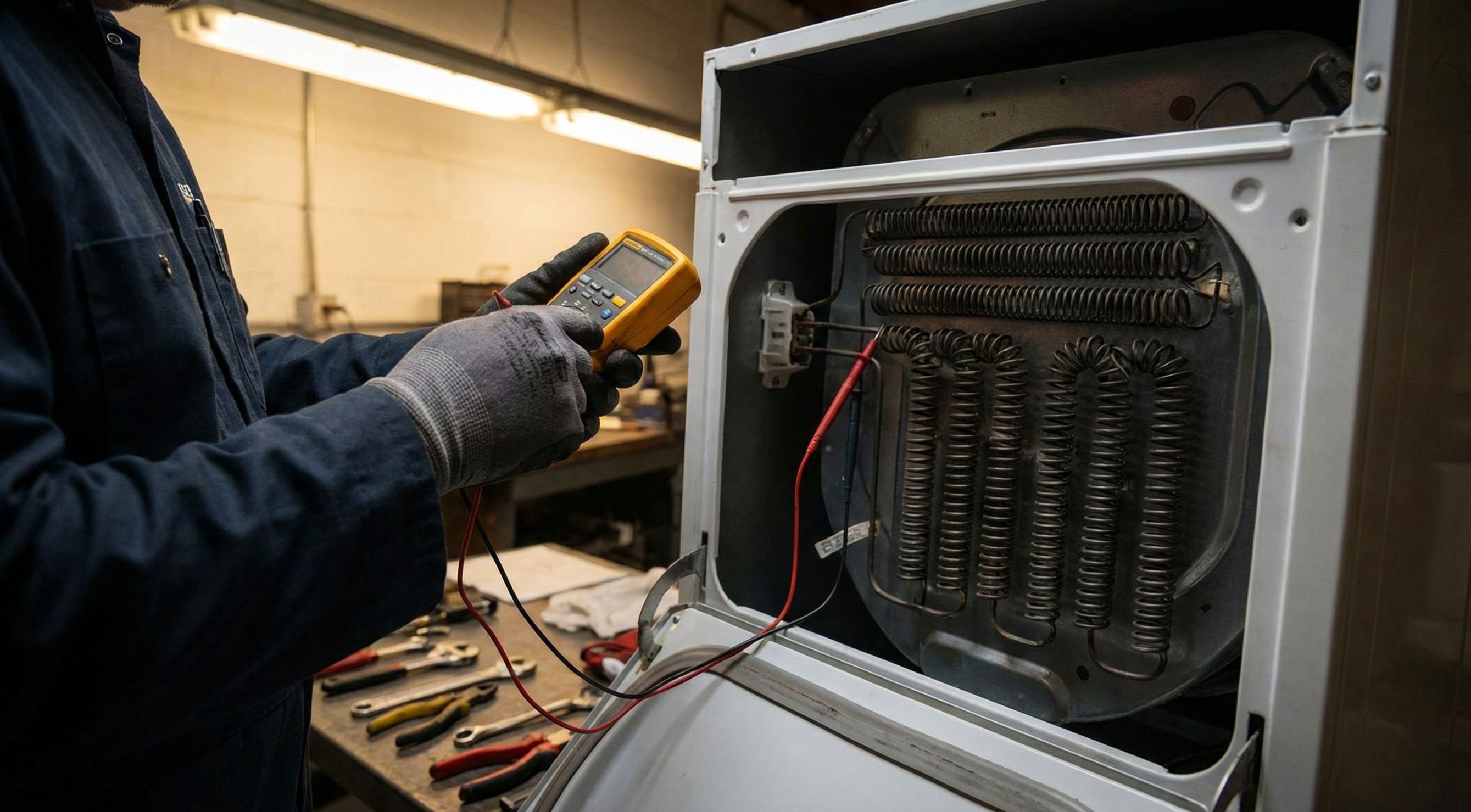
If the thermal fuse has continuity and you're working on an electric dryer, the heating element is next. The element is a coiled resistance wire inside a metal housing, usually mounted on the back wall or inside the drum housing depending on manufacturer.
Pull the wires off the element terminals and check resistance. A good element reads somewhere between 8 and 50 ohms, depending on wattage. An open reading means the coil broke. Also check each terminal to ground (the element housing). Any continuity to ground means the coil sagged and is touching the housing — that'll trip the thermal fuse or the breaker, sometimes both.
Common element part numbers:
- Whirlpool/Kenmore 29" dryers — 3387747. This one part covers about 40% of the electric dryers in the field. If you don't stock it on the truck, you should.
- Samsung DV42H/DV45H/DV48H series — DC47-00019A. These run hot and the elements tend to fail after 5-7 years.
- LG DLE series — 5301EL1001J. LG elements last longer on average, but when they go, the coil usually breaks at the connection point rather than mid-span.
- GE/Hotpoint — WE11M10001. GE uses a can-style element that's accessed from the back. Different mounting but same diagnostic approach.
- Maytag Bravos/Centennial — Same Whirlpool 3387747. These are Whirlpool-built machines under the Maytag badge.
When you pull a broken element, look at where the coil failed. If it broke right at the terminal connection, that's normal wear — metal fatigue from heating and cooling cycles. If it broke mid-span or sagged to the housing, the dryer was overheating before the element failed. That means restricted airflow. Check the vent and the cycling thermostat before you close the ticket.
One more thing on electric dryers: check the breaker. Electric dryers run on a 240V circuit with two legs. If one leg of the breaker trips, the dryer gets 120V. That's enough to run the motor and the timer, but not enough for the element. The breaker will look like it's on. You have to flip it fully off and back on, or better yet, meter the outlet. You want 240V across the two hot legs. I see this about once a month, and it wastes an hour if you don't check it upfront.
The Igniter and Gas Valve Solenoids (Gas Models)
Gas dryers don't have a heating element. They have a burner assembly with an igniter, a flame sensor, and gas valve solenoid coils. When a gas dryer tumbles but won't heat, the failure is almost always one of these three components.
The igniter is a silicon carbide or silicon nitride bar that glows orange-hot to ignite the gas. Over time, igniters weaken. They'll still glow, but they won't draw enough current to open the gas valve. The gas valve uses the igniter's current draw as a signal — once the igniter pulls enough amps (around 3-3.5A), the valve opens. A weak igniter glows but never reaches that threshold.
Diagnosis: watch the igniter through the front access panel (lower kick plate). Start a heat cycle. If the igniter glows for 15-90 seconds and then shuts off without the gas lighting, the igniter is weak OR the gas valve coils are bad. To tell the difference, meter the igniter current. Under 3 amps while glowing? Igniter. Over 3 amps but gas still doesn't flow? Coils.
The gas valve solenoid coils are the other common failure. Most dryers use two coils on the valve: the booster coil (holding coil) and the secondary coil. Whirlpool part 279834 is a two-pack that fits the vast majority of Whirlpool, Kenmore, Maytag, Amana, and Roper gas dryers. This is a $12 part. Stock it.
A telltale pattern with failing coils: the dryer heats for the first 5-10 minutes, then quits. The coils work when cool but fail when they heat up. Internal winding resistance increases with temperature. The customer says, "It heats a little then stops." That's coils.
Here's a field trick I've used for 15 years. If you suspect weak gas valve coils but want to confirm before pulling parts, start a heat cycle and let the igniter glow. Right as it shuts off (no ignition), hit the coils with a shot of freeze spray. If the next cycle lights, the coils are heat-sensitive and need replacement. Not a textbook diagnostic, but it works and it'll save you a trip back to the truck.


The Cycling Thermostat and High-Limit Thermostat
Both gas and electric dryers use thermostats to regulate heat. The cycling thermostat opens and closes the heating circuit to maintain the set temperature. The high-limit thermostat is a safety that cuts heat if the cycling thermostat fails and the dryer overheats.
When a cycling thermostat fails open, the dryer gets no heat at all. Failed closed, the dryer overheats and eventually blows the thermal fuse. Either way, test it.
The cycling thermostat is usually clipped to the blower housing near the thermal fuse. Check continuity at room temperature — it should be closed (near zero ohms). The Whirlpool 3387134 cycling thermostat fits most of their 27" and 29" dryers. Samsung uses DC47-00018A.
The high-limit thermostat is typically mounted on the heater housing. Same test — continuity at room temperature. Whirlpool 3977767 is the common part. If it's open, replace it, but also figure out why it tripped. Usually restricted airflow. Same story as the thermal fuse.
On Whirlpool and Kenmore dryers, I replace the thermal fuse, high-limit thermostat, and cycling thermostat as a set whenever one fails. You can buy them as a kit — Whirlpool makes a dryer thermostat kit (part 279816 plus 3392519) that covers all three. The parts cost maybe $25 total. Beats making two trips because the 15-year-old cycling thermostat that "tested fine" dies three weeks later.
The Control Board — Last Resort
If everything else checks out — fuse has continuity, element or igniter tests good, thermostats are closed, vent is clear — the electronic control board is your last suspect. Modern dryers from about 2010 forward use electronic controls that manage the heat cycle. The relay or triac on the board that switches the heating circuit can fail.
This is where it gets brand-specific.
Whirlpool/Maytag (W10174746 and revisions): The relay that drives the heater circuit can burn its contacts. Visually inspect the board for scorched spots near the relay. Sometimes you can see it, sometimes you can't. If everything else is ruled out, replace it.
Samsung (DC92-01729A and variants): Samsung boards fail more often than average, in my experience. The DV42H and DV45H series in particular. The board is behind the rear panel. Fair warning: Samsung board part numbers change frequently between production runs. Match the board number exactly.
LG (EBR76542946 and similar): LG boards are generally reliable, but their wiring harness connectors corrode in humid environments. Before you condemn the board, pull every connector, clean the terminals, and reseat. I've fixed more than a few LG "board failures" with contact cleaner and a pick.
Quick-Reference Diagnostic Order
For every dryer-not-heating call, work the list in this order. It's ranked by probability, not by difficulty.
- Thermal fuse — 2-minute test. Start here every time.
- Heating element (electric) or igniter/coils (gas) — these are the actual heat source. If the safety devices are fine, the heat generator is next.
- Cycling thermostat and high-limit thermostat — less common than the first two, but a 5-minute test.
- 240V circuit check (electric only) — half-voltage from a tripped breaker leg.
- Control board — last resort after everything else is eliminated.
For more on what to charge for these repairs, check out our pricing guide for appliance repair in Southern California. And if you're running a kitchen appliance call and the customer also mentions a dishwasher issue, we've got a similar walkthrough for Whirlpool dishwashers not draining.
Model-Specific Notes
Whirlpool/Kenmore 80 Series and 90 Series — These older mechanical-timer dryers are still all over the field. No control board to worry about. If the thermal fuse and element (or igniter) test good, check the timer contacts. The timer has a set of contacts that close the heater circuit. Worn contacts = no heat. Replacement timer is part 3976576 or equivalent.
Samsung DV42H and DV45H — High element failure rate. The DC47-00019A element stretches and sags after 5-7 years. When it contacts the housing, it shorts and trips the house breaker. Always check the element before blaming the breaker.
LG DLEX/DLE3700 series — These use a dual-element design with a resistance heater and a steam heater. If the customer says "no heat on regular cycles but steam cycles work fine" (or vice versa), you're looking at one element, not both. The main element is 5301EL1001J.
Maytag Bravos (MEDB, MEDX series) — Whirlpool-built. Uses all the same parts. The thermal fuse location is slightly different — it's on the exhaust duct behind the drum, not on the blower housing. Don't let the different location throw you off.
GE/Hotpoint front-access models — GE puts the heating element in a can-style housing accessed from the back, but the thermal fuse and thermostats are behind the front drum panel. You'll need to remove the front to get to them. Plan your access accordingly so you're not pulling the dryer apart twice.
Why does my dryer spin but not heat?▾
The most common cause is a blown thermal fuse, which cuts power to the heating circuit while allowing the motor to run. On gas dryers, a failed igniter or gas valve solenoid produces the same symptom. Start by testing the thermal fuse for continuity — it's a 2-minute test and it's the answer about 40% of the time.
How much does it cost to fix a dryer that won't heat?▾
Most repairs run $150-300 including parts and labor. A thermal fuse replacement is the cheapest at $100-150 total. A heating element swap runs $200-300. Gas valve coils are $150-200. Control board replacement is the most expensive at $300-475 all-in. See our full pricing guide for regional labor rates in Southern California.
Can I reset the thermal fuse on my dryer?▾
No. Thermal fuses are one-time-use safety devices — once blown, they must be replaced. More importantly, a blown fuse means something caused the dryer to overheat. Always check the vent system and clean the exhaust path before installing a new fuse. If you skip that step, the new fuse will blow too.
My gas dryer heats for a few minutes then stops. What's wrong?▾
This is the classic symptom of failing gas valve solenoid coils. The coils work when cool but lose their holding force as they heat up. The dryer lights for the first cycle or two, then the coils can't open the valve anymore. Replace both coils as a set — Whirlpool 279834 covers most brands. It's a $12 part.
Need a repair professional?
Get free quotes from verified technicians in your area.
Find a Pro Near You