


Heat Pump vs. Furnace in Southern California: The Honest Buyer's Guide

Terry Okafor
Master refrigeration tech and NATE-certified instructor who moonlights as the magazine's advice columnist. His 'Ask Big Terry' mailbag has been settling shop disputes and diagnosing mystery leaks since 2011.
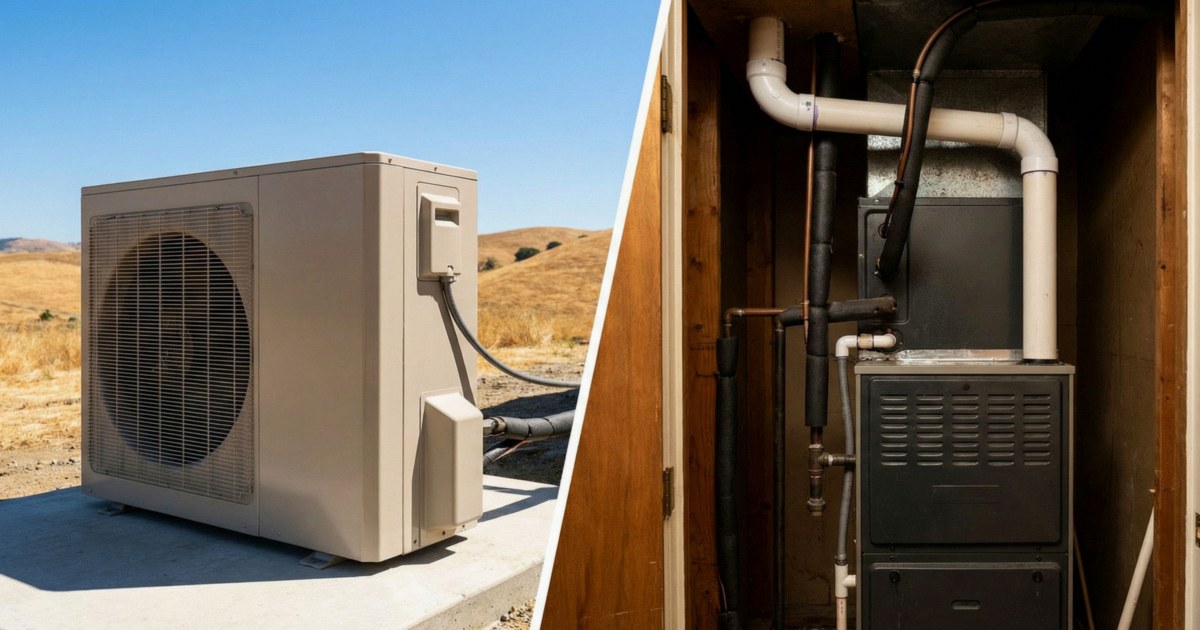
I service both heat pumps and gas furnaces across the San Fernando Valley, Inland Empire, and coastal SoCal markets. When customers ask me which system to buy, my honest answer is almost always the same: in Southern California, a heat pump usually wins. Not always. But usually.
Here's the full breakdown so you can make an informed decision rather than trusting whatever the HVAC salesperson happens to push that week.
Why Southern California Changes the Equation
The heat pump vs. furnace debate plays out differently depending on climate. In Minnesota, a gas furnace might make sense. In Los Angeles, Riverside, or San Diego, the math almost always favors a heat pump — and by a wider margin than most homeowners realize.
Heat pumps don't generate heat. They move it. In heating mode, they extract heat from outdoor air and transfer it inside. The efficiency is measured as a Coefficient of Performance (COP). A COP of 3.0 means the unit delivers 3 units of heat energy for every 1 unit of electrical energy it consumes. Even at 45°F outside — a cold SoCal night — a modern heat pump runs at COP 3.0 to 3.5.
Gas furnaces operate at 80-96% efficiency. There's no COP multiplier. Every BTU in the gas is (at best) 0.96 BTUs of heat delivered. A heat pump at COP 3.0 is effectively 300% efficient. Those numbers make the choice obvious in a mild climate.
The only time a gas furnace consistently beats a heat pump in SoCal is when gas is extraordinarily cheap and electricity is very expensive in your specific utility territory. SCE and SDG&E rates have climbed significantly. Run the numbers using your actual utility bill before anyone tells you gas is cheaper. In most SoCal service territories, it isn't anymore.
Heat Pump Performance in Mild vs. Cold Weather
The biggest misconception I hear from homeowners is that heat pumps "don't work when it's cold." This was true of older technology. It is not true of heat pumps manufactured in the last decade.
Modern cold-climate heat pumps (Carrier Infinity 24, Lennox XP25, Mitsubishi Hyper-Heat, Bosch IDS series) maintain full or near-full heating capacity down to 5-17°F depending on the model. In Southern California's Coastal and Valley zones, the design heating temperature — the coldest it gets 99% of the time — is typically 35-45°F. Even in the colder Inland Empire and high desert communities (Victorville, Apple Valley), the 99% design temp is around 25-30°F.
Current cold-climate heat pump models handle this easily without supplemental heat.
Zone-by-zone performance notes:
- Coastal LA, Orange County, San Diego — heat pump efficiency is near-perfect year-round. Heating demand is so low that system choice matters more for cooling season efficiency than for heating at all.
- San Fernando Valley, Inland Empire — mild winters, hot summers. Heat pump is ideal. Summer cooling load is where you want the efficiency.
- High desert communities (Victorville, Palmdale, Lancaster) — colder winters, though still within most cold-climate heat pump specs. A cold-climate rated unit (rated to at least 5°F) is warranted here.
- Mountain communities (Big Bear, Running Springs) — this is where the furnace or dual-fuel argument starts to hold merit. Below 20°F sustained operations stretch most heat pumps.
Upfront Costs: What to Actually Expect
People get sticker-shocked by heat pump quotes. Some of the surprise is justified; some isn't. Here's what the numbers look like in 2026 for a typical SoCal single-family home.
The gap is real but narrowed significantly by incentives (see below). When you factor in lower operating costs over a 15-year system life, the total cost of ownership often favors the heat pump even without rebates.
Federal and State Incentives: Where Things Stand in 2026
The Inflation Reduction Act created two overlapping incentive paths for heat pumps. Their status changed significantly going into 2026, so read this section carefully before counting on either one.
Energy Efficient Home Improvement Credit (Section 25C) — terminated after 2025
Until recently, 25C offered a 30% federal tax credit, capped at $2,000 per year for heat pump upgrades — a direct dollar-for-dollar reduction in your federal tax liability, not a deduction. Eligible equipment had to meet minimum efficiency ratings published by ENERGY STAR.
Here's the critical update: the 25C credit was terminated for property placed in service after December 31, 2025 by P.L. 119-21 (the budget reconciliation act signed in 2025). The IRS now lists the credit as available only for qualifying property placed in service before December 31, 2025.
- If your heat pump was installed during 2025, you can still claim the credit on your 2025 return (Form 5695), provided the equipment was made by a qualified manufacturer and you report the manufacturer's QMID number.
- If you install in 2026 or later, there is no 25C credit to claim. Do not let a salesperson tell you otherwise.
High-Efficiency Electric Home Rebate Act (HEEHRA) — California Implementation
Income-qualified homeowners can access point-of-sale rebates through California's state energy programs. As of 2026:
- Income at or below 80% of area median income (AMI): up to $8,000 rebate on the heat pump
- Income between 80-150% AMI: up to $4,000 rebate
- No rebate for incomes above 150% AMI
Current status caveat (early 2026): HEEHRA single-family rebates are administered by the California Energy Commission (CEC) and are funded from a fixed federal IRA allocation. That funding has run out. Central and Southern California regions became fully reserved in January 2026, and the program reached statewide full reservation on February 24, 2026. New reservation requests are now placed on a waitlist that only pays out if additional funding becomes available. In practical terms, do not assume you can get a HEEHRA rebate right now — confirm current availability and your place on the waitlist before factoring it into your budget.
Check current California program status through the CEC's IRA Residential Energy Rebate Programs page. Availability varies by region and changes as program funding shifts.
The 25C credit only applies to heat pumps placed in service through the end of 2025 — for a 2025 install you claim it on your own federal return regardless of what your installer says or does, but there is no equivalent federal credit for 2026 installs. The HEEHRA rebate is applied at the point of sale and requires your installer to participate in the program — but with single-family funding fully reserved/waitlisted statewide as of early 2026, confirm a rebate is actually available before you count on it. Ask your contractor specifically: "Is HEEHRA funding still available for my project, and are you enrolled?" Not all contractors are.


Operating Costs Over Time
This is where the heat pump advantage compounds. Let me use real numbers from a typical SoCal household — a 1,800 sq ft home in the San Fernando Valley.
Annual heating energy cost estimates (SoCal):
A gas furnace (96% AFUE) heating a 1,800 sq ft Valley home uses roughly 300-500 therms per year for heating. At $1.80-2.20/therm (current SoCalGas rates), that's $540-$1,100/year in heating gas.
The same home with a heat pump (HSPF2 10.0) uses roughly 1,200-2,000 kWh for heating. At $0.25-0.32/kWh (SCE tiered rates), that's $300-$640/year.
Annual cooling (this is where it gets interesting):
A central heat pump is also an air conditioner. If you're replacing a gas furnace + central AC unit, the heat pump replaces both systems. Your comparison should be (furnace + AC) vs. heat pump, not just furnace vs. heat pump.
A 16 SEER central AC replacement costs $4,500-7,000 installed. A 3-ton heat pump at 18-20 SEER2 replaces both the furnace and the AC. The combined system cost comparison looks very different from the standalone numbers above.
Dual-Fuel Systems: Who They're Actually For
A dual-fuel system pairs an electric heat pump with a gas furnace. The heat pump handles most of the load, and the furnace kicks in when outdoor temperature drops below the heat pump's efficient operating range (the "balance point," typically 35-40°F).
In theory, this captures the best of both systems. In practice, in most SoCal zip codes, the furnace kicks in for fewer than 50 hours per year. You're paying $2,000-$4,000 more for a gas furnace, gas line maintenance, annual furnace service, and continued gas utility fees — all to cover roughly two weeks of occasional cold snaps.
Where dual-fuel makes sense in SoCal:
- Big Bear, Idyllwild, Wrightwood, and other mountain communities above 5,000 ft
- High desert communities with consistent sub-25°F overnight lows
- Properties where gas is already present and an existing furnace can be retained as the backup (avoiding the cost of a new furnace)
Where dual-fuel is overkill:
- Anywhere in coastal LA, Orange County, or San Diego
- The San Fernando Valley, Conejo Valley, Simi Valley
- Inland Empire communities below 2,000 ft elevation
Heat Pump Types: Central vs. Mini-Split
For homes with existing forced-air ductwork, a central ducted heat pump is usually the most cost-effective replacement.
For homes without existing ducts — common in older California bungalows and additions — a ductless mini-split heat pump is often the right choice. Mini-splits offer zone control (each room gets its own thermostat), very high efficiency ratings, and installation flexibility. See our mini-split installation guide for Southern California for a full breakdown on sizing, permits, and what to expect from the install process.
The Bottom Line: How to Decide
Work through these four questions:
- Are you replacing just a furnace, or furnace + AC? If both, a heat pump is almost certainly the right choice financially. It replaces both systems.
- Is your home in a mountain or high desert community? If yes, spec a cold-climate rated heat pump (HSPF2 ≥ 10, rated to at least 5°F) or consider dual-fuel.
- Do you have existing ductwork in good condition? If yes, a central ducted heat pump is efficient and cost-effective. If no, mini-splits or ductless units deserve serious consideration.
- What's your utility situation? If you're on a time-of-use (TOU) rate with your utility, a heat pump can be even cheaper to run by shifting operation to off-peak hours with a programmable thermostat.
For troubleshooting an existing system, check our AC not cooling diagnostic guide for the full walkthrough on what goes wrong with cooling systems and how to diagnose it.
Do heat pumps work in Southern California winters?▾
Yes — very well. Modern cold-climate heat pumps operate efficiently down to 0°F. In SoCal, where winter nights rarely dip below 35-40°F in most areas, a heat pump runs at peak efficiency virtually year-round. The cold-climate concern is largely a northern-state issue.
What federal rebates are available for heat pumps in 2026?▾
The federal Energy Efficient Home Improvement Credit (Section 25C) — a 30% tax credit up to $2,000 on heat pumps — was terminated for property placed in service after December 31, 2025 by P.L. 119-21. Only heat pumps installed during 2025 can claim it on a 2025 return; there is no 25C credit for 2026 installs. California's income-qualified HEEHRA rebate (up to $8,000 for the lowest-income tier) is administered by the California Energy Commission, but its single-family rebates were fully reserved/waitlisted statewide as of early 2026.
Is a dual-fuel system worth the extra cost?▾
In SoCal, rarely. Dual-fuel systems make sense where winter temperatures drop below 25°F regularly. In most Southern California zip codes, those temperatures almost never occur, so the gas furnace backup runs only a handful of hours per year — not enough to justify the added complexity and cost.
Sources
- Internal Revenue Service. "Energy Efficient Home Improvement Credit." https://www.irs.gov/credits-deductions/energy-efficient-home-improvement-credit (credit allowed for qualifying property placed in service before December 31, 2025).
- 26 U.S. Code § 25C — Energy efficient home improvement credit. Legal Information Institute, Cornell Law School. https://www.law.cornell.edu/uscode/text/26/25C (as amended by P.L. 119-21).
- California Energy Commission. "Inflation Reduction Act Residential Energy Rebate Programs (HEEHRA)." https://www.energy.ca.gov/programs-and-topics/programs/inflation-reduction-act-residential-energy-rebate-programs (single-family rebates fully reserved statewide as of February 24, 2026).
- ENERGY STAR. "Federal Tax Credits for Energy Efficiency" (heat pump efficiency thresholds). https://www.energystar.gov/about/federal-tax-credits
Need a repair professional?
Get free quotes from verified technicians in your area.
Find a Pro Near You