


Whirlpool Cabrio Bearing Replacement: Bearing-Only vs. Full Tub Assembly
Terry Okafor
Master refrigeration tech and NATE-certified instructor who moonlights as the magazine's advice columnist. His 'Ask Big Terry' mailbag has been settling shop disputes and diagnosing mystery leaks since 2011.
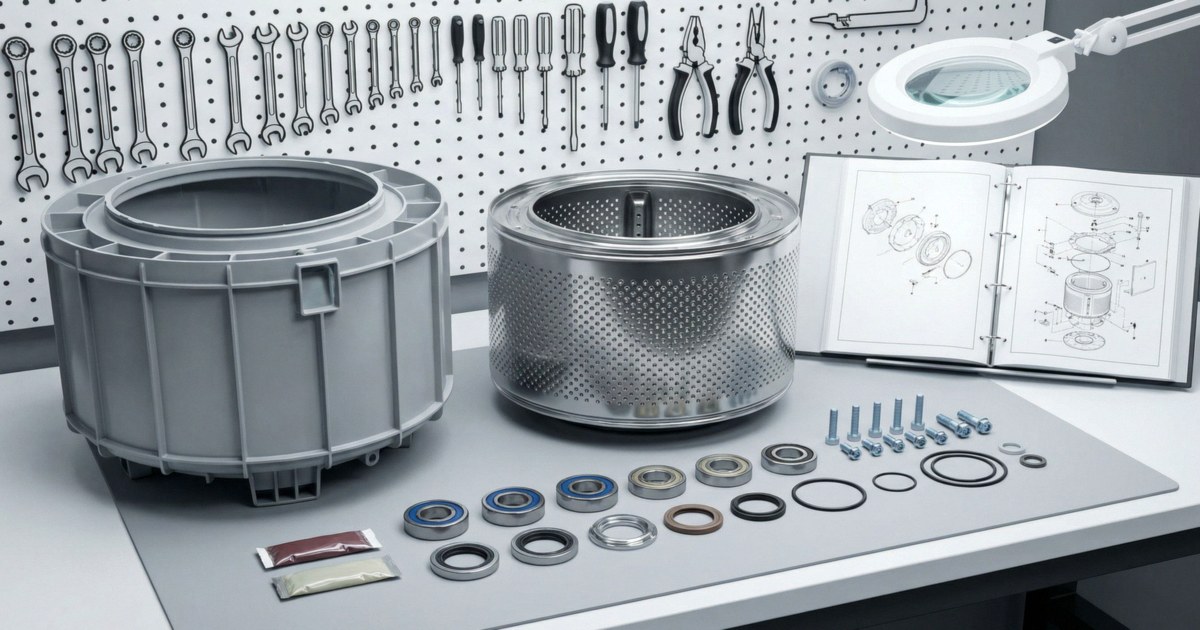
The Whirlpool Cabrio bearing failure is one of the most recognizable sounds in appliance repair — a deep, building roar that starts as a soft rumble during high-speed spin and eventually turns into something that sounds like the machine is about to take flight. If you've been doing appliance repair in Southern California for more than a year, you've heard it.
The Cabrio, along with its twins the Kenmore Oasis and Maytag Bravos, uses a design where the drum bearing is pressed into the outer tub hub. When the bearing fails, you have a choice: reuse the existing tub and press in a new bearing/shaft/seal kit, or replace the entire outer tub (which ships with the bearing factory-pressed). Either way, a bearing gets pressed into a tub hub — the only question is whether you do the pressing in the field or buy a tub that already has it done. Both approaches are legitimate, and shops argue about which is correct. Here's what actually matters.
Diagnosing Bearing Failure vs. Other Noises
The roaring grinding noise on spin is characteristic of bearing failure, but not every loud noise is a bearing. Before you start disassembling, confirm the diagnosis.
Bearing failure sounds like: A sustained roaring or grinding sound on spin, increasing with drum speed. Starts during the high-speed portion of the spin cycle and gets louder over time. May be accompanied by a slight vibration. The pitch and volume track the drum speed — as the machine ramps up, the noise ramps up.
What it doesn't sound like: A rhythmic banging (that's suspension rods or an unbalanced load), a scraping metal sound at low speed (that's a foreign object in the drum gap or damaged spider arm), or intermittent clicking (that's usually a rib or foreign object hitting the drum).
Physical test: Open the lid, reach in, grab the drum, and try to wobble it vertically. Grab the outer drum rim and push up, then down. On a healthy machine, there should be almost no vertical play — maybe 1/16" at most. If you can feel a notable clunk or more than 1/8" of vertical movement, the bearing is worn. On heavily worn bearings, you can often hear the grinding just by rotating the drum by hand.
Spin test: Run just a spin cycle with no load. The noise should be present without any load influence from wet clothes. If the noise only appears with clothes in the drum, you might be looking at an unbalanced suspension situation, not a bearing.
On the Cabrio, an early sign of bearing wear is water under the machine after the spin cycle. The bearing is sealed, but when it wears, it allows water to wick past the seal and down the shaft. If the customer mentions water on the floor and a new-ish grinding noise, you've confirmed bearing failure even before you open it up. The leaking bearing seal is the failure before the roaring noise, not after.
The Tub Design: Why This Bearing Fails
The Cabrio's outer tub is a single plastic assembly with the bearing race molded into the bottom of the tub hub. There's no separate bearing housing that can be unbolted. The bearing is pressed into the tub plastic.
The failure pattern: water and detergent slowly work past the seal over years. The bearing corrodes and develops play. As play increases, the bearing race in the plastic hub begins to oval out, accelerating wear. By the time the customer calls, the bearing has often already damaged the tub hub bore — which affects the bearing-only repair.
Bearing-Only vs. Full Tub Assembly: The Real Decision
Option 1: Bearing/seal kit (press in the field)
Labor time: 4-6 hours for an experienced tech who has done this before. Longer for first-timers.
Parts cost: $20-50 for the bearing alone (SKF 6305-2Z or equivalent), or roughly $40-90 for the OEM-style bearing/shaft/seal kit (W10435302), which bundles the upper and lower bearings, shaft, tub seal, grease, and adhesive. Note that W10435302 is a repair kit, not a finished tub — the bearing must still be pressed into the tub hub, and the installation requires the matching press/driver tool W10447783. Several suppliers sell W10435302 and W10447783 bundled together for exactly that reason.
Process: Full disassembly, separation of the outer tub (which is often brittle and cracks when pried open), pressing out the old bearing with a bearing press, inspecting the hub bore for damage, pressing in the new bearing and seal with the W10447783 tool, reassembly.
Risks: The outer tub halves are plastic and 10+ years old. They crack during separation more often than you'd expect, especially in California where UV exposure and temperature cycling take their toll. If the tub cracks during the bearing job, you're ordering the tub assembly anyway — and you've already spent 3 hours on disassembly.
Also check: the hub bore. If the plastic around the bearing seat is damaged or ovaled out, a new bearing won't seat correctly and you'll be back in a few months.
Option 2: Complete replacement outer tub
Labor time: 2-3 hours.
Parts cost: $200-350 for a complete replacement outer tub with the bearing factory-pressed. Confirm the correct tub part against your model number — the Cabrio/Bravos/Oasis platform spans several tub revisions, so don't order off a generic listing. (Do not confuse this with W10435302, which is the bearing/shaft/seal kit described in Option 1, not a finished tub.)
Process: Remove the agitator and inner basket, disconnect the suspension rods, remove the drive shaft assembly and motor, lift out the old outer tub, install the new outer tub, reassemble.
No field pressing required and no risk of cracking a brittle old tub during separation. The replacement tub arrives with a new bearing already pressed in at the factory and a fresh hub bore, so you're guaranteed a correct bearing fit without the W10447783 press tool.
The parts premium for a complete tub is partly offset by the labor you save versus pressing a kit in the field. In a shop billing $100-125/hour, the two routes often land within a few hundred dollars of each other once labor is included; the complete tub trades a higher part cost for less bench time and less risk. For a solo tech billing time-and-materials, do the math for your own labor rate.
When the bearing/seal kit makes sense:
- The customer is on a tight budget and accepts the longer labor time
- You own the W10447783 press tool (or its bundle) and know the Cabrio disassembly well enough to do it in under 4 hours
- The machine is relatively new and the tub plastic is in good condition
When the complete tub makes sense:
- Older machine where the tub plastic is more fragile
- First time doing this model (the learning curve is real)
- You don't own the press tool and don't want to buy it for a one-off
- Shop billing structure rewards faster turnaround


Part Numbers
Always verify the exact part against your specific model number before ordering — the Cabrio/Bravos/Oasis platform went through multiple tub and bearing revisions, and a part that fits one model year may not fit another. Use the manufacturer model/serial lookup or a parts diagram (AppliancePartsPros, Reliable Parts, PartSelect) for your unit.
Bearing/shaft/seal kit (press into the existing tub):
- W10435302: Whirlpool Cabrio/Kenmore Oasis/Maytag Bravos tub bearing, shaft, and seal kit. This kit is pressed in — it is not a finished tub.
- W10447783: The required bearing/seal installation tool for the W10435302 kit. Many suppliers sell the W10435302 kit and W10447783 tool bundled together.
- Bearing (if buying the bearing on its own): SKF 6305-2Z (the bearing used across the Cabrio/Bravos/Oasis platform). The shaft seal is included in the W10435302 kit.
Complete replacement outer tub (bearing factory-pressed):
- Sold as a complete outer tub assembly for the Cabrio/Bravos/Oasis platform. Confirm the correct tub part number against your model's parts diagram — listings vary by tub revision, so look it up rather than relying on a single catch-all number.
Suspension rods (replace while you're in there — they tend to wear in a similar time window as the bearing):
- W10189077 (4-pack of suspension rod assemblies)
Required Tools
If you press a bearing/seal kit in the field, you need:
- The W10447783 bearing/seal installation tool (the kit's purpose-built driver) and/or a bearing press — a gear puller sometimes works for extraction but not for installation
- Snap ring pliers
- A tub-nut spanner wrench sized for your model (aftermarket options such as the Supco TB123A/TB123B are commonly used; confirm the fit for your basket nut)
- Shaft seal driver (if not pressing the seal with the W10447783 tool)
For the complete-tub route, the tool list is simpler — no bearing press:
- A tub-nut/basket spanner wrench (Supco TB123A/TB123B or equivalent for your model)
- Torx T-20 and T-25 for various fasteners
- Standard socket set and flat-blade for clips
The Repair vs. Replace Decision
The Cabrio bearing job on a machine that's 10+ years old warrants a direct conversation with the customer about repair vs. replacement.
At 10 years, the Cabrio is near the upper end of the typical 8-14 year service life for a top-load washer (Whirlpool washers generally run about 8-12 years; top-loaders average around 14). A bearing repair at $440-800 commits more money than replacing with a new entry-level machine ($500-700). The calculation shifts if:
- The rest of the machine is in excellent condition (no agitator wear, good lid switch, no water inlet valve issues)
- The customer prefers the Cabrio's capacity and wash action over current alternatives
- The machine is a Maytag Bravos or upper-trim Cabrio with features not replicated at the same price in current models
For the full repair vs. replace framework, see our appliance repair vs. replace guide. For the full spin system diagnostic — including what happens when bearing wear progresses to complete spin loss — see our washing machine not spinning guide.
What does a bad bearing sound like on a Whirlpool Cabrio?▾
A roaring, rumbling sound that builds with spin speed — often described as sounding like a jet engine at full spin. The noise increases in volume over months as the bearing wears. Early signs include water on the floor after spin cycles (bearing seal leaking) and a slight grinding sensation when rotating the drum by hand.
Should I replace just the bearing or the entire tub assembly?▾
Both routes involve a pressed bearing. The bearing/seal kit (W10435302) is pressed into the existing tub with the W10447783 tool — cheaper on parts but 4-6 hours of work and a real risk of cracking aging tub plastic during disassembly. A complete replacement outer tub ships with the bearing factory-pressed, takes 2-3 hours, needs no press, and removes the tub-cracking risk. The higher part cost of a complete tub is partly offset by the labor and risk it saves. There is no genuine "no-press" bearing kit for this design.
Is it worth repairing a Whirlpool Cabrio bearing?▾
For machines in good condition that are well within the typical 8-14 year service life of a top-load washer, yes — a bearing repair at $440-795 can make sense. For older machines, the math is tighter: you're spending $400+ to extend a machine that may be near the end of its life. Consider the customer's specific situation and whether other components are showing wear.
Sources
- W10435302 Cabrio tub bearing/shaft/seal kit and required W10447783 installation tool (kit contents and "cannot complete the repair without the tool" note): Genuine Appliance Parts — W10435302KIT and PartsDiscount — Cabrio bearing kit W10435302 / W10447783
- W10447783 bearing/seal installation tool (used to press the W10435302 kit): Walmart — Cabrio bearing kit & tool W10435302 + W10447783
- Whirlpool Cabrio parts diagrams and model lookup (for confirming the correct tub/bearing part by model number): PartSelect — Whirlpool Cabrio Parts and Whirlpool Product Lookup
- Tub-nut spanner wrench (Supco TB123A/TB123B): Amazon — Supco TB123A Spanner Wrench
- Washer service-life figures (Whirlpool washers ~8-12 years; top-load average ~14 years): Slager Appliances — washer lifespan and How Long It Lasts — Whirlpool washer lifespan
Need a repair professional?
Get free quotes from verified technicians in your area.
Find a Pro Near You