


Mechanical Ventilation Cuts School HVAC Energy 80% While Hitting IAQ Targets

Dale Resnick
A 30-year veteran of residential HVAC who's crawled through more attics than he can count.
If you bid school district retrofits, a study out in Energy and Buildings (2025) gives you a concrete number to lead with. A team led by Maiques, Tarragona, Gangolells, and Casals at UPC Barcelona simulated four ventilation strategies across 11 Mediterranean-climate zones and found that mechanical ventilation hit indoor-air-quality and comfort targets while using about 80% less HVAC energy than natural ventilation. Add CO2-sensor demand control on top and the system shaves another eight percent.
That's the kind of stat a facilities director will actually read, and it lines up with how California is tightening Title 24 for K-12 buildings.
Natural ventilation has a nice ring to it on paper. Open the windows, let the breeze in, save on fan power. The problem shows up on the energy bill. When classrooms rely on operable windows, the HVAC system ends up conditioning a much larger volume of outside air than it needs to, and comfort swings wildly with the weather. The study ran the numbers across coastal, inland, and hot-dry zones, and the mechanical option won in every one of them.
Why This Matters for Retrofit Bids
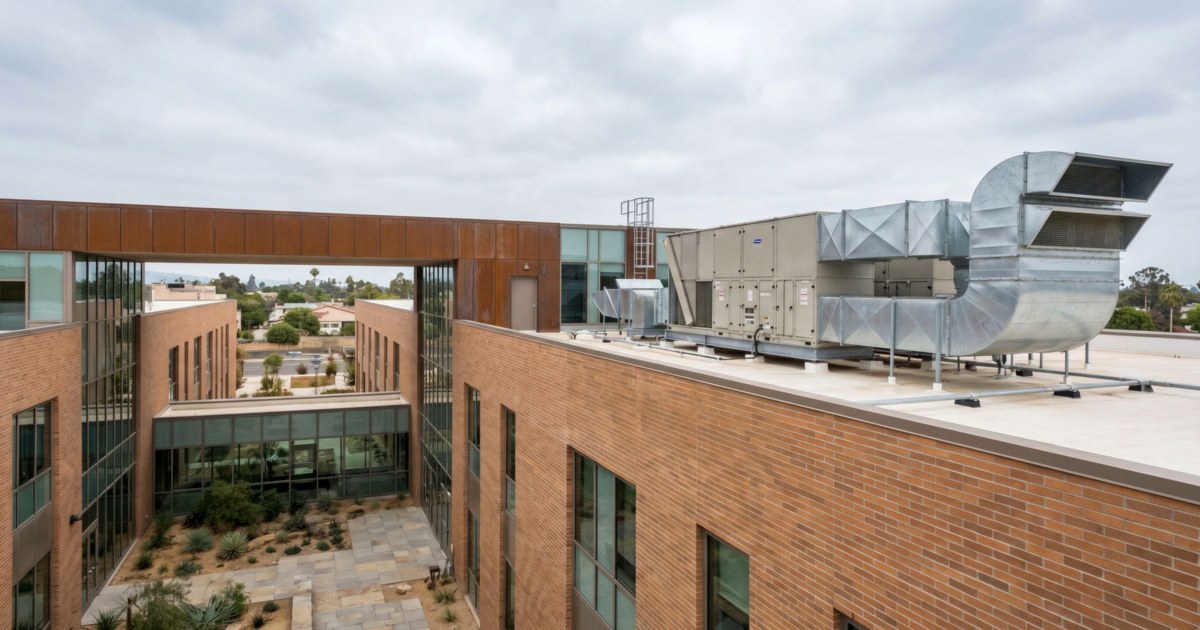
California schools are sitting on decades of deferred ventilation work. Many buildings still run on packaged rooftop units from the early 2000s with no outside-air modulation, no CO2 sensors, and economizers that haven't cycled correctly in years. When a district finally funds a retrofit, the spec often defaults to whatever the design engineer wrote up last time.
That's your opening. If you can walk into a district facilities meeting with a peer-reviewed study showing 80% HVAC energy reduction against a natural-ventilation baseline — plus another eight percent from CO2 demand control — you've changed the conversation from "this costs money" to "this pays back measurably."
The CO2 demand control piece is worth a closer look. Instead of fixed outside-air rates, the ventilation system reads classroom CO2 and ramps fresh-air delivery up or down against occupancy. Empty classrooms at 2 p.m. during a staff meeting don't get over-ventilated. Full classrooms during third period get the air they need. The hardware is cheap. The savings are real.


What to Actually Spec
On your next school bid, add a line item for CO2 sensors in every classroom zone and tie them to the VFD fan controller. It's a few hundred dollars per classroom and it's the single change in this study that moved the needle another eight percent on energy.
Variable-frequency drives on supply fans, properly commissioned economizers, CO2 sensors tied to demand control, and a DDC system that can actually enforce setpoints — that's the stack. Skip any one of them and you leave savings on the floor. The study flagged commissioning quality as the difference between a system that hits the modeled numbers and one that drifts within a year.
Districts funding retrofits through Prop 39 successors or CALSHAPE money need documented energy performance. Peer-reviewed modeling gives your proposal teeth that vendor datasheets don't.
One more thing. The study was run on Mediterranean-climate schools, which happens to describe most of California outside the Central Valley. For inland districts that hit 110F, the fan-energy share shifts, but the demand-control layer still holds up. Don't throw out the whole playbook because your climate zone is a bit hotter.
For related coverage, see our reporting on DOE 2027 efficiency standards and smart appliance diagnostics.
Source
Maiques, M., Tarragona, J., Gangolells, M., & Casals, M. (2025). "Energy implications of meeting indoor air quality and thermal comfort standards in Mediterranean schools using natural and mechanical ventilation strategies." Energy and Buildings, Vol. 328, Article 115076. https://doi.org/10.1016/j.enbuild.2024.115076
Need a repair professional?
Get free quotes from verified technicians in your area.
Find a Pro Near You