


Stanford Study Puts a Number on Gas Stove NO2 Exposure: 4 ppb, and It Doesn't Stay in the Kitchen
Maria Solano
Former appliance warranty claims adjuster turned investigative repair journalist. Maria's 'What Went Wrong' teardown series has made her the most feared woman in the white-goods industry.
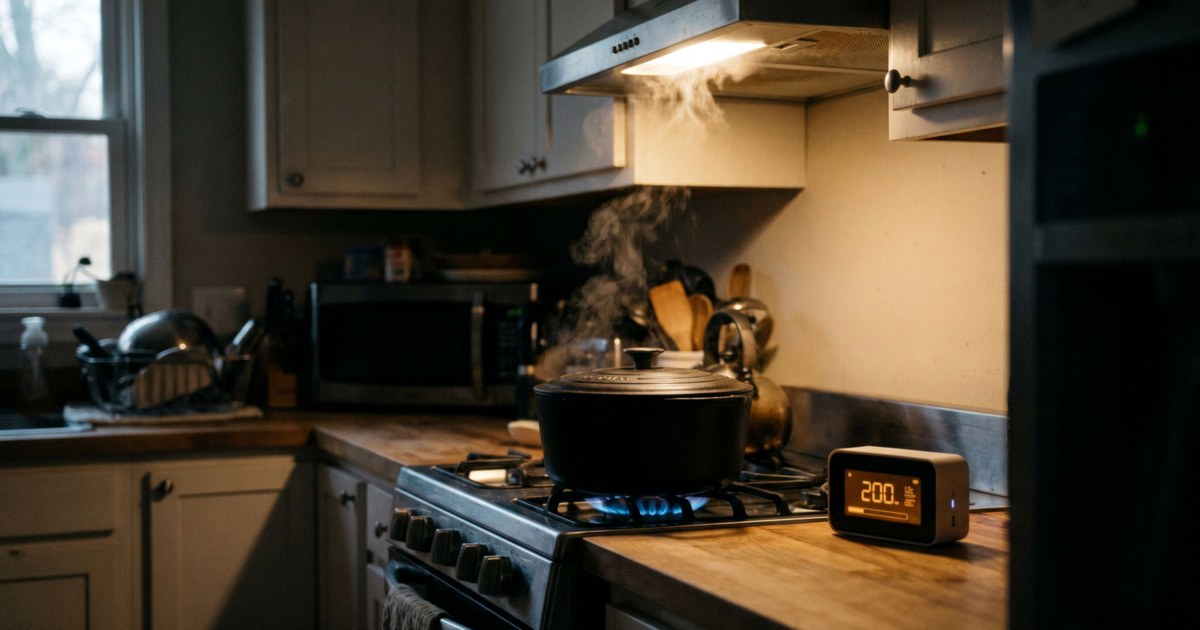
A Stanford-led team measured stove emissions in more than 100 homes and put a hard number on a question the industry has argued about for years. Typical gas or propane stove use adds 4.0 parts per billion to a person's long-term nitrogen dioxide exposure. That's three-quarters of the World Health Organization's annual exposure guideline, used up before anyone counts traffic or outdoor sources.
The paper, published in Science Advances by Yannai Kashtan, Rob Jackson, and colleagues, is worth a tech's attention because of how the measurements were done. The team metered NO2 from 50 gas, 11 propane, and 14 electric stoves across 20 counties in California, Colorado, Texas, New York, and Washington, D.C., then combined those emission rates with a room-by-room indoor air model and real housing data. Not a survey. Actual sensors in actual kitchens.
Two findings matter most for anyone who services gas cooking equipment.
First, the pollution travels. In bedroom measurements, NO2 concentrations exceeded the EPA's 1-hour benchmark within 25 minutes of cooking in half the homes tested. After the oven went off, bedroom levels stayed above health guidelines for another 2 to 3 hours. The exposure isn't a kitchen problem that ends when dinner's plated.
Second, home size dominates. Residents of homes under 800 square feet saw 8.6 ppb of stove-attributable exposure, more than four times the 2.0 ppb in homes over 3,000 square feet. Same appliance, very different dose. That drove demographic gaps too: long-term NO2 exposure from stoves ran 60% above the national average in American Indian and Alaska Native households and 20% above average in Black and Hispanic or Latino households.
On health, the authors estimate gas and propane stoves account for roughly 50,000 current cases of pediatric asthma from long-term NO2 exposure. They also publish a mortality estimate of up to 19,000 adult deaths annually, which they flag as carrying far more uncertainty. The asthma link itself isn't new; the paper builds on five decades of epidemiology tying NO2 to respiratory disease regardless of where the gas comes from.
What the Gas Stove NO2 Findings Mean on a Service Call
None of this requires a tech to take a side in the gas-versus-electric fight. It does suggest a few concrete service items.
Ventilation checks belong on the ticket. The study found outside-venting range hoods cut hour-averaged kitchen NO2 by anywhere from 10% to 70%, with a mean reduction of 35%. That spread is the story. Some outside-venting hoods in the study were simply ineffective, and plenty of installed hoods are recirculating units that move air through a grease filter and back into the room, doing nothing for combustion gases. Verifying that a hood actually ducts outdoors, that the damper opens, and that the customer runs it every time a burner lights is a five-minute check most shops never bill for. It's legitimate work. So is replacing a hood that fails the check.
The findings also pair with combustion work techs already do. A range that's burning dirty emits more than one pollutant, and the same habits covered in our combustion analysis guide apply at the cooktop: a documented reading turns "your stove seems fine" into a number the customer can keep. Anyone opening up gas cooking equipment should already be following the practices in our gas valve troubleshooting and safety guide.
And then there's the conversion conversation. Customers are reading the same coverage of this research that you are, and some will ask about switching. A tech who can speak plainly about the 4 ppb figure, what a working hood does and doesn't fix, and what an induction swap involves (often a 240V circuit, sometimes panel work) is more useful than one who waves the question off. Induction is no longer a niche ask; Samsung, Thermador, Wolf, and Bosch all pushed mainstream induction lines this year.
The honest read of the study: gas ranges aren't going away, small homes bear most of the exposure, and ventilation, properly installed and actually used, is the lever a service company controls. That's a service item, not a political position.
Source
Kashtan, Y., Nicholson, M., Finnegan, C.J., et al. (2024). "Nitrogen dioxide exposure, health outcomes, and associated demographic disparities due to gas and propane combustion by U.S. stoves." Science Advances, 10(18). https://doi.org/10.1126/sciadv.adm8680
Need a repair professional?
Get free quotes from verified technicians in your area.
Find a Pro Near You