


Two-Stage R-290 Liquid-to-Liquid Heat Pump Boosts Cold-Climate Heating 18%

Dale Resnick
A 30-year veteran of residential HVAC who's crawled through more attics than he can count.
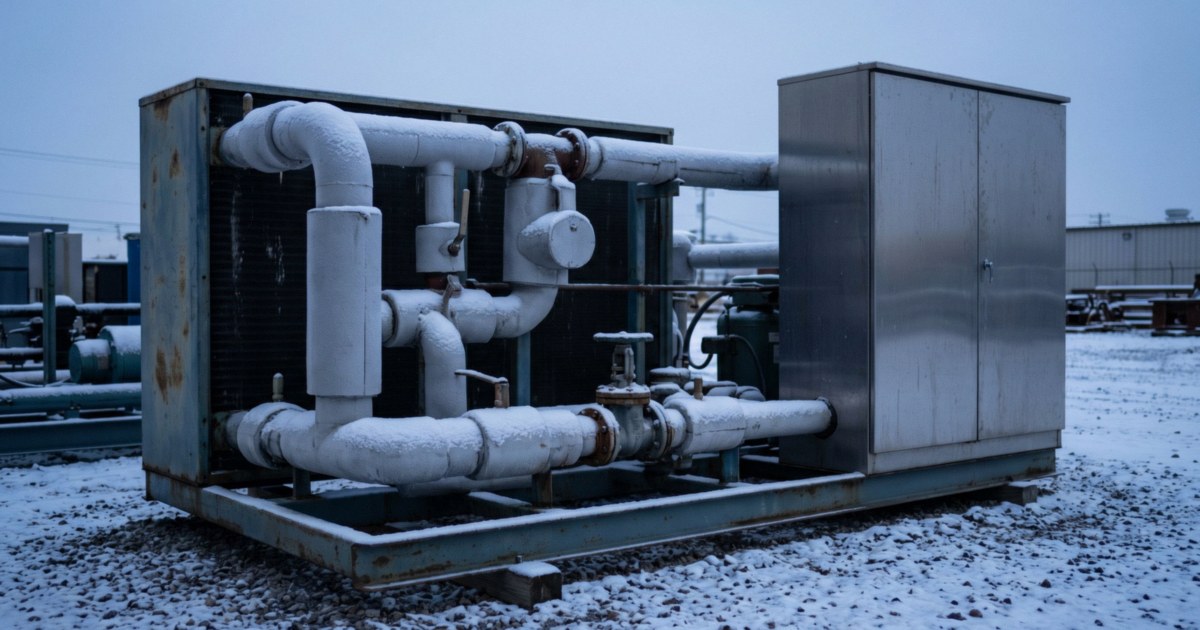
Purdue researchers published a 2025 Applied Thermal Engineering paper on a two-stage R-290 liquid-to-liquid heat pump that cold-climate installers should file away. The variable-speed unit, with independent control of each compressor stage, delivered 18.3% higher heating capacity and 5.8% better COP at minus 8.3°C compared with a single-stage design built on the same refrigerant.
R-290 is propane. GWP of 3. A3 class, which means flammable.
The indirect liquid-to-liquid architecture is the clever part. Rather than pushing propane charge through indoor coils inside a home, the unit heats a brine or glycol loop outdoors and that loop carries the energy inside. The R-290 stays confined to the outdoor cabinet, which keeps the flammable charge small and isolated from occupied spaces.
For California installers watching the A2L and A3 code path questions, this kind of architecture is relevant even if propane heat pumps aren't hitting residential showrooms yet. The state is actively figuring out where A3 refrigerants can go, and indirect designs are one of the most promising answers for residential and light commercial.
Why two-stage matters at low ambient
Single-stage compression struggles at low outdoor temperatures. The pressure ratio climbs, volumetric efficiency drops, and the refrigerant mass flow that actually delivers heat gets squeezed. Cold-climate heat pumps for decades have addressed this with vapor injection, economizers, or multi-stage setups.
The Purdue rig ran two stages with independent speed control. That lets the controller pick the best compression split for each operating condition rather than living with whatever fixed pressure ratio a geared or sequenced setup would deliver. The 18.3% capacity gain at minus 8.3°C is where that flexibility shows up.
For contractors pitching cold-climate work in mountain communities or high-desert California, those are the exact ambient conditions where the sale is hardest to make. A meaningful capacity boost with an honest COP improvement changes how a proposal reads.
When R-290 liquid-to-liquid products reach the residential market, expect them to price above air-source R-454B units. The hydronic distribution on the building side (radiators, radiant panels, coils in air handlers) is an additional cost. Budget accordingly when scoping early projects.


The code and training picture
EPA and state-level approvals for A3 refrigerants in residential applications are evolving. California in particular is drafting rules that will define where propane heat pumps can be sold and installed, and those rules lean heavily on confinement architectures like the one Purdue tested.
Training will follow. Expect manufacturer-specific A3 handling courses to appear as products come to market. The combustion safety mindset from gas work maps over reasonably well, but the specific procedures for propane refrigerant charges are different enough to warrant dedicated instruction.
The indirect approach also simplifies service. A tech working on the indoor hydronic side isn't working with flammable refrigerant at all, just brine or glycol. That's a meaningful safety improvement over direct-expansion R-290 units.
For related coverage, see our EPA refrigerant transition update and our heat pumps outsell gas furnaces article.
Source
Bani Issa, A. A., Liang, C., Liu, H., Groll, E. A., & Ziviani, D. (2025). "Experimental analysis of a liquid-to-liquid two-stage R290 heat pump system for residential cold-climate applications." Applied Thermal Engineering. https://www.sciencedirect.com/science/article/abs/pii/S1359431125018150