


Seven Field Studies Agree: Heat Pumps Hold a COP Near 2 Well Below Freezing

Dale Resnick
A 30-year veteran of residential HVAC who's crawled through more attics than he can count. Dale writes the 'Duct Tape & Beyond' column and believes every compressor tells a story if you listen close enough.
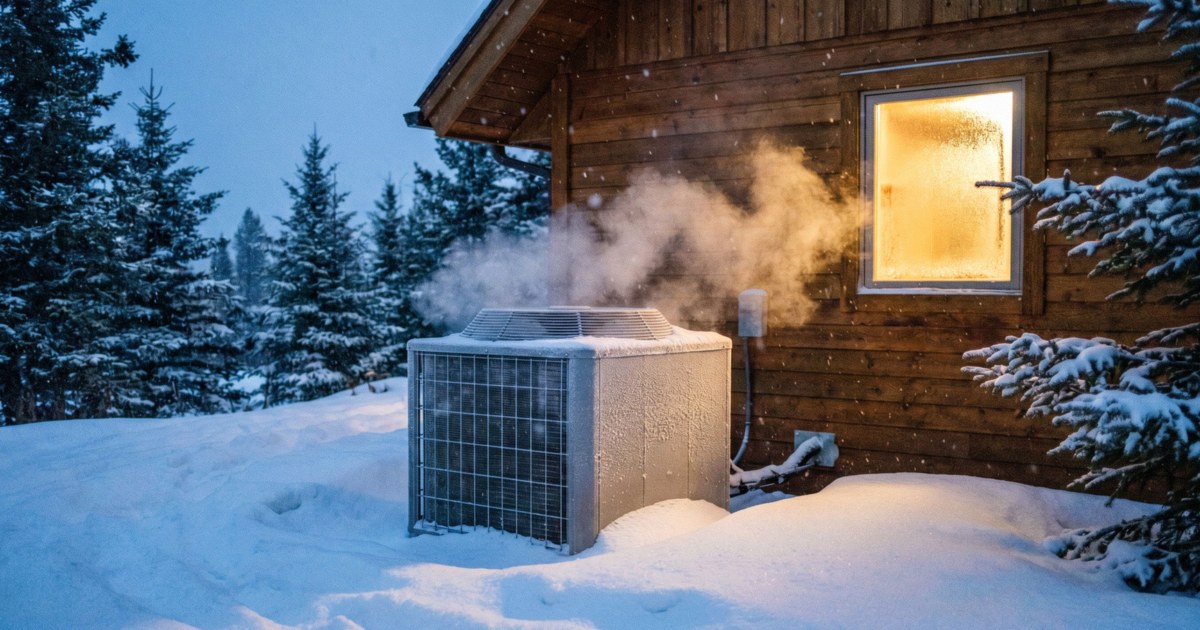
Every tech who quotes a heat pump hears the same objection at the kitchen table. "I heard those don't work in the cold." In 2023, four researchers put that claim up against field data from roughly 550 installed heat pumps and more than 2,760 real-world efficiency measurements, published as a commentary in the journal Joule. The claim lost.
Duncan Gibb, Jan Rosenow, and Richard Lowes of the Regulatory Assistance Project, working with Neil Hewitt of Ulster University, pulled together seven field studies spanning Europe, North America, and Asia. Not lab benches. Occupied houses, monitored through actual winters, with measured coefficient of performance plotted against outdoor temperature.
Here's the headline number. Between 41°F and 14°F, the air-source units in those studies averaged a COP around 2.7. One watt of electricity in, 2.7 watts of heat out. Electric resistance heat is stuck at a COP of 1 no matter how you wire it.
Performance does slide as the mercury drops. Nobody's claiming otherwise. But the field data showed standard air-source units still running at a COP around 2 on the coldest days recorded in the studies. And purpose-built cold-climate machines tested in extreme conditions held COPs between 1.3 and 2 at temperatures heading toward -22°F. Even at the bottom of that range, the heat pump stays ahead of a resistance coil.
Stacked against combustion, the gap gets wider. The review found heat pumps running two to three times more efficient than oil and gas systems between 32°F and 5°F. Down near -22°F the advantage narrowed but never disappeared; cold-climate units still held a COP of 1.5 to 2 — roughly double what a resistance coil delivers.
One detail worth keeping in your back pocket: the Canadian installs in the dataset averaged a COP of 3.3 in the moderate-cold band — among the strongest results, behind only Germany at 3.7. A place with some of the harshest winters still posted strong numbers, which tells you what proper sizing and commissioning for the climate can do.
That's the part the customer never hears.
Where the Cold-Weather Reputation Came From
The "doesn't work in the cold" line isn't pure myth. It's a memory. Builder-grade single-speed units from the 1990s really did fall off a cliff below freezing and lean on strip heat half the winter. What changed is the hardware: inverter-driven compressors, vapor injection, smarter defrost logic. The Joule data reflects what current equipment does in real houses, and the cold-climate category keeps moving; see the two-stage R-290 prototype that posted an 18% heating boost in cold-climate testing.
Gibb and his coauthors include an honest caveat, and you should too. In climates that regularly sit below about 14°F, supplemental heat can still make sense, because building heat demand climbs at exactly the moment capacity drops. That's an argument for careful Manual J work and a hard look at design temperature, not an argument against the equipment. A heat pump undersized for the design day will disappoint no matter what the meta-analysis says.
For shops in mild-winter territory the conversation is easier. Our heat pump vs. furnace guide for Southern California covers that math, in a market where the cold-weather objection barely applies at all.
The market isn't waiting on the skeptics. Heat pumps have been outselling gas furnaces in the US for several years running, and every one of those sales went through somebody who had to answer the cold question first. Now there's a peer-reviewed answer: across 550 systems, seven studies, and three continents, the equipment kept working. Print the chart, laminate it, and leave it in the truck.
Source
Gibb, D., Rosenow, J., Lowes, R., Hewitt, N.J. (2023). "Coming in from the cold: Heat pump efficiency at low temperatures." Joule, 7(9), 1939-1942. https://www.cell.com/joule/fulltext/S2542-4351(23)00351-3
Need a repair professional?
Get free quotes from verified technicians in your area.
Find a Pro Near You