


A2L Refrigerants in the Field: Tools, Leak Detection, and Transport Rules for R-454B and R-32
Dale Resnick
A 30-year veteran of residential HVAC who's crawled through more attics than he can count. Dale writes the 'Duct Tape & Beyond' column and believes every compressor tells a story if you listen close enough.
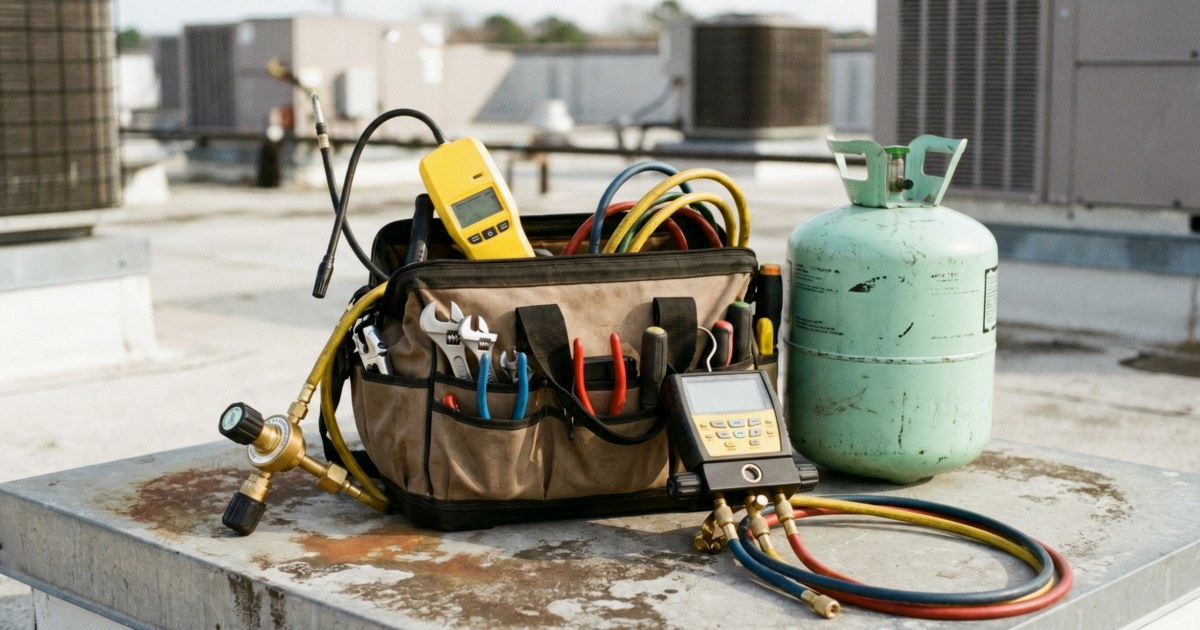
A2L refrigerants stopped being a seminar topic on January 1, 2025. That's when the EPA's Technology Transitions rule ended manufacture of new residential systems built for R-410A, and every major OEM moved to R-454B or R-32. Eighteen months on, those systems are past the install-warranty honeymoon and landing on ordinary service tickets. If you haven't put gauges on one yet, you will this summer.
This guide covers the hands-on side: the tools, the leak detection rules, the cylinder hardware, and what you can legally carry in the van. For the regulatory backstory, start with our R-410A phase-down guide for technicians, and keep an eye on the EPA rollback fight under the AIM Act, because the political weather keeps shifting even while the equipment in the field does not.
What Actually Changes on a Service Call
Less than the trade-show panic suggested.
The refrigeration physics hasn't moved. R-454B runs pressures close enough to R-410A that your gauge habits transfer almost directly. R-32 runs somewhat higher pressures and noticeably hotter discharge temperatures, which matters when you're interpreting superheat at the compressor. Recovery, evacuation to below 500 microns, and charging by weight all work exactly the way they always have.
What changes is ignition discipline. A2L means "lower flammability" in the ASHRAE classification: these blends are hard to light, with burn velocities under 10 cm/s, and they need both a concentrated pocket of refrigerant and a high-energy ignition source. An open torch flame qualifies. A relay arcing inside a non-rated recovery machine might. So the rules now care about which tools you own, where the refrigerant pools, and what's sparking nearby.
Your EPA 608 card still covers the work. No new federal certification exists for A2Ls, though distributors increasingly ask about A2L training before they'll sell you the gas. Our refrigerant handling and EPA 608 compliance guide covers the recordkeeping side, which hasn't changed.
Tooling Up for R-454B and R-32
The recovery machine is the big-ticket item. It needs to be A2L-rated, meaning spark-resistant construction with sealed switching. The Fieldpiece MR45 carries the rating and streets around $1,150. NAVAC's dual-cylinder flammable-refrigerant unit runs about $1,100. Plenty of machines sold in the past few years are already rated, so check the label on yours before spending money. The label, not your memory of the sales pitch.
Vacuum pumps follow the same logic. The worry is motor and switch arcing, and most current-production pumps from the major brands now carry A2L ratings. Older pumps with open brush motors are the ones to retire from A2L work.
Manifolds, scales, and core tools mostly carry over. The catch is at the cylinder: left-hand valve threads mean your existing hoses won't connect without left-hand adapters or new hose ends.
That's roughly $1,600-2,000 to fully outfit a truck that has nothing rated, and far less for most shops that bought tools recently. Spread over the service life of the equipment, it's a modest bill for staying in the residential AC business.
A2L Leak Detection: Your Detector and the Equipment's Own Sensors
Handheld first. Heated diode detectors, the old standby, lose sensitivity as the sensor ages and aren't uniformly rated for A2L blends. Infrared is the safer buy. The Fieldpiece DR82 is rated for A2L and A1 refrigerants, finds leaks down to 0.03 oz/yr, and its sensor is rated for up to 10 years. If your detector predates the transition, verify the rating in writing or replace it.
The bigger shift is that the equipment now watches for leaks on its own. UL 60335-2-40, the safety standard A2L systems are listed under, requires a refrigerant detection system on equipment where the charge exceeds what the room volume can safely dilute. Charge limits are calculated against the smallest room the unit serves, with a safety factor of 4. When the onboard sensor reads 25% of the refrigerant's lower flammability limit, the board responds: typically it locks out the compressor and any ignition-capable components and drives the blower to dissipate the pocket of refrigerant.
That changes your diagnostics. A blower running with no call and a locked-out compressor is not automatically a stuck relay or a failed board. Check for an RDS fault code before condemning anything. And know that these sensors have a service life; some boards will lock out heating and cooling entirely when the sensor expires, which means a future service call that didn't exist in the R-410A world.
A2L blends are denser than air, so leaked refrigerant pools low. Before any hot work, and honestly before any diagnosis on a suspected leaker, sweep your detector along the floor of the equipment closet, the bottom of the air handler cabinet, and the lowest point of a basement or crawlspace. Sampling at standing height tells you almost nothing.


Cylinders: Left-Hand Threads, Red Bands, and Relief Valves
Cylinder identification changed across the board under AHRI Guideline N: everything is gray now, with the refrigerant identified by the printed label rather than paint color. A2L cylinders add a red band or a fully red top to flag flammability.
Two hardware differences matter in the field. The left-hand valve threads, mentioned above, exist so R-410A equipment physically can't connect. And the relief device is different: A2L cylinders use a resettable pressure relief valve where R-410A cylinders use a rupture disc. Overpressurize an R-410A jug and the disc bursts, dumping the entire charge. An A2L relief valve vents just enough to drop the pressure, then reseats.
One warning here. Noncompliant import cylinders have been showing up with rupture discs on A2L refrigerant, mostly gray-market product. A rupture disc dumping 20 lbs of flammable gas in an enclosed space is exactly the scenario the valve exists to prevent. Buy from your distributor, and look at the valve.
Transport: The 440-Pound Question
A2L cylinders ship as Class 2.1 flammable gas under DOT rules, which sounds worse than it plays out. The materials of trade exception covers a working service vehicle: up to 440 lbs gross weight of cylinders, no placards, no shipping papers, no hazmat-certified driver. Keep cylinders secured upright, valve caps on, in a ventilated cargo area. One detail that catches people: any single Division 2.1 cylinder is also capped at 220 lbs gross under the MOT exception, and the cylinders must still carry their DOT hazard labels — it's the placards on the vehicle that the exception waives, not the labels on the bottle.
For most residential techs carrying two or three jugs plus a recovery cylinder, nothing about your routine changes except the fire extinguisher. Carry a Class B dry powder unit. Some carriers and local jurisdictions layer on their own requirements, so a five-minute call to your insurance agent is worth making.
Separately, 49 CFR 173.307(a)(4)(iii) exempts refrigerating machines and their components — packaged units, precharged condensers, mini-split line sets — holding 12 kg (25 lbs) or less of flammable non-toxic gas from the Hazardous Materials Regulations entirely, except when offered or transported by air. So hauling a precharged mini-split condenser down the highway is just hauling equipment; put it on a plane and the exception no longer applies.
Brazing and Jobsite Ventilation
The brazing rules are the rules you were already supposed to follow, now with sharper consequences. Recover the full charge. Break vacuum with nitrogen and keep a purge flowing while you braze. Verify with your leak detector that the work area and the line set are clear before the torch ever lights.
Ventilation deserves real attention in below-grade work. Because these blends sink, a basement or crawlspace leak concentrates at the floor where your torch and your knees are. Move air at floor level with a blower before hot work, not after. In an attic or open mechanical room, normal air exchange usually handles it, but run the detector sweep anyway. Takes two minutes.
Keep the obvious ignition sources out of the work zone while refrigerant is being transferred: no smoking, no open flame, no running the shop vac with the brush motor right next to the recovery rig.
None of this is exotic. The techs who treated R-410A's arrival in the early 2000s as a tooling upgrade rather than a crisis did fine, and the same play works here — buy the rated tools once, respect where the gas pools, and the A2L service call becomes just another ticket.
Do I need a new EPA certification to work on A2L refrigerants like R-454B and R-32?▾
No. EPA Section 608 Type II or Universal certification covers A2L refrigerants the same as R-410A. There is no separate federal A2L license. Distributors and many employers expect A2L safety training, which runs $20-50 online through providers like ESCO Institute.
How much A2L refrigerant can I transport without DOT placards?▾
Under the DOT materials of trade exception, a service vehicle can carry up to 440 lbs gross weight of refrigerant cylinders without placards, shipping papers, or hazmat training certification. Cylinders must be secured upright with valve caps on, and any single Division 2.1 cylinder is capped at 220 lbs gross. Separately, 49 CFR 173.307(a)(4)(iii) exempts refrigerating machines and components holding 12 kg (25 lbs) or less of flammable non-toxic gas from the Hazardous Materials Regulations entirely, except when transported by air.
Will my R-410A leak detector work on R-454B and R-32?▾
Check the rating label. Older heated diode detectors lose sensitivity and aren't all rated for A2Ls. Infrared detectors like the Fieldpiece DR82 ($300-400) are rated for A2L and A1 refrigerants, detect leaks down to 0.03 oz/yr, and carry sensors rated for up to 10 years.
Why do A2L cylinders have left-hand threads?▾
To physically prevent connecting R-410A hoses and equipment to an A2L cylinder. You'll need left-hand thread adapters or new hose ends ($20-60). A2L cylinders are gray with a red band or red top per AHRI Guideline N, and use a resettable pressure relief valve instead of a rupture disc.
Sources
- U.S. EPA. "Technology Transitions: HFC Restrictions by Sector" (AIM Act Technology Transitions rule). epa.gov
- UL Solutions. "Updated Requirements for Refrigerant Detection Systems" (UL 60335-2-40 RDS). ul.com
- U.S. DOT / PHMSA. "49 CFR 173.6 — Materials of trade exceptions." ecfr.gov See also 49 CFR 173.307(a)(4)(iii) for the refrigerating-machine exception (12 kg / 25 lb or less of flammable non-toxic gas, except by air). ecfr.gov
- AHRI. "Guideline N — Assignment of Refrigerant Container Colors" (2017). ahrinet.org
Need a repair professional?
Get free quotes from verified technicians in your area.
Find a Pro Near You