


Combustion Analysis for Gas Appliances: Using an Analyzer on Furnaces and Water Heaters
Dale Resnick
A 30-year veteran of residential HVAC who's crawled through more attics than he can count. Dale writes the 'Duct Tape & Beyond' column and believes every compressor tells a story if you listen close enough.
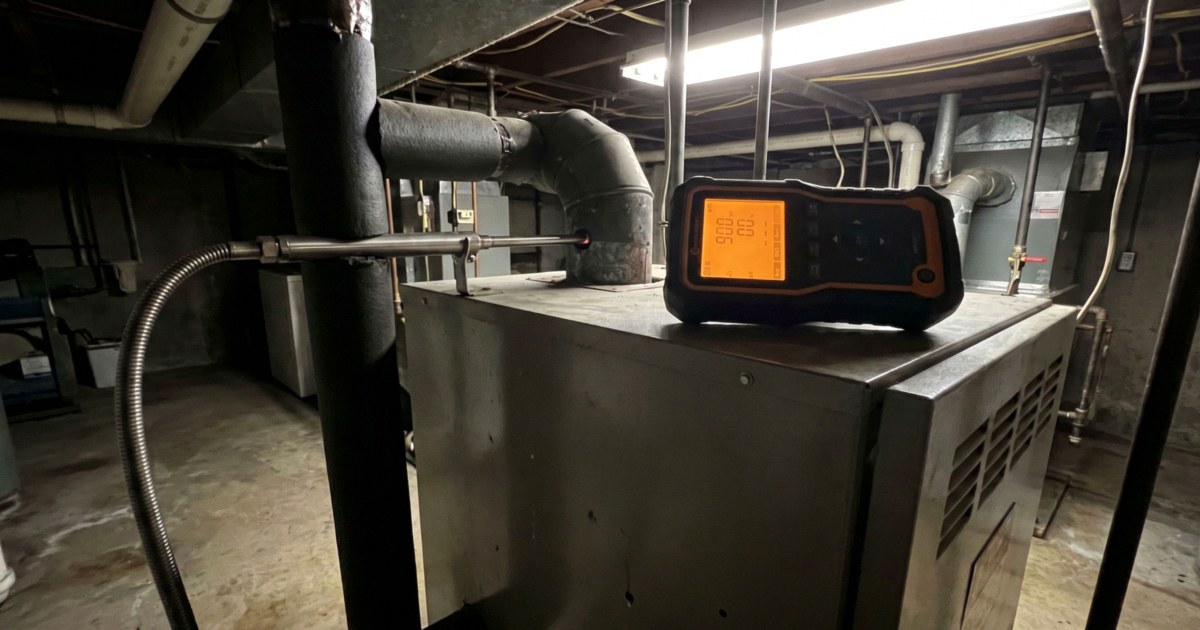
Combustion analysis is the line between "I cleaned the flame sensor and it looks good" and a documented, numbers-on-paper safety service. The analyzer reads what the flame is actually doing inside the heat exchanger, which your eyes cannot, and it turns a $89 tune-up into work you can defend and charge for. This guide covers what the four core readings mean, target numbers for furnaces and water heaters, where to put the probe, and how to read the ugly results.
A surprising number of techs own an analyzer and use it as a CO alarm. It's a diagnostic instrument. Treat it like one.
What the Four Readings Tell You
Oxygen (O2) is your excess air gauge. Perfect combustion would consume all the oxygen; real appliances run lean on purpose. On natural gas you want 6-9% O2 in the flue. Lower means the fire is running rich and flirting with incomplete combustion. Much higher means excess air is scrubbing heat out of the exchanger and your efficiency is leaving through the vent.
CO2 is the mirror of O2, and most analyzers calculate it rather than measure it. Natural gas tops out near 11.7% CO2 at perfect stoichiometric combustion, so a real-world 8-9.5% confirms the O2 story.
Carbon monoxide is the safety number, and the raw ppm on the screen is only half of it. Excess air dilutes the sample, so analyzers compute CO air-free: CO multiplied by 20.9 divided by (20.9 minus O2). A reading of 100 ppm measured at 14% O2 is over 300 ppm air-free. Dilution hides problems, and the air-free math un-hides them.
Stack temperature is your efficiency proxy and a venting health check. Too hot means heat is skipping the exchanger. Too cold on a non-condensing appliance means flue gases may condense in the vent, and acidic condensate eats B-vent from the inside out.
Combustion Analyzer Targets for Furnaces and Water Heaters
The certification ceiling first. ANSI Z21.47 allows a gas furnace to produce up to 400 ppm CO air-free and still pass. Nobody should tune to that number. Field training bodies like the National Comfort Institute treat 100 ppm as an action line, and a healthy furnace runs under 50. (NCI's published carbon-monoxide table frames 100 ppm as an as-measured stop-and-investigate level, not an air-free value; once you correct a diluted sample to air-free it climbs higher still, which is exactly why air-free is the number that matters.) Between 100 and 400 you have a unit that's legal and wrong, and it deserves a written recommendation.
For an 80% induced-draft furnace, look for 6-9% O2, CO under 100 ppm air-free and stable, and stack temperature 170-270°F above the supply air temperature. Natural-draft equipment runs hotter, 270-370°F above supply. Watch the trend across a full 10-minute run, not a snapshot at ignition; CO that climbs steadily as the blower comes on is the classic fingerprint of heat exchanger trouble disturbing the flame.
Condensing furnaces flip the stack logic. A 90%+ unit should show flue temperatures around 100-130°F, low enough that you can hold the PVC vent comfortably. A condensing furnace with a 200°F stack isn't condensing, and you should be asking why: overfired, airflow starved, or a plugged secondary exchanger.
Atmospheric water heaters are the appliance the trade skips, and they share the same air the furnace breathes. Targets are similar (CO under 100 ppm air-free), but the sampling location is everything, which we'll get to. Add the draft test: after five minutes of runtime, smoke or a mirror at the draft hood should confirm flue products are going up, not rolling out into the room. Power-vent water heaters behave like induced-draft furnaces and get sampled the same way.
Soft numbers without context condemn good equipment, by the way. High O2 with high CO points at flame impingement, misaligned or dirty burners, lifting flames. Low O2 with high CO points at overfiring or starved combustion air. Same CO, opposite fixes. Check manifold pressure (3.5" w.c. is the usual natural gas spec) and clock the meter before touching anything, and if the gas valve itself is suspect, work through our gas valve troubleshooting and safety guide before adjusting.
Where to Drill and Probe
On an 80% furnace, sample the single-wall flue 12-18 inches above the inducer outlet, upstream of any elbow or draft device. Drill 1/4" to 3/8", center the probe tip in the flue stream, and hunt for the hottest spot, since the highest stack reading is the true one. Plug the hole with a high-temp cap when you're done. An open test hole is a draft leak you installed.
Most 90%+ furnaces give you a factory test port near the vent connection or inducer outlet. Use it. If there isn't one, drill the PVC at least 12 inches downstream of the inducer and seal with a silicone test plug rated for the job. While you're at the termination, sample the combustion air intake too; recirculated flue gas from a bad termination layout shows up as elevated CO2 in the intake air and slowly poisons the combustion numbers.
The atmospheric water heater is where most sampling goes wrong. Probe above the draft hood and you're reading flue gas mixed with a slug of room air, which drives O2 up and CO down and makes a sick water heater look fine. Slide the probe through the draft hood opening, angled into the flue stream upstream of the dilution air. That's the real sample.
Zero the analyzer outside in fresh air every time, not in the mechanical room where ambient CO might already be elevated. And when the test is done, let the pump run clean air for a few minutes before you bag the tool. Purging the sensors after every test is the cheapest sensor-life extension there is.


Reading High CO Air-Free
High CO is a symptom with maybe six common causes, and the run-cycle trend narrows them fast.
CO stable but high from ignition points at the fire itself: dirty burners, misaligned crossovers, wrong orifices for the gas type or altitude, overfiring. CO that starts reasonable and climbs as the heat exchanger warms and the blower starts suggests the airflow side is disturbing the flame, and a cracked exchanger belongs on the suspect list. Confirm with a visual inspection and a scope before condemning; the analyzer raises the question, it doesn't answer it alone.
Don't forget the building. Depressurization from a big exhaust fan or a return leak in the mechanical closet can backdraft an atmospheric water heater that tested clean with the door open. Test under worst-case conditions: door closed, air handler running, dryer and kitchen exhaust on.
If the furnace won't even light long enough to test, that's a different workflow, covered in our furnace not turning on guide.
Turning Analysis Into a Billable Safety Service
Here's the business case. A tune-up without numbers is a subjective opinion competing on price. A combustion safety analysis with a printed or emailed report is documentation: before-and-after readings that justify the burner cleaning, the gas pressure adjustment, the vent repair, and the heat exchanger referral.
Numbers on paper close jobs.
The report also protects you. When CO air-free reads 250 ppm and the customer declines the repair, your documented reading and recommendation is the record that you found it and said so. Shops that fold analysis into every maintenance visit, the way our spring maintenance checklist treats it, find it pays for the instrument inside a season through legitimate found work.
Analyzer Choices and Calibration
Entry-level units like the Testo 310 II handle O2, CO, stack temp, and the calculated values, and street in the $450-600 range. That's enough instrument for residential furnace and water heater work. The mid-tier UEi C165+ runs about $1,500-1,700 (more in the kit with printer) and adds 10,000 ppm hydrogen-compensated CO measurement, draft, and differential pressure. Testo's 300-series smart-touch kits and Sauermann's Si-CA line compete in the same brackets, with the bigger kits adding wireless reporting that makes the customer-facing PDF painless.
Whatever you buy, budget for upkeep. Annual factory calibration is the standard recommendation, typically $100-200. O2 cells are consumables with a 2-3 year life; CO sensors usually last 3-5 years. An analyzer with an expired O2 cell lies with complete confidence, which is worse than no analyzer at all.
The instrument earns its keep the first time it catches a 300 ppm water heater the eyeball method would have passed. After that it's just how you do tune-ups.
What is an acceptable CO reading on a gas furnace?▾
ANSI Z21.47 allows up to 400 ppm CO air-free as a certification ceiling. Field best practice treats 100 ppm as the action threshold, and a clean, properly fired furnace typically runs under 50 ppm. CO that rises through the run cycle matters as much as the absolute number.
Where do you drill the test hole for combustion analysis?▾
On an 80% furnace, drill a 1/4" to 3/8" hole in the single-wall flue 12-18 inches above the inducer outlet, upstream of any draft device, and cap it afterward. Many 90%+ furnaces include a test port; otherwise drill the PVC at least 12 inches downstream of the inducer. On atmospheric water heaters, sample upstream of the draft hood to avoid dilution air.
How often does a combustion analyzer need calibration?▾
Annually at the factory, typically $100-200. O2 cells commonly last 2-3 years and CO sensors 3-5 years, with replacement cells around $80-150. Zero the analyzer in fresh outdoor air before every test.
What O2 and stack temperature should a gas furnace show?▾
On natural gas, target 6-9% O2 with CO2 around 8-9.5%. Stack temperature should run 270-370°F above supply air on natural-draft equipment and 170-270°F above supply on induced-draft 80% furnaces. Condensing furnaces typically show flue temperatures around 100-130°F.
Sources
Intertek. "ANSI Z21.47 / CSA 2.3 — Gas-Fired Central Furnaces." Standards Updates. intertek.com — the certification standard for gas-fired central furnaces, which sets the 400 ppm air-free CO ceiling referenced above.
U.S. Consumer Product Safety Commission. "Carbon Monoxide Emissions From Gas Furnaces." cpsc.gov (PDF) — CPSC technical report on furnace CO emissions and the air-free measurement basis.
National Comfort Institute. "Carbon Monoxide Test Numbers — What Do They Mean?" nationalcomfortinstitute.com — NCI's field reference for CO action thresholds, including the 100 ppm stop-and-investigate level.
Need a repair professional?
Get free quotes from verified technicians in your area.
Find a Pro Near You