


Five Appliance Maintenance Tasks Most Homeowners Overlook
Maria Solano
Former appliance warranty claims adjuster turned investigative repair journalist. Maria's 'What Went Wrong' teardown series has made her the most feared woman in the white-goods industry.
I spent several years processing appliance warranty claims before I switched to writing about them. In that time, I saw the same failures over and over, and in most cases the documentation trail made it clear: the failure was preventable. Not "preventable with the right technician" or "preventable if you'd bought a better model." Preventable with a vacuum cleaner and 20 minutes, twice a year.
These five tasks are the ones that generate the most avoidable service calls. None of them require tools. All of them take under 15 minutes when done on schedule. And all of them are almost never done, which is why appliance repair shops have steady business.
1. Clean the Dryer Vent — Every Year, Minimum
The dryer vent is a duct that runs from the back of the dryer through the wall to an exterior exhaust point. It carries hot, moist, lint-laden air out of the house. It accumulates lint on the duct walls with every load. Over time, the accumulation restricts airflow, raises exhaust temperatures, and eventually either causes a fire or blows the dryer's thermal fuse.
How often: Every 12 months for a typical household. Every 6 months if you have pets, use the dryer more than 7-8 times per week, or have a duct run longer than 15 feet.
How to do it:
- Pull the dryer away from the wall and disconnect the flex duct from the back.
- Use a dryer vent cleaning brush kit (a set of flexible rods with a lint brush head, available for $25-40) to run through the duct from inside out.
- Also clean the duct stub on the back of the dryer itself — lint accumulates inside the dryer's exhaust path too.
- Reconnect everything, push the dryer back, and make sure you haven't kinked the flex duct. A crushed flex duct behind the dryer is the second-most-common vent restriction after lint buildup.
Signs you're overdue: Clothes taking two or more cycles to dry, the exterior of the dryer feeling very hot during operation, or clothes that feel unusually hot at the end of a cycle.
For more on what happens when you skip this — including the specific parts that fail — see our complete dryer not heating diagnostic guide.
2. Clean the Refrigerator Condenser Coils — Every 6-12 Months
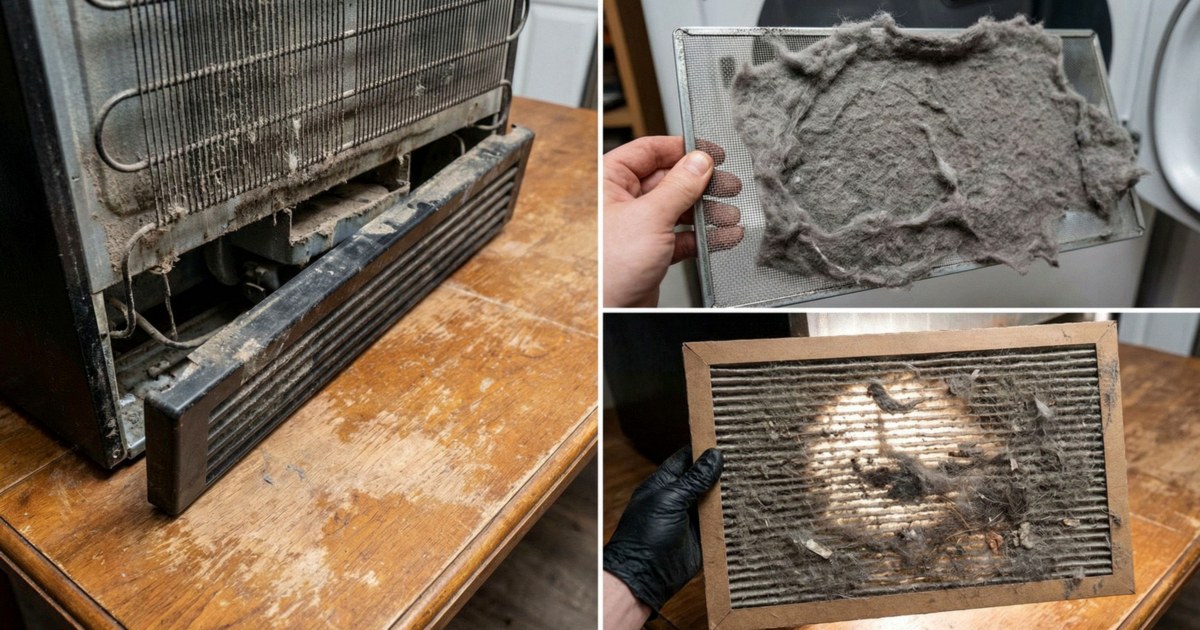
The refrigerator's compressor and condenser coils are how it dumps heat from the inside to the outside. The coils need to be able to release that heat into the surrounding air. When they're coated in dust and pet hair, they can't. The compressor runs longer cycles, runs hotter, and eventually fails early.
Where the coils are:
- Most modern refrigerators (2000s onward): Behind a grille at the bottom front of the unit, on or near the floor.
- Older refrigerators (1990s and earlier): On the back of the unit, exposed, where they're usually black.
- Some built-in and counter-depth models: May be at the top or require panel removal — check your owner's manual.
How to do it:
- Unplug the refrigerator or pull it away from the wall enough to access safely.
- Remove the front grille (usually snaps off or has one or two clips).
- Use a coil brush (a long, narrow brush, $10-15) or a vacuum with a brush attachment to remove dust from the coils and the condensate drip tray.
- Also clean the condenser fan if accessible — dust-clogged fan blades restrict airflow as much as dirty coils.
- Replace the grille and plug back in.
Signs you're overdue: The refrigerator feels warm on the outside at the bottom, the compressor runs almost constantly, or your electricity bill has crept up without explanation.
This is especially important in dusty environments (desert areas, homes with dogs that shed heavily) and homes where the refrigerator is in a confined space like a cabinet enclosure with limited air circulation.
For refrigerators already struggling to maintain temperature, see our refrigerator not cooling guide for the full diagnostic approach.
3. Clean the Dishwasher Filter — Every 1-3 Months
Modern dishwashers (roughly 2010 onward) use a manual-clean filter system instead of a self-cleaning grinder. The filter sits at the bottom of the dishwasher tub, usually under the bottom spray arm, and catches food particles during the wash cycle. It requires manual cleaning.
Most homeowners don't know this exists. The filter fills up quietly. Wash performance degrades gradually enough that they don't notice at first. Then the dishwasher starts smelling like drain water because decomposing food is sitting in the filter. Then dishes start coming out dirty. Then it starts not draining properly. Eventually someone calls a technician, who removes a filter that looks like it hasn't been touched since installation.
How often: Every month to three months depending on how heavily you use the dishwasher and how well you scrape dishes before loading.
How to do it:
- Remove the bottom rack.
- Locate the filter assembly — it's usually a cylindrical filter that twists to unlock, over a flat mesh filter.
- Remove both pieces and rinse under running water. For heavy buildup, soak in warm soapy water for 5-10 minutes and scrub with a soft brush.
- Reinstall both filter pieces. The cylindrical filter should twist to lock; a loose filter means dishes come out dirty.
While the filter is out, wipe down the filter housing and the area around it in the bottom of the tub. This is where food particles accumulate outside the filter and create odor. Also wipe the inside of the door gasket — another odor accumulation point that's easy to miss.


4. Clean the Front-Load Washer Door Gasket — Monthly
The door gasket on a front-load washer is a rubber bellows seal that creates a watertight seal between the drum and the door. It also traps water, lint, hair, and anything small that comes out of pockets in its folds after every wash cycle. That trapped moisture, in a sealed environment, creates mold within weeks.
The mold transfers to laundry. Clothes that smell fine coming out of the washer start smelling musty after sitting in a drawer. Sometimes the smell is noticeable right out of the washer. The solution that actually works is prevention.
How often: Wipe the gasket dry after every load. Deep-clean monthly.
After every load: Leave the washer door slightly ajar. This allows the drum and the inside of the gasket to dry out between uses. A sealed wet drum is a mold incubator.
Monthly deep-clean:
- Pull back the gasket folds and remove any debris — coins, hair clips, small socks.
- Wipe all the interior folds with a cloth dampened with a diluted bleach solution or washer cleaning spray.
- Dry thoroughly.
- Once a month, run a clean cycle with a washer cleaning tablet (Affresh, Tide Washing Machine Cleaner, or equivalent) on the hottest water setting.
When it's too late for maintenance: If the gasket has black mold embedded in the rubber, cleaning will reduce the smell but not eliminate it. Replacement is the permanent fix. Gasket replacement is a $150-300 repair depending on brand — still worth it compared to replacing the washer, but avoidable entirely with 2 minutes per laundry day.
5. Clean the Range Hood Filter — Every 3-6 Months
The range hood removes smoke, steam, grease vapor, and cooking odors from the kitchen. The filter is what catches the grease before it coats the fan motor and the inside of the ductwork. When the filter is saturated, the hood barely moves air. The grease goes into the ductwork instead. In extreme cases, grease buildup in range hood ductwork creates a fire risk.
How often: Every 3 months for heavy cooking (daily stovetop use, lots of frying). Every 6 months for light use.
Types of filters:
- Aluminum mesh filters (most common on residential hoods) — dishwasher-safe. Run them through the dishwasher on the hottest cycle. For heavy grease, soak in hot water with dish soap first.
- Baffle filters (common on higher-end hoods) — also dishwasher-safe. Usually more durable and easier to clean than mesh.
- Charcoal/carbon filters (recirculating hoods that don't vent outside) — not washable. Replace every 3-6 months; they cannot be cleaned.
Signs you're overdue: You can feel reduced suction when you hold your hand under the hood. The filter looks visibly saturated with yellow-brown grease. The kitchen fills with smoke more than it used to during high-heat cooking.
How to clean:
- Remove the filter (most slide or clip out from below the hood).
- Dishwasher method: hot cycle, heaviest setting. Works well for moderate buildup.
- Manual method for heavy grease: boil water in a large pot, add baking soda (1/4 cup), and submerge the filter for 1-2 minutes. The grease releases. Rinse with hot water, dry, reinstall.
These five tasks — dryer vent, condenser coils, dishwasher filter, washer gasket, range hood filter — represent the gap between the appliances that last 15 years and the ones that need service calls every 18 months. The same gap appears on every appliance service ticket for a preventable failure: "routine maintenance not performed."
How often should I clean my dryer vent?▾
At minimum, once a year for a dryer used 4-5 times per week. If you have a long duct run (over 15 feet), pets that shed, or use the dryer more frequently, clean every 6 months. A blocked dryer vent is the leading cause of dryer fires and a nearly guaranteed path to a thermal fuse failure. The cleaning takes about 20 minutes with a $25 brush kit.
How do I clean refrigerator condenser coils?▾
Unplug the refrigerator. Locate the condenser coils — either behind a grille at the bottom front (most modern refrigerators) or on the back (older models). Use a coil brush or vacuum with a brush attachment to remove dust buildup. Plug it back in. The job takes under 10 minutes and should be done every 6-12 months. In dusty or pet-hair-heavy households, clean every 6 months.
Why does my dishwasher smell bad?▾
A dishwasher that smells musty or like drain water usually has a clogged filter. The filter collects food particles during every wash cycle and needs to be removed and rinsed under running water every 1-3 months. A clogged filter also reduces wash performance and eventually causes drain problems. The filter is at the bottom of the tub and twists out for removal.
How do I prevent mold in my front-load washer?▾
Leave the door slightly ajar after every wash cycle to allow the drum to dry. Wipe the door gasket folds with a dry cloth to remove moisture. Run a hot clean cycle monthly with a washer cleaning tablet. Leaving the door sealed after every wash is the single most common cause of front-loader mold buildup in the gasket folds.
Need a repair professional?
Get free quotes from verified technicians in your area.
Find a Pro Near You