


Bosch Dishwasher E15 Error Code: Anti-Flood Fix Step by Step
Terry Okafor
Master refrigeration tech and NATE-certified instructor who moonlights as the magazine's advice columnist. His 'Ask Big Terry' mailbag has been settling shop disputes and diagnosing mystery leaks since 2011.
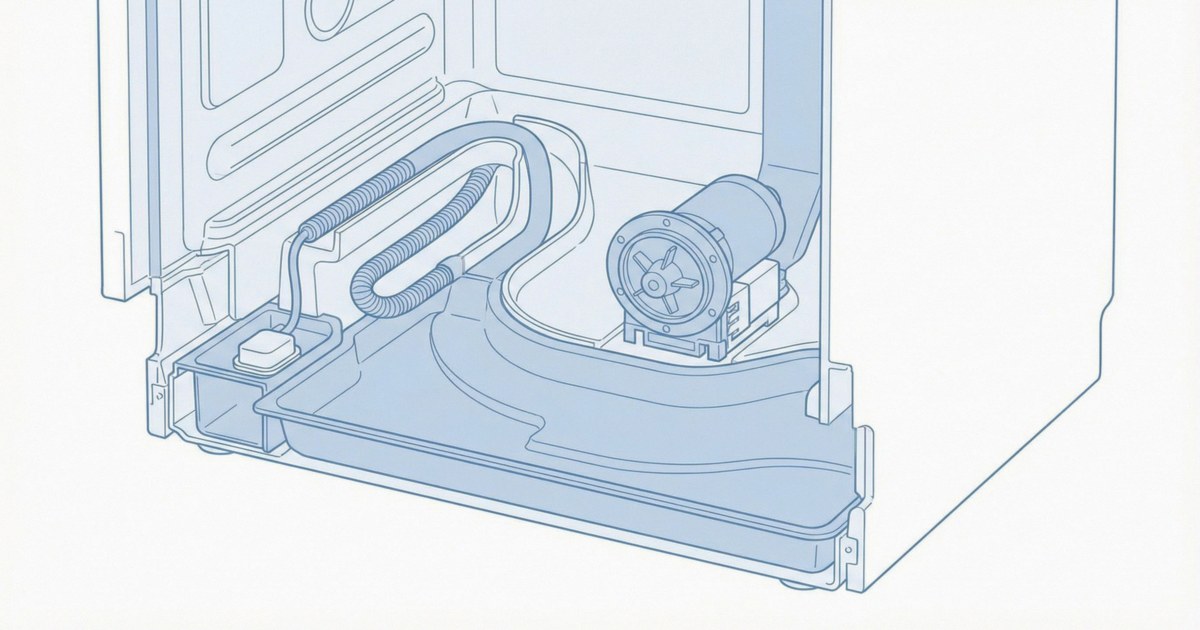
E15 is Bosch's anti-flood protection code, and it's one of the more dramatic error codes you'll encounter on a residential call — the machine is completely locked out, the display flashes E15 or shows a tap/water symbol, and the customer is convinced the dishwasher is done for. It almost never is. Here's the complete diagnostic and repair sequence.
What E15 Actually Means
Every Bosch dishwasher (and Bosch-manufactured Thermador models) has a polystyrene float in the base pan — the sheet metal or plastic tray that sits under the entire machine below the tub. When water accumulates in that pan from any source, the float rises. That activates a float switch connected to the control board. The board immediately activates the drain pump continuously (trying to evacuate water) and locks out all other functions.
The E15 error has two phases. First, the machine detects water in the pan and tries to drain. If the drain pump can't remove the water from the pan (there's no drain path from pan to pump in most models — the pump drains the tub, not the base), the float stays up and the lockout persists. The customer sees E15 and nothing happens when they press any button.
Step 1: Access the Base Pan
Pull the dishwasher out from under the counter. You'll need to remove the kick plate first — it's typically held by one or two screws at the bottom front. On Bosch 500, 800, and Benchmark series, the kick plate clips on without screws on some trims.
With the kick plate off, lay the dishwasher on its back on a moving blanket or cardboard. You'll immediately see the base pan. Most of the time, there's visible water standing in it. Towels and a wet-vac are the tools here. Absorb or vacuum out every drop.
Some techs tilt the dishwasher rather than laying it flat — tilt backward about 45 degrees, brace it, and the water runs to one corner where you can soak it up. This works on minor water accumulation. For significant water (more than a cup or two), laying it flat and vacuuming is faster and more complete. Either way, make sure the float mechanism physically drops back down to its resting position after the pan is dry — on a few models I've seen the float stick in the up position even with a dry pan.
Step 2: Dry the Pan and Test the Float Switch
With the pan drained, locate the float. It's a rectangular or cylindrical polystyrene block attached to a plastic bracket near the front-center of the base pan. Connected to it is a two-wire microswitch — that's the float switch. Manually push the float down and verify it moves freely. Then check the switch:
Disconnect the two wires from the float switch and test continuity. With the float in the down (normal) position, the switch should be open — no continuity. With the float pushed up (water present), the switch closes — continuity. If the switch fails either test, replace it.
Float switch part numbers:
- Bosch 300/500/800 series (most SHE, SHP, SHX models): 00165256 — this covers the vast majority of North American Bosch dishwashers built after 2005.
- Thermador DWHD650 and related: 00165256 as well — Thermador dishwashers share the Bosch platform exactly.
- Bosch Benchmark and 800+ series: some newer units use 12019637 — check the model number on the door jamb sticker to confirm.
Bosch part numbers vary by production run — confirm the exact number against your model's spec sheet or an authorized Bosch parts lookup before ordering.


Step 3: Find the Leak Source
Draining the pan clears the E15 error, but if you don't find and fix the leak, the customer will call back in two weeks. Run a full wash cycle with the machine pulled out and the base pan visible. Watch for drips.
Most common leak sources, in order of frequency:
Inlet Water Valve (Most Common)
The inlet valve is at the bottom-left of the machine behind the left side panel or accessed from below. It controls water fill. A failing inlet valve drips slowly even when the machine isn't filling — the solenoid coil or the valve seat wears and allows a slow seep into the tub, which overflows into the base pan over time.
Test: after a cycle, watch the bottom of the machine for 10-15 minutes at rest. Any drips from the valve area? Disconnect the water supply and check whether water continues to seep through — if it does, the valve is failing closed imperfectly (diaphragm wear).
- Bosch inlet valve (standard flow, SHE/SHP/SHX models): 00628334 — fits most North American Bosch
- Bosch inlet valve (Aquastop integrated cable version): 11019321 — used on units with the Aquastop supply line. Do not substitute a non-Aquastop valve on a unit originally equipped with Aquastop.
- Thermador: same part numbers as Bosch in most cases
Door Gasket/Seal
A damaged or deformed door seal allows water to spray out during the wash cycle and run down into the base pan. Look for cracked, hardened, or torn sections of the door gasket. Check the bottom corners especially — that's where gaskets fail first. The gasket seats in a channel around the tub opening; it can sometimes be reseated without replacement if it's only shifted out of its groove.
- Door gasket, Bosch 500/800 series: 00436458
- Door gasket, Bosch 300 series (shorter height): 00264051
Bosch part numbers vary by production run — confirm the exact number against your model's spec sheet or an authorized Bosch parts lookup before ordering.
Circulation Pump Seal
The circulation pump sits at the bottom of the tub. Its shaft seal can leak after 7-10 years of use. This is a slow, intermittent leak that's hard to reproduce during a single test cycle — run two consecutive cycles if you suspect it. The pump seal is typically replaced as part of the pump assembly.
- Circulation pump assembly, Bosch (with motor): 00654575 — covers most SHE, SHP, SHX 300/500/800 platforms
- Labor for pump seal/pump: $200-350 total
Step 4: Reinstall and Verify
Once the base pan is dry, the float switch is confirmed good, and the leak source is repaired, reinstall the dishwasher. Before sliding it fully under the counter, run a complete cycle with the kick plate off and your eye on the base pan. Zero water should appear. If the pan stays dry through a full hot-water cycle (including the heated dry), you're done.
If E15 returns during the test cycle, there's still an active leak. Go back to step 3 and look harder. Common miss: the Aquastop supply hose — some Bosch models have a dual-line supply hose with an integrated flood sensor in the hose coupling. If this internal hose has failed, it looks fine externally but leaks internally into the hose jacket, which drains into the base pan. Replace the entire Aquastop hose assembly if suspected.
For other dishwasher drain issues, including clogs and pump failures on Whirlpool platforms, our Whirlpool dishwasher not draining guide covers the parallel diagnostic.
What does E15 mean on a Bosch dishwasher?▾
E15 is Bosch's anti-flood error. Water accumulated in the base pan and raised the float switch, locking out the machine. The root cause is a leak — usually from the inlet valve, door gasket, or pump seal. The machine will stay locked until the pan is drained and the float drops.
How do I clear E15 on a Bosch dishwasher?▾
Pull the kick plate, tilt the unit backward 45 degrees to drain the base pan, or lay it on its back and soak up the water. Once the pan is dry and the float drops, the error clears. Then run a test cycle and watch for the source of the leak — otherwise it comes back.
How much does it cost to repair a Bosch E15 error?▾
A basic pan drain with no active leak is a $100-150 service call. An inlet valve replacement runs $200-280 all-in. A pump seal or pump assembly is $275-375. Door gasket replacement is $150-220. Aquastop hose replacement, if that's the source, is $60-100 parts plus $100-150 labor.
Need a repair professional?
Get free quotes from verified technicians in your area.
Find a Pro Near You