


How to Unclog a Dishwasher Drain: 3 Clog Points Every Homeowner Should Know
Maria Solano
Former appliance warranty claims adjuster turned investigative repair journalist. Maria's 'What Went Wrong' teardown series has made her the most feared woman in the white-goods industry.
Standing water in the bottom of a dishwasher looks alarming, but it's one of the most approachable appliance problems a homeowner can tackle. The majority of dishwasher drainage failures come down to one of three clog points, and two of them require nothing but your hands and maybe a small brush.
Here's what to check in order, starting with the fix that resolves about half of all standing-water calls.
First: Is the Standing Water Normal?
Before you start disassembling anything, know this: every dishwasher holds a small amount of water in the sump after a completed cycle. This is by design. The water — typically one to two cups' worth — keeps the pump seal hydrated and extends its life. The water sits below the filter assembly and is not visible unless you look for it.
What's not normal: water pooling above the filter, water visibly standing an inch or more deep in the tub after the cycle is complete, or a wash cycle that ends with the tub water level unchanged.
If you're not sure, run the dishwasher through a full cycle and check immediately when it ends. A puddle that's clearly above the filter assembly is a drain problem. A small amount visible only if you crouch down and look inside is normal.
Clog Point 1: The Filter Basket
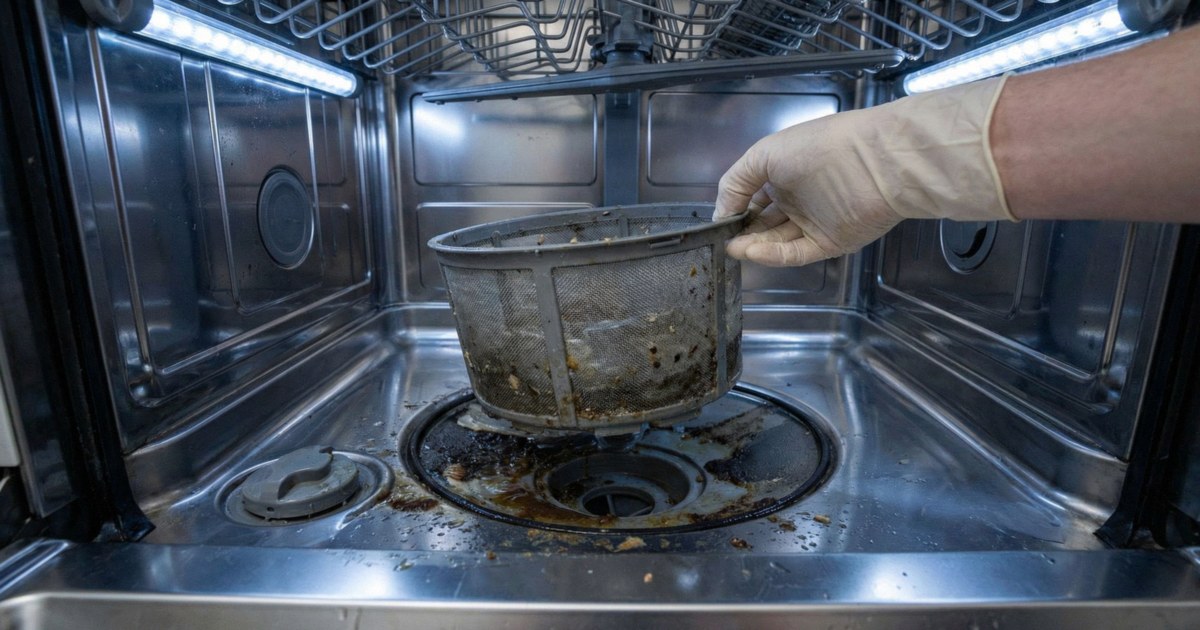
The filter assembly is the most common cause of standing water in modern dishwashers, and it's the easiest fix. Filters trap food debris to prevent it from clogging the pump. When the filter clogs, the pump can't pull water through it efficiently.
Location: The filter is in the bottom center of the dishwasher tub — the cylindrical or flat assembly under the bottom spray arm. Most filter systems have two parts: a cylindrical fine-mesh filter that twists out, and a flat coarse filter beneath it.
Removal:
- Remove the bottom dish rack
- Rotate the cylindrical filter counterclockwise (most brands — Whirlpool, Bosch, GE, Maytag) and lift it out
- The flat mesh filter usually lifts straight out after the cylinder is removed
Cleaning: Rinse the filter under warm running water. Use a soft brush — an old toothbrush is perfect — to scrub both mesh surfaces. For heavy grease buildup, soak in warm soapy water for 10-15 minutes first. Do not use anything abrasive on the fine mesh filter; it will damage the mesh and allow food particles into the pump.
Reinstall and test. Twist the cylindrical filter clockwise until it stops and locks. Run a short rinse cycle and check for drainage.
If the filter was visibly clogged — brown, greasy, full of debris — this is almost certainly your fix. Clean filters monthly for average use, more often if you run the dishwasher daily or don't pre-rinse dishes.
If the filter is clean and has been clean, and the dishwasher started draining poorly recently without any other changes, think about what changed in the kitchen. New garbage disposal? New disposal knockout that wasn't removed? Dishwasher hose moved during under-sink work? The problem almost always has a trigger — find the change and you'll find the cause.
Clog Point 2: The Air Gap and Garbage Disposal Connection
This is the most frequently overlooked clog point — especially on dishwashers connected to a garbage disposal.
The air gap is the small chrome or plastic cap mounted on the kitchen countertop or sink deck, usually near the faucet. Not every installation has one — some local codes require them, others don't. The air gap prevents contaminated sink water from back-siphoning into the dishwasher. Inside it is a simple plastic diverter that can clog with debris.
To check: unscrew the cap (it usually just lifts off or unscrews by hand). Remove the plastic cover underneath. You'll see two hoses connected to the air gap body — one from the dishwasher, one going to the disposal. Check for debris buildup inside the air gap body. If it's clogged, clean it with a toothpick or small brush and flush with water.
The garbage disposal connection: The dishwasher drain hose connects to either the garbage disposal or a dedicated drain line stub on the sink drain. There are two common problems here:
The knockout plug: New garbage disposals ship with a plastic plug in the dishwasher inlet port. If you installed a new disposal and your dishwasher stopped draining at the same time, this plug was never removed. It completely blocks drainage. Disconnect the drain hose from the disposal inlet, and look inside the inlet port — if you see a plastic disc, that's the knockout. Knock it out with a screwdriver and hammer, then retrieve the plug from inside the disposal before running it.
Disposal inlet clogging: Even with no air gap, food debris can build up at the point where the drain hose connects to the disposal inlet. Disconnect the hose (have towels ready — some residual water will drain out), and inspect the connection point for blockage. Clear it with a small brush or bottle brush.


Clog Point 3: The Drain Hose
The drain hose runs from the dishwasher pump to the disposal or drain line. It can clog with debris or kink behind the dishwasher.
Check for kinks first. Pull the dishwasher out enough to see the drain hose routing under the sink. A hose kinked sharply against the cabinet wall or pinched by the dishwasher's foot will restrict drainage severely. Straighten it and secure it so it won't kink again.
High loop: The drain hose should be routed up to the underside of the countertop and secured with a clamp (the "high loop") before it drops down to the disposal connection. This prevents back-drainage and siphoning. If the hose runs directly from the dishwasher to the disposal connection without this loop, water can siphon back in after draining. Many plumbers and homeowners skip this step on installations.
Internal hose clog: If kinks and high-loop issues are ruled out, the hose itself may have a debris clog — usually at the disposal connection end. Disconnect the hose at the disposal, put the end in a bucket, and run a short drain cycle. If water flows freely from the hose into the bucket, the hose is clear and the problem is the disposal connection. No flow from the hose during a drain cycle means either the hose is clogged or the pump isn't running.
When Standing Water Means a Pump Problem
If you've cleaned the filter, cleared the air gap, confirmed the disposal knockout was removed, and verified the hose routing — and the dishwasher still won't drain — the problem is likely the drain pump.
Signs it's a pump problem:
- You can hear the pump running (a humming sound from under the tub) but water isn't moving
- No sound from the pump at all during the drain portion of the cycle (complete pump failure)
- Water drains partially but always leaves several inches in the tub
The drain pump impeller can jam on hard debris — a piece of broken glass, a small bone, a cherry pit. It's possible to access the pump from below the dishwasher and clear a jam, but it requires pulling the unit and isn't a beginner repair. At this point, call a technician.
For model-specific drain pump issues on Whirlpool and Maytag dishwashers, see our Whirlpool dishwasher not draining guide.
Quick Diagnostic Flow
| What You See | First Check | Second Check |
|---|---|---|
| Water standing after cycle, filter visible above | Clean filter basket | Drain hose routing |
| New disposal installed, drain problem started same day | Disposal knockout plug | Air gap |
| Air gap on counter spraying water | Air gap clogged | Drain hose connection |
| Pump running but not draining | Drain hose kink | Impeller jam (call a tech) |
| No pump sound at drain | Power to pump | Control board (call a tech) |
The dishwasher drain diagnosis usually takes under 30 minutes. Most homeowners can handle the filter and air gap steps completely on their own. If those two don't resolve it and the drain hose routing is correct, the repair crosses into technician territory — but at least you'll be able to tell them exactly what you've already ruled out.
Is it normal to have standing water in the bottom of a dishwasher?▾
A small amount — one to two cups — is normal and by design. The water keeps the pump seal from drying out. If you can see water clearly pooling above the filter assembly or the tub has an inch or more standing after a complete cycle, that's a drainage problem worth investigating.
Why won't my dishwasher drain completely?▾
Start with the filter basket — clean it thoroughly with warm water and a soft brush. If the filter is clean, check the air gap on the counter and the connection point at the garbage disposal. If you recently installed a new disposal, the knockout plug inside the disposal's dishwasher inlet may not have been removed. These three points cover the vast majority of standing-water complaints.
When should I call a technician instead of trying to fix it myself?▾
Call a tech if you've cleaned the filter, cleared the air gap, confirmed the disposal knockout is removed, and verified the drain hose has no kinks — and it still won't drain. That points to a failed drain pump or a pump impeller jam, both of which require disassembling under the dishwasher. Not a beginner task.
Do all dishwashers have filters that need cleaning?▾
Most dishwashers made after 2010 have manual filters requiring monthly cleaning. Older units had self-cleaning filters with hard food disposers. If you have a newer machine and have never cleaned the filter, it's overdue. Find it in the bottom of the tub under the spray arm.
Need a repair professional?
Get free quotes from verified technicians in your area.
Find a Pro Near You