


Dishwasher Not Cleaning Dishes: 8 Causes From Filter to Circulation Pump

Terry Okafor
Master refrigeration tech and NATE-certified instructor who moonlights as the magazine's advice columnist. His 'Ask Big Terry' mailbag has been settling shop disputes and diagnosing mystery leaks since 2011.
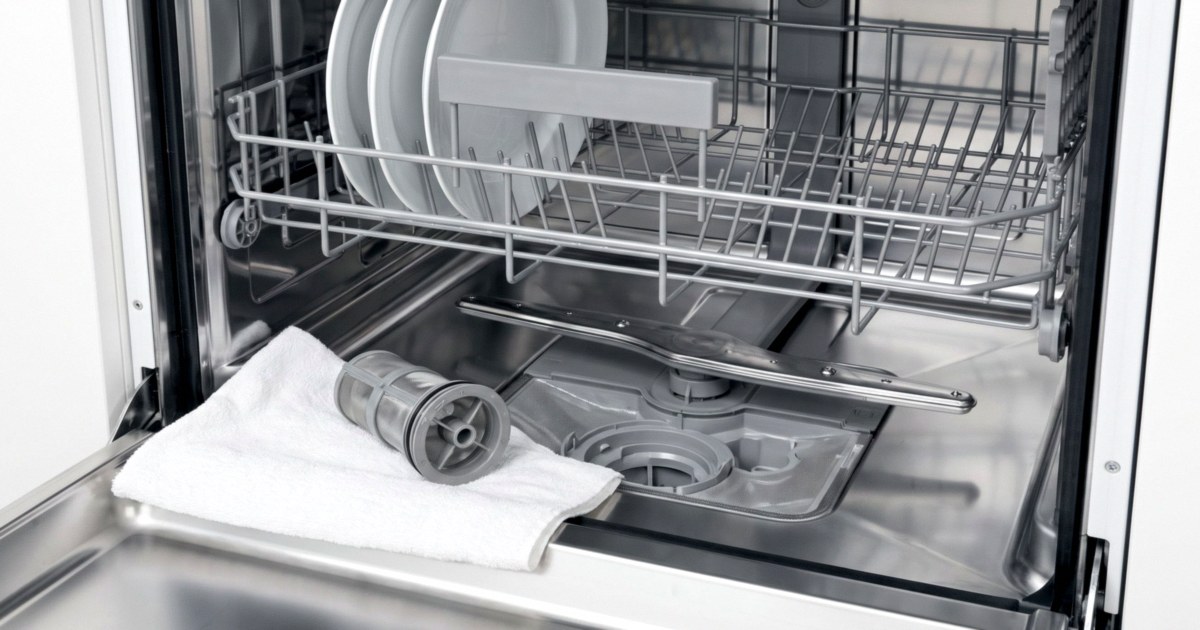
A dishwasher not cleaning dishes is a water problem far more often than a soap problem. Grit on the glasses, chalky film on the flatware, dried oatmeal welded to a bowl on the top rack: every one of those complaints traces back to water that was too cool, too dirty, too little, or never got where it needed to go.
Customers almost always blame the detergent. It's almost never the detergent.
The eight causes below run in the order I actually check them, cheapest and fastest first. Six cost nothing. Two involve parts.
Before You Start
Pull the plug or kill the breaker before you reach past the filter housing. Dishwashers combine standing water, a 120V heating element, and wiring that runs along the bottom of the tub, and the junction box under the toe kick is not always as watertight as the installer thought.
The heating element stays hot for a while after a cycle. Give it 15 minutes.
And watch for glass. Broken stemware works its way down into the sump and filter assembly, and the first thing your fingers find when you go digging is the sharp edge. Gloves.
1. The Filter Is Packed
This is the first thing to check and, on a machine that used to clean fine, it's the most likely single answer.
Every filtered dishwasher built in roughly the last 15 years recirculates its wash water. That water passes through a filter under the lower rack, and when the filter loads up with grease and soil the machine starts washing your dishes in the sludge it just rinsed off. The result isn't "dirty dishes" so much as gritty ones, with a fine sandy film in the bottoms of cups.
Whirlpool and KitchenAid machines use a filter cup, a cylindrical upper filter that twists out of a lower flat screen. Bosch uses a stack instead: a coarse cylinder, a fine filter around it, and a microfilter in the base, all lifting out together. Bosch's own support page says the filter has to be cleaned regularly to avoid overflow and to keep the machine cleaning properly.
Rinse it under hot water with a soft brush. If it's greasy enough to feel slick, soak it in hot water with a squirt of dish soap for 10 minutes first. Do not use a wire brush on the fine mesh.
If the filter cup itself is cracked or the mesh is torn, it has to be replaced. On Whirlpool-family machines that part is the W10872845 Dishwasher Filter Cup, which the parts catalogs list across Whirlpool, KitchenAid, JennAir, Amana, Inglis and Kenmore dishwashers and which supersedes more than 20 older numbers. Check the part number against your model number before ordering, because the same brand used several filter designs over the years.
Tell the customer to pull and rinse the filter once a month, and tie it to something they already do. I use the water bill. The households that call me back inside a year for the same complaint are, without fail, the ones who never touched it again after I showed them.
2. The Spray Arms Aren't Spinning or the Jets Are Blocked
With the racks out, spin each arm by hand. Lower, upper, and the small third-level arm if the machine has one. They should turn freely with a light push. If one binds, grinds, or won't complete a rotation, find out why before you go further.
Then hold each arm up to a light and look at the jets. Hard water scale and seed-sized debris close them off, and a clogged jet doesn't just stop cleaning one zone, it changes the pressure balance across the whole arm. A toothpick clears most of them.
Look at the feed tube for the upper arm too. On many models it's a plastic tube at the back of the tub that hooks into the upper rack, and a rack seated wrong never couples to it, so the upper arm gets almost nothing. That presents as "the bottom rack is clean and the top rack is filthy," which is a useful diagnostic all by itself.
Cracked arms leak pressure instead of throwing it. Our walkthrough on replacing a dishwasher spray arm covers that swap.
3. It's Loaded Wrong
Not a dodge. Loading is the cause in a meaningful share of the "my new dishwasher doesn't clean" calls I run, especially after somebody replaces a 15-year-old machine and keeps loading it the old way.
Tall items on the left of the lower rack block the arm's throw. A cookie sheet across the front blocks everything behind it. Bowls stacked flat trap a pocket of air. Two plates nested together get washed on exactly one side each.
KitchenAid's own loading guidance is worth repeating to customers: knives down, forks up, alternate the spoons so they don't nest, cups and bowls face down and angled, plastics up top. I add one of my own: face the soiled side of everything toward the center of the tub, because that's where the water comes from.
Then leave gaps. A dishwasher packed to capacity cleans worse than the same machine two-thirds full.
4. Detergent, Rinse Aid, and What's in Your Water
Old detergent is a real failure mode. Powder and tablets absorb humidity under the sink and lose enzyme activity, so a box open since last spring may not be doing much.
Rinse aid is not optional on a modern machine, and an empty dispenser shows up as spotting and filming that customers read as "not clean." KitchenAid says a full dispenser holds about 5 oz and should last roughly a month, so if yours empties in a week the setting is turned up too high and if it's still full after two months it isn't dispensing.
Hard water is the quiet one. Scale builds on the heating element, inside the wash lines, and in the spray arm jets, and it does it slowly enough that nobody notices the machine getting worse. KitchenAid recommends running a dishwasher cleaner every 30 days. A citric-acid cleaner or a commercial descaler on an empty hot cycle will pull a surprising amount of white crust off a five-year-old machine in a hard-water district.
5. The Incoming Water Is Below 120°F
KitchenAid states it directly: its dishwashers perform best with incoming hot water at 120°F (49°C), and that temperature is what dissolves detergent, breaks down grease, and supports the machine's own heating functions.
Test it the way the manufacturer suggests. Run the kitchen faucet 30 to 60 seconds, fill a cup, put a thermometer in it. Under 120°F, look at the water heater setpoint and the distance from the heater to the kitchen.
A long uninsulated run is the one people miss. If the kitchen is at the far end of a 1,900-square-foot single-story, the first several quarts arriving at the dishwasher are room temperature, and the machine has already started washing with them. Running the tap hot immediately before starting the cycle fixes that for free.
If the water is hot at the tap but the dishes still come out greasy and the machine never seems to get warm, suspect the dishwasher's own heating element or its thermistor. That also shows up as poor drying, which we cover in why your dishwasher isn't drying.
6. It Isn't Filling Enough
Low fill is underdiagnosed. A machine taking on 60% of its normal water still runs a full cycle, still sounds normal through a closed door, and cleans badly.
Check it directly. Start a cycle, let it fill and run about a minute, then open the door and look at the sump. You want an obvious pool of water sitting in the sump with the level at or just below the heating element, never over it. A thin film across the bottom means it isn't filling.
Two common causes. The first is the water inlet valve, whose inlet screen clogs with sediment and mineral grit; the valve opens on command but passes a fraction of the flow it should. The second is siphoning, where the drain hose pulls water back out during the wash. Whirlpool specifies connecting the drain hose to the waste tee or disposer inlet above the plumbing's drain trap and a minimum of 20 inches (50.8 cm) above the floor. Plenty of installations miss that, and a machine that siphons will also run long and finish cold.
Also confirm the supply valve under the sink is all the way open. Whirlpool lists that first for a reason, and half-closed angle stops are a real thing after a plumbing repair.


7. The Detergent Dispenser Isn't Opening
Open the door after a finished cycle and look at the dispenser cup. Caked detergent still sitting in it, or a door that's still latched shut, tells you the whole cycle ran on plain water.
Three causes, in the order I find them. Buildup of old detergent and grease around the latch, which cleans off with hot water and a toothbrush. A weak or broken spring, which you can feel when you close the flap and it doesn't snap. And a failed bi-metal release or wax motor, which gets replaced.
Check one more thing: whether a tall item in the lower rack is blocking the flap from swinging open. Cutting boards and baking sheets loaded against the door do it constantly.
8. The Circulation Pump Is Failing
This is the last thing on the list because it's the most expensive and because everything above it can imitate it.
The circulation pump, also called the wash pump or wash motor, is the impeller and motor assembly that drives water up through the spray arms. When it's healthy you can hear it: open the door 60 seconds into a cycle and there's an unmistakable rush of water hitting the tub walls. When it's failing you get a hum, a grind, or a quiet machine with arms that barely turn and dishes that come out unchanged.
Clean the filter first. I mean it. A packed filter starves the pump inlet and produces exactly the same weak-spray symptom, and a pump is a $150 to $250 part where a filter rinse is free.
If the filter is clean, the arms spin freely, the fill level is right and the spray is still weak, the pump is the answer. On Whirlpool-family machines the current assembly is the W11032770 dishwasher circulation pump and motor assembly, which the parts catalogs show replacing W10349483, W10510667, W10529163, W10816492, W10864037, W10885542 and WPW10510667, and which lists fitment on models including the KitchenAid KDTE104D series and the Whirlpool WDF560SAF series. Bosch, LG and Samsung all use their own designs, and I'm not going to print a number for those. Check the part number against your model number on the manufacturer parts catalog before you buy.
Those are typical ranges in our market. Note the arithmetic on the last one: a circulation pump job lands somewhere around $325 to $525 installed, against maybe $600 to $1,100 for a mid-grade replacement dishwasher. On a machine under six years old I fix it. On a 12-year-old builder-grade unit I tell the customer what a new one costs and let them decide.
When to Call a Pro
The first five causes on this list are homeowner work and I'd rather people did them. Filter, spray arms, loading, detergent and water temperature cover a large share of these complaints and none of them require opening anything.
Call somebody when the fix involves the inlet valve, the dispenser, the heating element or the pump, because all four mean pulling the machine out from under the counter with a live water line and a live electrical connection still attached. Call immediately if you see water under the cabinet, smell anything burnt, or the machine trips a breaker.
And if the complaint is really a drainage complaint, standing water in the bottom at the end of a cycle, you're in a different guide: start with unclogging a dishwasher drain.
Why is my dishwasher leaving food on dishes?▾
The wash water isn't reaching the dishes with enough force or heat. Check the filter under the lower rack first, then spin both spray arms by hand and hold them to a light to confirm the jets are open. After that, check water temperature at the kitchen tap. KitchenAid specifies 120°F incoming hot water, and cooler water leaves detergent only partly dissolved.
How do I know if my dishwasher circulation pump is bad?▾
Open the door about a minute into a wash cycle and listen. A healthy machine makes an obvious rushing sound and both arms are spinning. A failing pump hums, grinds, or runs quietly while the arms barely move. Clean the filter and confirm the fill level before condemning the pump, because a packed filter starves the pump inlet and produces the identical symptom.
Does water temperature affect dishwasher cleaning?▾
Yes, more than most people expect. KitchenAid states its dishwashers perform best with incoming hot water at 120°F, which is the temperature that dissolves detergent and cuts grease. Run the kitchen faucet hot before starting a cycle and measure it at the tap with a thermometer. A long uninsulated run from the water heater to the kitchen is a common cause of underperformance.
Should I rinse dishes before loading the dishwasher?▾
Scrape, don't rinse. Modern enzyme detergents need soil to work against. Get rid of bones, rice, pasta and anything stringy, then load with the soiled surfaces facing the center of the tub and gaps between items. Loading density matters much more than pre-rinsing; a machine packed to capacity cleans worse than the same machine two-thirds full.
Sources
KitchenAid. "Dishwasher Water Temperature Troubleshooting." Product Help. producthelp.kitchenaid.com
KitchenAid. "Getting the Best Results when Using a Dishwasher." Product Help (rinse aid capacity, loading, cleaner interval). producthelp.kitchenaid.com
Whirlpool. "Will Not Fill With Water - Dishwasher." Product Help (supply valve, 20-inch minimum drain hose height). producthelp.whirlpool.com
Bosch. "How to clean your dishwasher filter." Owner Support. bosch-home.com
Dey Appliance Parts. "Dishwasher Filter Cup W10872845" (component name and brand fitment). deyparts.com
XPart Supply. "W11032770 Whirlpool Dishwasher Circulation Pump & Motor Assembly" (component name, superseded numbers, model fitment). xpartsupply.com
Need a repair professional?
Get free quotes from verified technicians in your area.
Find a Pro Near You