


Energy-Efficient Appliance Upgrades Ranked by Payback Period in California
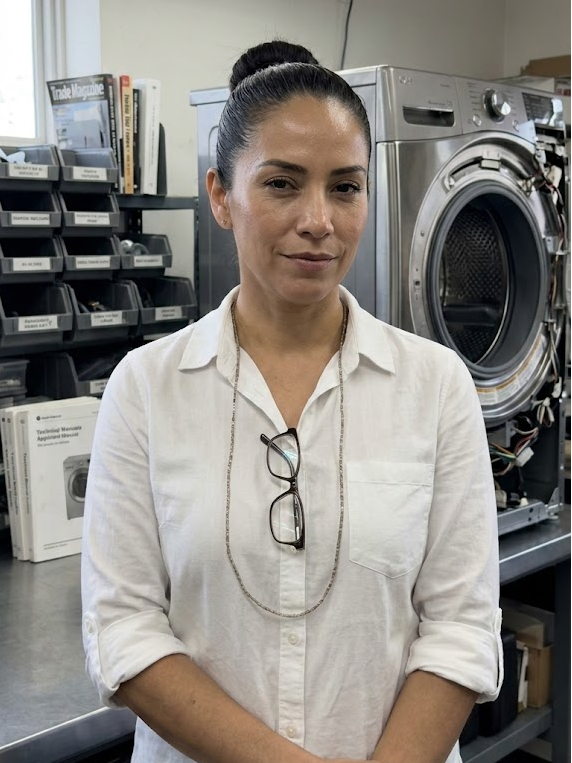
Maria Solano
Former appliance warranty claims adjuster turned investigative repair journalist. Maria's 'What Went Wrong' teardown series has made her the most feared woman in the white-goods industry.
California has some of the highest electricity rates in the continental United States — the statewide average is around $0.28-0.33 per kWh depending on your tier and utility, compared to the national average of $0.16. That changes the math on energy-efficient appliances dramatically.
An upgrade that barely breaks even at national average rates can pay for itself in 2-3 years in Southern California. The reverse is also true — some "green" upgrades that get heavy marketing attention have payback periods so long they'll never pencil out before the appliance needs replacement anyway.
Here are the major appliance upgrade categories ranked by actual payback period at California rates, with current rebate information for SoCal Edison, PG&E, and SDG&E customers.
Methodology
All calculations use California average residential electricity rates (weighted average ~$0.30/kWh, reflective of PG&E/SCE tiered pricing for mid-usage households). Natural gas prices used are California average of approximately $1.50/therm. Upgrade costs reflect typical installed costs (appliance + delivery + basic installation, no major modifications).
Important update (June 2026): The federal residential energy tax credits this guide originally relied on — the Section 25C Energy Efficient Home Improvement Credit and the Section 25D Residential Clean Energy Credit — were terminated by Public Law 119-21 (signed July 4, 2025) for property placed in service after December 31, 2025. They are no longer available in 2026. Any 25C/25D figures below are shown as historical (struck through or labeled "expired") for readers who placed equipment in service in 2025 or earlier. California's federally funded HEEHRA rebates and the state TECH Clean California program were also fully reserved/waitlisted as of early 2026 (single-family HVAC and heat-pump-water-heater reservations closed November 2025; HEEHRA single-family rebates fully reserved statewide as of February 24, 2026, with new requests added to a waitlist). The remaining live incentives are investor-owned utility rebates (SCE, PG&E, SDG&E), which is what current payback math should be based on.
For context on which appliances are worth repairing versus replacing before you upgrade, see our appliance repair vs. replace guide.
#1 — Heat Pump Water Heater (HPWH)
Payback period: 2-3 years after incentives
The heat pump water heater is the most financially compelling appliance upgrade available to California homeowners right now. Full stop.
A standard electric resistance water heater has an Energy Factor (EF) of about 0.9 — it converts 90 cents of every electricity dollar into hot water. A heat pump water heater has an EF of 3.5-4.5 — it moves 3.5-4.5 units of heat energy for every 1 unit of electricity consumed, by extracting heat from the surrounding air.
Annual energy savings: $400-700 per year replacing an electric resistance unit. Replacing a gas water heater — it depends heavily on current gas rates, but the gap is narrowing as gas prices rise.
Cost: $1,100-1,800 installed (replacing an existing electric water heater with similar footprint and amperage).
Incentives:
Federal 25C tax credit: 30% of installed cost, up to $600(EXPIRED — terminated for systems placed in service after Dec 31, 2025)- SoCal Edison: $100-200 rebate (check sce.com/energysavings)
- PG&E: $100-400 rebate (rebates vary by model and installation type)
- SDG&E: $100-300 rebate
TECH Clean California: Additional $1,000-1,500 for income-qualifying households(fully reserved/waitlisted as of early 2026 — check techcleanca.com for Phase II)
With the live utility rebate alone, net cost is roughly $700-1,700. At $500 savings per year, that's a 1.5-3.5 year payback. (Households that placed a unit in service in 2025 or earlier and also captured the now-expired 25C credit and TECH rebate saw net costs as low as $400-900.)
Practical considerations: HPWHs need at least 700-1,000 cubic feet of surrounding air space to operate efficiently. They're ideal in garages, utility rooms, and basements. In conditioned closets or small laundry rooms, performance drops. They also produce about 60 dB of noise — fine for a garage, noticeable in a bedroom hallway.
#2 — Heat Pump Dryer
Payback period: 3-5 years
Heat pump dryers use 40-50% less electricity than conventional electric dryers by recycling heat instead of exhausting it. At $0.30/kWh, the average California household doing 5-7 loads per week saves $80-120 annually.
Cost: $1,000-1,400 for a heat pump dryer vs. $600-900 for a standard electric dryer. Premium: $300-500.
Federal incentive: None. The Section 25C Energy Efficient Home Improvement Credit never covered clothes dryers (it applies to heat pumps, heat pump water heaters, insulation, windows, doors, and electrical panels — not laundry or kitchen appliances), and 25C is expired in any case. Income-qualifying households could previously claim a HEEHRA point-of-sale rebate (up to $840) for an ENERGY STAR electric heat pump dryer, but California's HEEHRA funds were fully reserved/waitlisted as of early 2026.
Utility rebates: Variable. PG&E and SCE occasionally offer $50-100 rebates — check current availability as these change seasonally.
The non-financial case for heat pump dryers is strong:
- No external venting required — install anywhere with a 240V outlet and a small drain
- Much lower operating temperature — gentler on fabrics
- Condenser captures moisture into a reservoir or drain instead of exhausting it through a duct
The no-vent feature is genuinely valuable in California condos and apartments where running an exhaust duct to the exterior is difficult or prohibited. For information on dryer vent maintenance that affects conventional dryer performance, see our dryer vent cleaning guide.
#3 — ENERGY STAR Refrigerator (Replacing Pre-2010 Model)
Payback period: 4-7 years
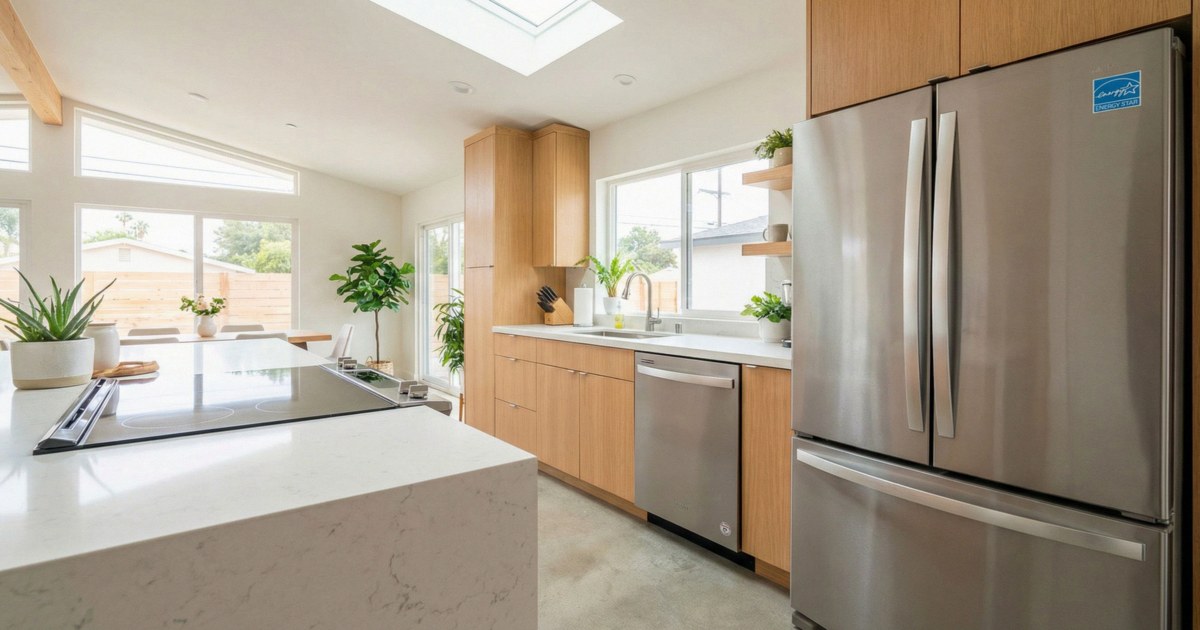
Refrigerators from 2009 and earlier use significantly more energy than current ENERGY STAR models. A 2005 side-by-side might draw 1,100-1,400 kWh per year. A current ENERGY STAR top-mount uses 350-500 kWh. That's a savings of 700-1,000 kWh annually — roughly $210-300 per year in California.
A new ENERGY STAR refrigerator costs $800-1,500 installed. Payback on energy savings alone is 4-7 years, which is within the useful life of the new appliance.
Important qualifier: this math only applies to pre-2010 refrigerators. Replacing a 2015 refrigerator with a 2025 ENERGY STAR model saves much less energy (maybe $40-60/year) and the payback period stretches to 15+ years. Only replace a refrigerator for energy savings if it's over 15 years old.
Utility rebates:
- SoCal Edison: $50 rebate for ENERGY STAR refrigerators, $75-100 for retiring old unit simultaneously
- PG&E: $50-100 depending on model efficiency tier
- SDG&E: $50-75
Also worth knowing: SCE and PG&E have "appliance recycling" programs where they'll pick up your old refrigerator for free AND pay you $50-75 for it, while ensuring proper refrigerant disposal.
#4 — Induction Cooktop (Replacing Gas Range)
Payback period: 8-15 years on energy savings alone
Induction cooktops are more energy-efficient than gas ranges: roughly 85-90% efficient vs. 40-55% for gas. But the payback period on energy savings alone is long — and the math depends heavily on your local gas rate relative to electricity.
In California, gas is relatively cheap compared to electricity. At $1.50/therm for gas and $0.30/kWh for electricity, the annual energy cost for cooking on gas is roughly $100-140. Switching to induction reduces that to $60-90 — savings of about $40-60 per year. At a cost premium of $500-800 to go induction over gas, that's a 10-15 year payback on energy alone.
The non-energy case for induction is strong: faster boiling, precision temperature control, cool surface reduces burns, and peer-reviewed research has documented measurably better indoor air quality when cooking on induction vs. gas. A 2024 Stanford-led study in Science Advances found gas and propane combustion in U.S. stoves raises long-term indoor NO2 exposure, and a 2024 Columbia/Lamont-Doherty study measured a ~56% reduction in daily NO2 after switching from gas to induction (see Sources).
Incentives:
- Federal 25C credit: does not apply. 25C never covered cooking ranges or cooktops — the widely cited "$840 for an electric stove/range" was a HEEHRA point-of-sale rebate, not a tax credit — and 25C is expired in any case. The HEEHRA $840 range rebate was fully reserved/waitlisted in California as of early 2026.
- SoCal Edison, SDG&E: Check current "electrification" rebate programs — these have been expanding as part of the state's electrification initiative
- Some Southern California gas utilities offer "swap out" incentives for electrification
The bottom line: Buy an induction cooktop for cooking quality and health benefits. Don't buy it expecting it to pay back quickly on energy savings.


#5 — ENERGY STAR Front-Load Washer (Replacing Top-Load)
Payback period: 6-10 years
Front-load washers use 40-60% less water and about 25% less energy than standard top-load agitator models. In water-scarce California, the water savings have real monetary value.
Annual savings: $50-90 in energy, $100-180 in water (at California water rates). Total: $150-270/year.
Cost premium over a standard top-load: $200-400.
Payback on energy + water savings: 1-3 years on paper. But the calculation has to account for higher repair rates on front-loaders compared to top-loaders (see the warranty discussion — front-loaders have above-average failure rates), and the front-loader premium over a basic agitator is often higher than $200-400 when you compare apples to apples.
Net assessment: ENERGY STAR front-load washers have good economics if you're replacing a non-HE top-load. They're a reasonable upgrade. They're not the slam-dunk that heat pump water heaters are.
The Upgrades That Don't Pencil Out
Smart thermostats — These aren't appliances, but they're often bundled with appliance discussion. Payback is 1-3 years. Worth it.
ENERGY STAR dishwasher — Saves ~3.5 gallons per cycle vs. an older model. Annual savings around $30-50 in water and energy. Payback period on energy/water savings alone is 15-25 years. Buy it for the features, not the savings.
ENERGY STAR window AC unit — Saves maybe $20-50/year vs. a standard window unit. Payback period of 8-15 years on a $150-200 premium. Modest value case.
How to Stack California Incentives
What changed in 2026: The federal portion of this stack is gone. The Section 25C tax credit (and the Section 25D residential clean energy credit) were terminated for property placed in service after December 31, 2025 under Public Law 119-21, and California's federally funded HEEHRA rebates plus the state TECH Clean California program were fully reserved/waitlisted by early 2026. As of mid-2026, the only reliably available incentive is your investor-owned utility rebate.
The incentive stack for a heat pump water heater (the best upgrade), 2026:
Federal 25C tax credit: 30% of installed cost, up to $600— expired after Dec 31, 2025Federal HEEHRA rebate (if income-qualifying): up to $1,750— fully reserved/waitlisted in CA; check for HEEHRA Phase II- Utility rebate (SCE/PG&E/SDG&E): $100-400 — still available
TECH Clean California (low-income): up to $1,500— fully reserved as of late 2025/early 2026
In 2026, a middle-income household in SCE territory who pays $1,500 installed for a heat pump water heater can expect roughly: $200 SCE rebate = ~$1,300 net cost. Payback at $500/year in savings: about 2.5 years. (Through 2025, the same household could have layered the $450 25C credit on top for a sub-2-year payback — that window has closed.)
Rebate programs change constantly, and some require pre-approval or purchase through a participating contractor. Before a customer buys anything expecting a rebate, have them verify the specific model and program at their utility's rebate portal. I've seen customers buy a heat pump water heater at a big-box store and discover the model doesn't qualify for the utility rebate because it wasn't on the approved product list. The $200 savings became zero. Always verify before purchase.
Summary Rankings
| Upgrade | Annual Savings | Net Cost After Incentives | Payback Period |
|---|---|---|---|
| Heat pump water heater | $400-700 | $400-900 | 1-3 years |
| Heat pump dryer | $80-120 | $200-400 | 3-5 years |
| New fridge (pre-2010 replacement) | $210-300 | $700-1,300 | 4-7 years |
| Front-load washer | $150-270 | $200-400 | 1-3 years |
| Induction range | $40-60 | $400-700 | 8-15 years |
| ENERGY STAR dishwasher | $30-50 | $400-700 | 15-25 years |
What is the best energy-efficient appliance upgrade in California?▾
A heat pump water heater is the single best energy-efficient upgrade for most California households. It uses 60-70% less electricity than a standard electric resistance water heater and saves $400-700 per year in energy costs at current California rates. Utility rebates of $100-400 are still available depending on your utility. Note that the 30% federal 25C tax credit (up to $600) that previously applied was terminated for systems placed in service after December 31, 2025. Even on the utility rebate alone, the typical payback period is roughly 2-4 years — still the fastest-payback appliance upgrade available.
What rebates are available for energy-efficient appliances in California?▾
SoCal Edison, PG&E, and SDG&E all offer appliance rebates. Heat pump water heaters qualify for utility rebates of $100-400, and ENERGY STAR refrigerators typically earn $50-100. Important: the federal 25C and 25D energy tax credits were terminated for property placed in service after December 31, 2025 (Public Law 119-21), and California's HEEHRA and TECH Clean California rebate funds were fully reserved/waitlisted as of early 2026. That leaves utility rebates as the main live incentive in 2026. Rebate availability changes seasonally — always verify eligibility at your specific utility's rebate portal before purchasing.
Is a heat pump dryer worth the extra cost?▾
At California electricity rates, a heat pump dryer saves $80-120 per year compared to a standard electric dryer. The installed cost premium is $300-500. Payback period is roughly 3-5 years. Beyond the energy savings, the no-external-vent feature is valuable in California condos and apartments where ductwork to the exterior is impractical or prohibited, and the lower operating temperature is gentler on fabrics.
Sources
-
Internal Revenue Service. "Energy Efficient Home Improvement Credit (Section 25C)." irs.gov — eligible improvements (heat pumps, heat pump water heaters, insulation, doors, windows, electrical panels; ranges and dryers are not covered).
-
Internal Revenue Service. "FAQs for modification of sections 25C, 25D, 25E, 30C, 30D, 45L, 45W, and 179D under Public Law 119-21 (One Big Beautiful Bill), FS-2025-05" (Aug. 2025). irs.gov — 25C/25D terminated for property placed in service / expenditures made after Dec. 31, 2025.
-
California Energy Commission. "Inflation Reduction Act Residential Energy Rebate Programs (HEEHRA / Home Efficiency Rebates)." energy.ca.gov — program status and funding.
-
TECH Clean California. "HEEHRA Rebates" and program incentive status. techcleanca.com — single-family heat pump / HPWH incentives fully reserved (Nov. 2025); HEEHRA single-family rebates fully reserved statewide as of Feb. 24, 2026, with new requests waitlisted.
-
ENERGY STAR / U.S. Department of Energy. "Heat Pump Water Heaters" and "ENERGY STAR Most Efficient" appliance criteria. energystar.gov — efficiency (uniform energy factor) figures for heat pump water heaters, dryers, refrigerators, and washers.
-
U.S. Energy Information Administration. "Electric Power Monthly — Average Price of Electricity to Ultimate Customers by State (California)." eia.gov — California residential electricity rates.
-
Kashtan, Y., et al. (2024). "Nitrogen dioxide exposure, health outcomes, and associated demographic disparities due to gas and propane combustion by U.S. stoves." Science Advances, 10(18), eadm8680. DOI: 10.1126/sciadv.adm8680 — indoor NO2 from gas vs. electric/induction cooking.
-
Commane, R., et al. (2024). "Out of Gas, In with Justice: Findings from a gas-to-induction pilot in low-income housing in NYC." Energy Research & Social Science. Reported via Columbia Climate School, "Study Finds Switching From Gas to Electric Stoves Cuts Indoor Air Pollution" (Jul. 26, 2024). news.climate.columbia.edu — ~56% reduction in average daily indoor NO2 after switching from gas to induction.
Need a repair professional?
Get free quotes from verified technicians in your area.
Find a Pro Near You