


Slow Refrigerant Leaks Pushed Home AC Energy Use Up 4-26% for Weeks at a Time
Dale Resnick
A 30-year veteran of residential HVAC who's crawled through more attics than he can count. Dale writes the 'Duct Tape & Beyond' column and believes every compressor tells a story if you listen close enough.
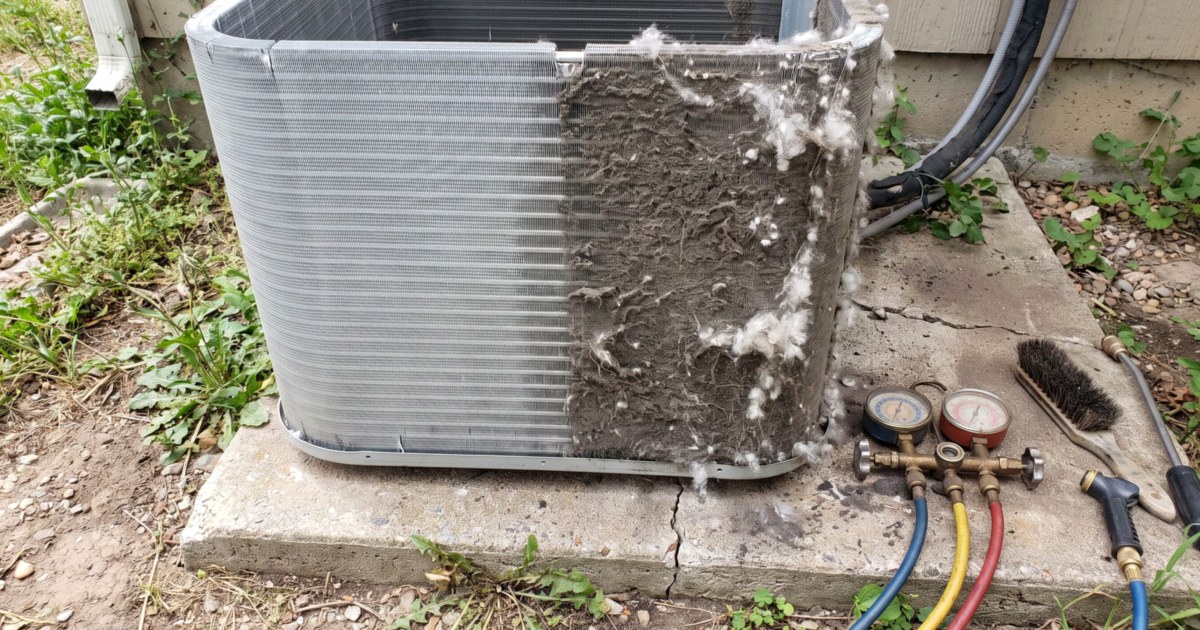
Five of 81 monitored residential air conditioners developed a refrigerant leak over a single cooling season, and each one pushed the home's daily energy use up by somewhere between 4% and 26%. Monthly coefficient of performance fell 4% to 10% across the same stretch. The degraded period ran 6.5 to 15 weeks.
The equipment kept cooling the whole time.
That data comes from Belén Llopis-Mengual, David P. Yuill and Emilio Navarro-Peris, published in Applied Thermal Engineering in June 2025. Llopis-Mengual and Navarro-Peris are at the Universitat Politècnica de València; Yuill is at the University of Nebraska-Lincoln.
They tested a time-series method on 81 units instrumented in occupied houses across the US and Canada, each one monitored through a full cooling season of 2 to 7 months. Refrigerant loss was flagged using a virtual refrigerant charge calculation. Inadequate condenser airflow was flagged by tracking the difference between condensing temperature and ambient temperature. Both come out of temperature data, not from a set of gauges on the back porch.
Two units in the group lost condenser airflow. Those drew 15% to 17% more electricity per day, with monthly COP down 4% to 7%, over a fault window of 8 to 8.5 weeks.
Most fault detection research leans on laboratory-imposed faults or simulations, "which may not reflect real-world conditions," the authors said. Long-term field analyses, they write, "remain scarce." Anyone who has put a manifold on a 12-year-old condenser in August already suspected as much.
Limits of the Refrigerant Leak Data
Seven faulty machines is a thin denominator. Leaks turned up in about 6% of the 81 units and airflow degradation in about 2%, and those percentages carry all the fragility you would expect from counts of five and two.
This is also a detection-methodology paper. It reports what the algorithm caught, not a census of everything wrong in those houses, and it attempts no service economics. There is no dollar figure anywhere in it, and nothing about whether a homeowner ever picked up the phone. So the honest version of the headline is that the faults persisted for weeks in the data, not that we know nobody called.
What the paper does establish: a soft fault is a slow, expensive, invisible thing, and it shows up in operating data well before it becomes a no-cool call.


What This Changes for a Shop
Maintenance agreements have always been sold on a soft promise: catch it early, spend less later. These numbers give that pitch an actual range. Take a house that would have burned $400 on cooling over a given stretch. At the study's leakage penalty, the same stretch costs $416 to $504 instead, and it keeps costing that until somebody finds the leak. Stack 6.5 to 15 weeks of it and the arithmetic starts to cover a plan.
Condenser airflow is the easier sell, because the fix is cheap. A 15% to 17% jump in electricity for restricted airflow is a number worth quoting to a customer standing next to a coil packed with cottonwood. It also argues for taking the coil cleaning line item on a spring maintenance visit seriously rather than treating it as a rinse-and-go.
The leak side is harder and more valuable. A system down on charge does not announce itself, and by the time the customer calls with an AC that isn't cooling, the compressor has been working under those conditions for a season. Reduced equipment life sits in the paper's list of soft-fault consequences, and that is the part a renewal conversation should lead with.
Detection here ran on continuously logged equipment data of a kind most residential split systems still do not produce. Communicating thermostats and connected condensers are closing that gap, slowly, and the shops that end up doing this well will be the ones already collecting runtime data on the units they cover under a maintenance agreement. Everyone else is still waiting for the phone to ring.
Sources
Llopis-Mengual, B., Yuill, D.P., Navarro-Peris, E. (2025). "Time series analysis of field data for soft faults detection and degradation assessment in residential air conditioning systems." Applied Thermal Engineering, 269, 126104. doi:10.1016/j.applthermaleng.2025.126104 (abstract and record: RiuNet, Universitat Politècnica de València)