


BPA Metered 57 Cold-Climate Heat Pump Homes for Three Winters: 30-50% Savings, and HSPF2 Predicted None of It

Dale Resnick
A 30-year veteran of residential HVAC who's crawled through more attics than he can count. Dale writes the 'Duct Tape & Beyond' column and believes every compressor tells a story if you listen close enough.
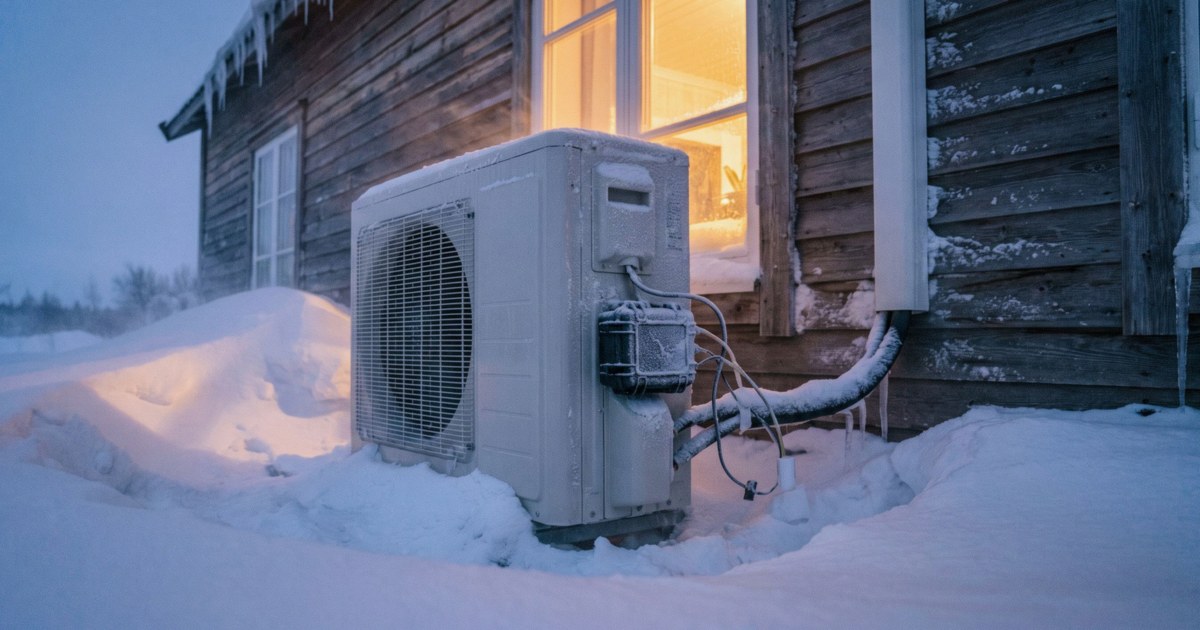
Bonneville Power Administration metered high-performance cold-climate heat pumps in 57 Northwest homes from Spring 2022 through Spring 2025, and the field study it released in June produced a number worth quoting at a kitchen table: those units cut 30% to 50% of the energy an electric resistance baseline burned, holding seasonal COPs of 2 or greater. Then it produced a number nobody wanted. HSPF2, the heating rating printed on the sticker, did not predict which of those systems actually delivered.
A word on what this document is: a contractor report, written by Ben Larson of Larson Energy Research, John Bush and Regina Hong of OTS Energy, and Bob Davis of Ecotope for the Washington State University Energy Program on behalf of BPA's Emerging Technologies program. Not peer-reviewed. Utility-funded field research is a different animal than a journal paper.
Scope was real, though: 34 unique systems from seven manufacturers across 22 product lines, 2 to 5 tons nominal, in homes heating with electric resistance and mostly without cooling.
Where the Seasonal Rating Fell Apart
For the ducted systems with measured heating capacity, the researchers built a field-measured HSPF2 at each site, taking the actual COP the system hit in each outdoor temperature bin and weighting it the way AHRI 210/240 weights Region IV, using the same math as the rating but feeding in real numbers.
Roughly 13 of the 29 scored systems (45%) came in at least 10% below their rated HSPF2. Seven of them (24%) came in at least 10% above. The remaining nine landed within 10% either way. Averaged across the fleet the rating looked fine, 8.9 rated against 8.8 measured. It is the site-level prediction that fails, which is the only level a contractor sells at.
The spread is what should change how you shop. Systems rated at about 9 HSPF2 landed anywhere from just under 6.0 to nearly 14.0 in the field, more than double the delivered efficiency on the exact same sticker.
Two metrics actually tracked with field performance, and one of them is a cooling number.
First, the listed COP at maximum capacity at 17°F outdoor temperature, a plain ratio of heat out to electricity in taken with the outdoor air at 17°F and the compressor running flat out. A regression using nothing but that value predicted about 50% of the field-measured HSPF2, the strongest single predictor in the analysis. Second, EER2, the single-point cooling ratio of Btu/h delivered per watt drawn at a 95°F outdoor condition. Rated EER2 correlated better with field heating efficiency than HSPF2 did, and it also predicted peak draw: 1 point of additional EER2 was worth 0.24 kW lower average power during the 5 to 9 a.m. window in the 20-25°F bin.
Researchers were candid about the limits. EER2 beat HSPF2 but was still, in their words, "not strong enough to be useful in practice." Their theory for why a cooling number works at all: the EER test is more tightly controlled, so those entries run more consistent than heating figures submitted at manufacturers' discretion.


Finding Those Two Numbers on a Spec Sheet
EER2 is easy. It sits on the AHRI Certificate of Product Ratings next to SEER2 and HSPF2, and on most manufacturer submittal sheets.
The 17°F max-capacity COP is not on the AHRI certificate. It comes from NEEP's Cold Climate Air Source Heat Pump Product List, which the BPA team treated as the industry's working definition of cold-climate performance. Each qualified indoor and outdoor pairing there carries an AHRI Directory reference number, the nominal SEER2, HSPF2 and EER2, then a manufacturer-reported table of power, capacity and COP at minimum, rated and maximum capacity at 47°F, 17°F and 5°F. Read the maximum-capacity row at 17°F.
Read the fine print while you're in there. NEEP tells manufacturers not to include defrost cycling or drain pan heater power in that table, so those are clean-coil numbers.
The report's explanation for the HSPF2 failure is blunt. HSPF2, "based on laboratory measurements, considers only a very limited use of ER heat." In occupied houses, resistance heat and blower power did the damage: going from 10% to 40% of total system energy consumed by blower and resistance heat strips 2.25 points off field HSPF2. "Clearly, the ER use is a gigantic contributor to overall system efficiency," the report said.
In a targeted trial at 14 ducted sites, thermostat setbacks did not save energy. After weather normalization, nine sites landed within 10% of the same consumption either way and the other five used at least 10% more with setbacks on. Morning peak got worse. The regression priced a 5°F setback at 1 kW per home on peak in Heating Zone 1 and 0.8 kW in Heating Zone 2.
Our Read on What This Changes
If you already sell off the NEEP list, the change is cheap. Stop leading with HSPF2 on the proposal and compare the 17°F maximum-capacity COP across the two or three units on your shortlist, with EER2 as the tiebreaker. Rebate paperwork will keep asking for HSPF2, which does not mean it should drive the selection.
The setback finding costs nothing to act on and will generate the most argument. Customers coming off electric baseboard were trained for decades to turn it down at night, and the thermostat installer is the last person in the house with a chance to change that. A flat setpoint on a correctly sized ducted system is the free half of this report. The sizing half is not. Meeting design load with no resistance heat, which Heating Zone 1 sites managed at a 20°F balance point, takes a real load calculation.
BPA's own conclusion is that no clear replacement metric emerged. Two predictors beat the rating everyone quotes, and neither is strong enough to be trusted on its own.
For more context, see our summary of the seven field studies on cold-climate heat pump COP, the Manual J sizing walkthrough, and the heat pump diagnostics guide.
Sources
Larson, B., Bush, J., Hong, R., Davis, B. (2026). "High-Performance High-Capacity Heat Pump Field Study Report." Prepared by Larson Energy Research, OTS Energy LLC and Ecotope Inc. for the Washington State University Energy Program on behalf of the Bonneville Power Administration Emerging Technologies program, June 2026. BPA report PDF
Northeast Energy Efficiency Partnerships. "Cold Climate Air Source Heat Pump Product List." ashp.neep.org
Northeast Energy Efficiency Partnerships. "Cold Climate Air Source Heat Pump Specification, Version 4.0." neep.org