


Defrost Hits Hardest Between 10°F and 30°F: PNNL's 22-Home Study Explains What Your Heat Pump Is Doing

Dale Resnick
A 30-year veteran of residential HVAC who's crawled through more attics than he can count. Dale writes the 'Duct Tape & Beyond' column and believes every compressor tells a story if you listen close enough.
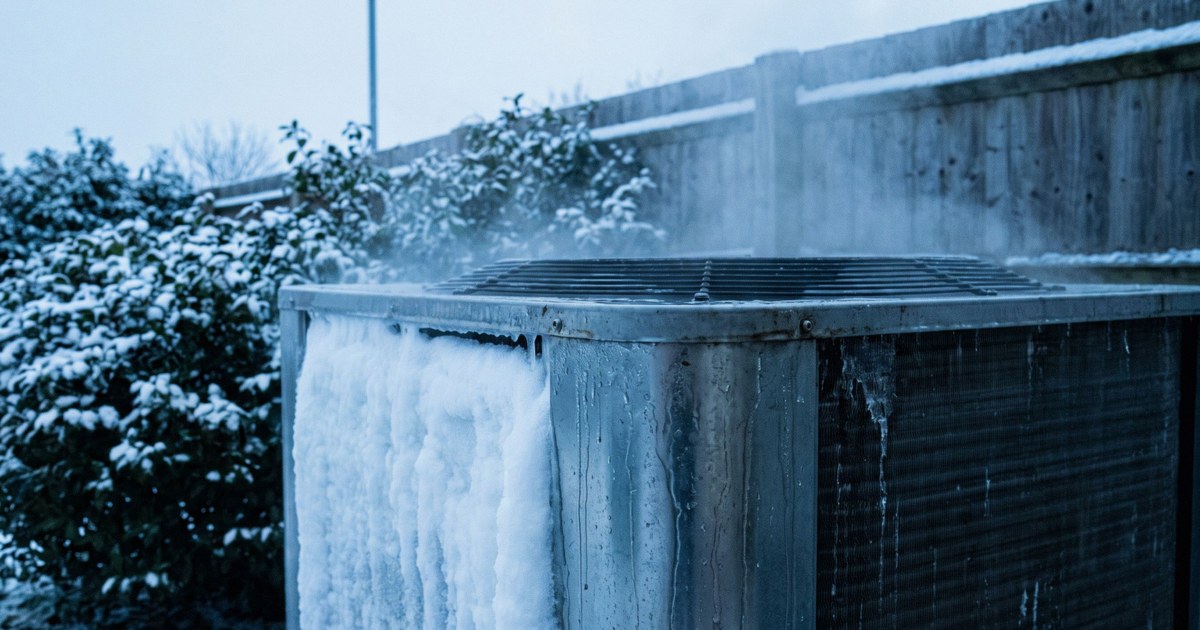
Pacific Northwest National Laboratory has published the field numbers behind two of the most common nuisance calls on a new cold-climate heat pump. Defrost mode "becomes both more prevalent and has a greater frequency at higher humidities," the paper reports, and "is also more prevalent and frequent at outdoor air temperatures from 10 °F to 30 °F." Cycles ran from a few minutes up to 20 minutes, with a median around 4 to 6 minutes across most outdoor temperature bins.
This one is peer-reviewed. Kevin Keene, Vrushali Mendon, Michael Brambley, Samuel Rosenberg and Julia Rotondo, all at PNNL, published it in Energy Efficiency on March 23, 2026, as volume 19, article 25. It's open access. Anyone on your crew can pull the PDF.
Equipment came from the Department of Energy's Residential Cold Climate Heat Pump Challenge: 13 units installed in the winter of 2022-23 and 10 more in 2023-24, in occupied homes across North America, with 22 residential sites in the analysis.
What Defrost Actually Does to the House
"None of the strategies for defrost were observed to have significant impacts to average room temperature throughout the homes," the authors write, with "median impact all less than 1 °F." That is the whole-home average, measured across every defrost approach the manufacturers used.
Units that ran the indoor supply fan during defrost, except those simultaneously firing 10 kW or more of auxiliary heat, "were associated with low supply air temperatures during defrost mode (median values less than 60 °F)," which the authors say "could have comfort impacts during winter to occupants especially near supply vents." Body surface temperature sits above that. So 58°F air moving across an ankle reads as cold air even while the thermostat barely twitches.
The team sorted the units into five defrost strategies by how much auxiliary heat and how much supply fan power ran during the cycle: No Fan with No Aux, High Fan with No Aux, Medium Fan with Medium Aux, Medium Fan with High Aux, and High Fan with Medium Aux. Their conclusion is that the No Aux and No Fan combination "may be the best option for balancing energy and comfort." One caveat comes attached: that strategy showed longer heat output recovery times after the cycle ended than the others did.
Frost insulates the coil and impedes heat transfer. Formation can cut heating capacity and COP by roughly 30% to 60%.


Our Read: Numbers to Use on the Phone
When a homeowner calls in January about steam rolling off the outdoor unit and cool air at the register, ask what it was doing outside. Between 10°F and 30°F with humidity in the air, frequent defrost is the system working correctly, and you now have a published field study to say so instead of a shrug. At 45°F and dry, repeated defrost is not normal, and that is worth a truck roll to look at the coil sensor, the defrost board, airflow across the outdoor coil, and charge.
Tell the customer to time the cycle. One that wraps up inside 10 minutes and does not immediately repeat is behaving like the units in this study, where the median landed at 4 to 6 minutes. Cycles running 30 minutes, or firing every 20 minutes at moderate outdoor temperatures, are abnormal and justify a service call.
If the installed unit runs the blower through defrost without meaningful auxiliary heat, expect supply air under 60°F and a customer who notices. Register placement matters more on those machines than on a furnace changeout. A supply directly over a sofa or under a desk is where the complaint comes from. Have that conversation during the walkthrough, not on a callback in February.
NEEP's cold-climate product list instructs manufacturers not to include defrost cycling or drain pan heater power in the performance tables, so the listed COPs are clean-coil numbers. PNNL's data is what happens between those data points.
The study covers a small sample of challenge-program equipment, which is not the same population as the base-model heat pumps most shops install. Behavior should generalize better than the specific strategies do, since defrost physics does not care whose badge is on the cabinet. Nobody should treat 22 homes as the fleet.
More field context lives in our roundup of cold-climate heat pump field studies, the heat pump diagnostics guide, and the cold-air call walkthrough in furnace blowing cold air.
Sources
Keene, K., Mendon, V., Brambley, M., Rosenberg, S., Rotondo, J. (2026). "Evaluating the impacts of defrost mode in cold climate residential heat pumps." Energy Efficiency, 19, 25. doi.org/10.1007/s12053-026-10424-7
U.S. Department of Energy. "Residential Cold Climate Heat Pump Challenge." DOE program page
Northeast Energy Efficiency Partnerships. "Cold Climate Air Source Heat Pump Specification, Version 4.0." neep.org
Northeast Energy Efficiency Partnerships. "Cold Climate Air Source Heat Pump Product List." ashp.neep.org