


Home ACs Leak Just 1.78% of Their Charge a Year, but 1% of Leaks Cause 80% of the Damage

Dale Resnick
A 30-year veteran of residential HVAC who's crawled through more attics than he can count. Dale writes the 'Duct Tape & Beyond' column and believes every compressor tells a story if you listen close enough.
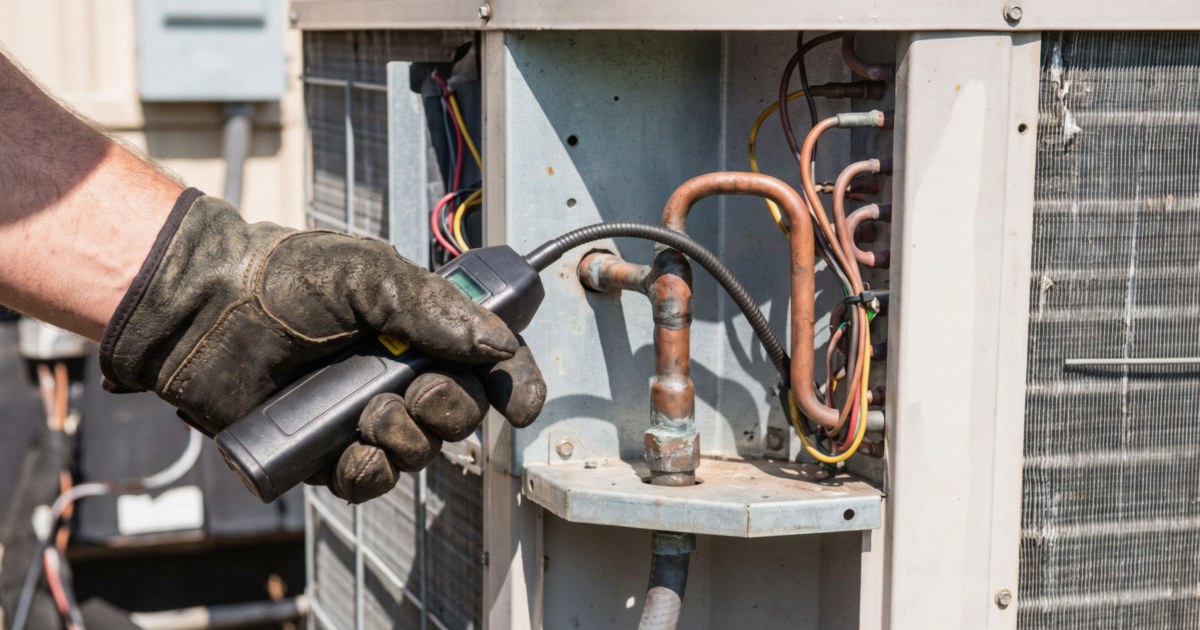
A team from PSE Healthy Energy and Stanford has put a real number on the residential AC refrigerant leak rate, and it is far lower than the industry has been assuming. Central HVAC units in the sample geography "leak an estimated 1.78% [95% CI: 0.83, 2.73] of their charge annually on average," the paper reports, "a value far lower than most current values used in lifecycle assessments or greenhouse gas budgets." The work is peer-reviewed, published in Environmental Research Letters on June 10, 2026, by Yannai Kashtan, Drew R. Michanowicz, Sergey Leskin, Seth B. C. Shonkoff and Robert B. Jackson.
The second finding is the one that matters on a service board. Leakage is brutally lopsided. The top 1% of residential leaks accounted for 80% of the total CO2-equivalent leakage emissions the team measured.
How They Got the Number
Nobody hung dataloggers on 126 condensers for this. The researchers partnered with a San Francisco Bay Area HVAC company and worked from its service records, analyzing 126 residential central AC service calls in which a technician identified a refrigerant leak. Those calls ran from July 10, 2023 through September 30, 2025. For each one, the tech had logged how much refrigerant was added and how much was recovered, and the leak fraction was built out of that. Third author Sergey Leskin is listed with Fuse Service, Inc. of Santa Clara, which puts a working contractor on the author list.
Across those 126 leaking units, an average of 30% of the factory charge was already gone when the tech arrived, with a confidence interval of 26% to 35%.
Getting from there to a fleet-wide annual rate took some assembly. The team combined the fraction of customers who report any AC service in a year against the fraction reporting scheduled maintenance, inferred that about 11% of HVAC service calls are attributable to a refrigerant leak, and applied the observed 30% average charge loss. They then added an adjustment for slow leaks that never trigger a call, on the reasoning that "leaks <20% of total charge might often go undetected." Strip that adjustment out and the estimate drops to 0.97% [95% CI: 0.56, 1.51] per year. Roughly 3.2% of Bay Area residential central units leak enough in a year to trigger a service call at all.
The paper estimates that approximately one in every 5,000 homes, or 0.02%, and at most 0.09% of residential central HVAC units in the sample geography lose their entire refrigerant charge indoors in a given year.
Refrigerant type mattered, at least on the surface. Within the 126-unit sample, the 58 R-22 units had a median leak fraction of 25.5% against 17.8% for the R-410A units, a gap the authors reported as significant. Age and refrigerant are tangled together there, and the paper does not pull them apart.
The authors close with a climate-policy recommendation. Given how low and how concentrated residential leakage turned out to be, they suggest that chasing residential leaks "may be a lower priority than mitigating refrigerant release elsewhere in the supply chain," meaning production and end-of-life recovery, and they read the near-absence of total indoor charge loss as support for moving to hydrocarbons like R-290.


What the Leak Rate Means for a Service Business
"It just needs a little every year" has been accepted folklore on both sides of the counter for as long as anyone has been doing this work. A 1.78% annual average, and 0.97% if you only count leaks anyone noticed, says otherwise. A sealed system in decent shape should hold its charge for years. A unit that lands back on the recharge list every summer belongs to the small population doing most of the damage.
That reframes the repeat-recharge customer. The economics of a full leak search, nitrogen pressure test and electronic sniffer, plus dye where it fits, have always been hard to justify against a $200 top-off. But the top-off customer is, statistically, the one who is going to lose the whole charge and then the compressor. Selling the search on the second visit instead of the fourth is a defensible position, and this study is the evidence for it.
EPA's Section 608 leak repair requirements attach to appliances with a full charge of 50 pounds or more, so a residential split system is not covered by the 10% comfort cooling trigger. Venting prohibitions and recovery requirements still apply to every job. The 30%-of-charge-gone finding also carries weight in a warranty argument, because it says the leak was probably present long before anyone picked up the phone.
The 0.02% figure is the one to keep filed away. As R-454B and eventually R-290 equipment lands in occupied homes, the first question from a nervous homeowner is what happens if it all comes out indoors. There is now a peer-reviewed number for how rarely that happens with the current fleet, measured rather than modeled.
This is one HVAC company in one mild coastal climate, where compressors run fewer hours and see less thermal cycling than a unit in Phoenix or Houston, and nearly half the sample was R-22 equipment already near end of life. The authors are careful about the geographic limit and so should we. Anyone quoting the 1.78% at a sales meeting should carry those two lines along with it.
For the field procedures behind this, see our sealed system repair guide, the EPA 608 refrigerant handling guide, and the diagnostic sequence in AC not cooling.
Sources
Kashtan, Y., Michanowicz, D.R., Leskin, S., Shonkoff, S.B.C., Jackson, R.B. (2026). "Residential San Francisco Bay area air conditioners leak less refrigerant than expected." Environmental Research Letters, 21, 114015. doi.org/10.1088/1748-9326/ae74e3
U.S. Environmental Protection Agency. "Refrigerant Management Requirements under Section 608 of the Clean Air Act." EPA Section 608 leak repair requirements