


Furnace Short Cycling: Causes, Fixes, and How to Read the Limit-Switch Fault
Dale Resnick
A 30-year veteran of residential HVAC who's crawled through more attics than he can count. Dale writes the 'Duct Tape & Beyond' column and believes every compressor tells a story if you listen close enough.
Furnace short cycling is three different problems wearing the same costume, and the fastest money you'll make this heating season comes from telling them apart in the driveway.
A furnace that overheats and trips its high limit looks, to a homeowner, exactly like a furnace that lights and immediately loses flame sensing. It also looks like a furnace that's simply twice the size the house needs. Same complaint on the phone: "it keeps turning on and off." Three completely different repairs, ranging from a 10-minute flame sensor polish to a conversation about replacing the equipment.
Trane puts a useful floor under the whole discussion: in general, a furnace cycle will be at least 7 minutes long. Anything consistently shorter than that is worth diagnosing.
What Counts as Furnace Short Cycling
On a cold day a correctly sized furnace in a reasonably tight house runs 10 to 15 minutes at a stretch, longer as the outdoor temperature drops, and it spends more of the hour running than not. That's the target.
What you're listening for isn't just cycle count. It's where in the sequence the thing quits.
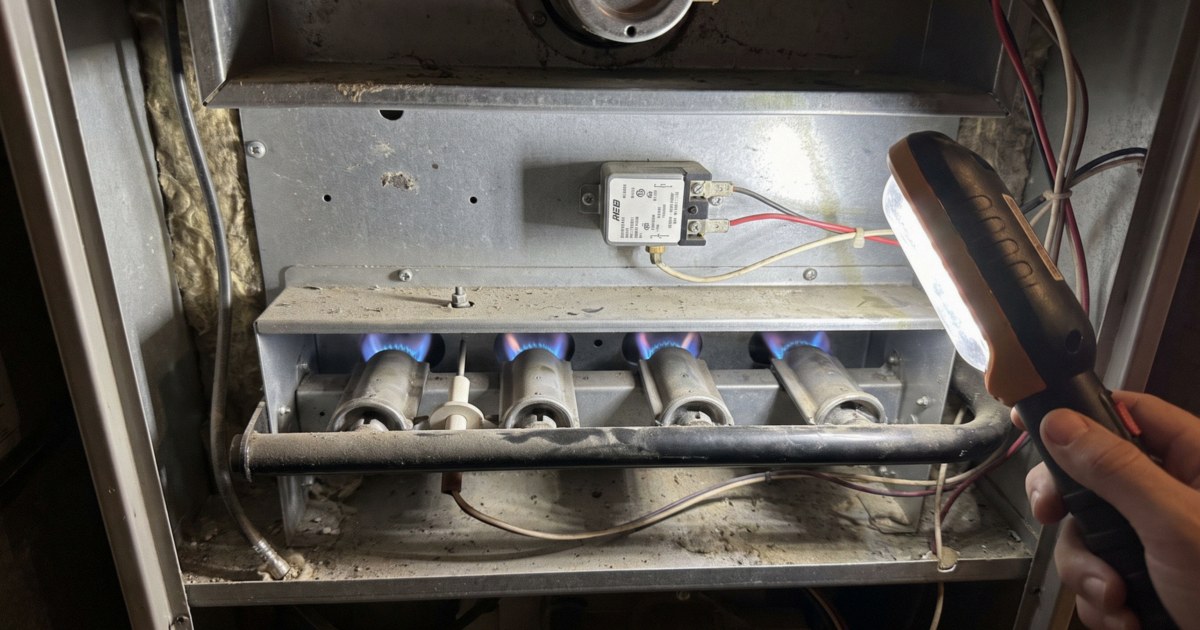
Stand at the unit and watch one full attempt. Inducer spins up. Pressure switch closes. Igniter glows. Gas valve opens and the burners light. Flame proves. Blower starts after its delay. Then the failure happens somewhere, and where it happens is your entire diagnosis.
Safety, Because This One Involves Gas
You're opening a cabinet that contains a live gas train, a 120V line-voltage section, and on the blower side a run capacitor that stays charged after the power is off.
Kill the breaker and the service switch before you pull panels. Verify dead with the meter. Discharge the blower capacitor through a resistor rather than a screwdriver blade. If you smell gas at any point, leave the building and call the utility from outside.
For homeowners this guide has exactly one hands-on step: change the filter. Everything past that is a 24V circuit sitting inches from line voltage and a combustion system that has to be tested, not guessed at. And if there's no working carbon monoxide alarm in the house, put this article down and go buy one.
Signature 1: The Limit Trip
The tell is the blower.
On a high-limit trip, the burners light normally and run for a while, typically 2 to 8 minutes, then the gas cuts out while the blower keeps running. That's the control board doing its job: the limit opened because the heat exchanger got too hot, so the board drops the gas and leaves the blower on to pull that heat out. Several minutes later the limit cools, closes, and the whole thing starts over.
Burners off, blower still running, house not warm. That's a limit trip and it means one thing: not enough air is moving across the heat exchanger.
The limit switch is a snap-disc mounted on the heat exchanger panel, and its rating is printed right on it. Carrier's HH12ZB160 is a common example, a 3-inch main limit rated L160-40F, which parts suppliers describe as opening on a rise to 160°F and closing again when it cools to 120°F. That 40-degree differential is why a limit-tripping furnace has such a distinctive rhythm: it can't restart until it has shed 40 degrees.
Do not jumper a limit switch to keep a customer warm overnight. I've seen the heat exchanger that came out of a house where somebody did.
Where the Air Went
Work the airflow path in this order, because it's ordered by how often it's the answer.
The filter comes first and it's the answer more than anything else on the list. Pull it and hold it up to a light. If you can't see the light through it, it's done. While you're there, check that it's seated in its track and that somebody hasn't stacked two filters in one slot, which I find about once a winter.
Then the blower wheel. Squirrel-cage blowers load up with a felt of dust between the fins, and a loaded wheel moves dramatically less air while sounding completely normal. Pull the assembly and look at the fins edge-on. Then the capacitor on a PSC blower: a 7.5 µF capacitor reading 5.8 µF lets the motor turn but not at rated speed, and that reads as an airflow problem all the way down the line.
After that, the duct system. Closed registers in unused bedrooms, a return grille behind a sofa, a crushed flex return in a crawlspace, a zone damper stuck closed. Any of them will overheat a furnace that was fine last winter.
Why a New Filter Can Cause Furnace Short Cycling
This one confuses people, and it's real.
ACCA's design protocols assume a pressure drop of about 0.10 inches of water column across the filter, and the typical residential furnace or air handler is rated for 0.5 i.w.c. of total external static pressure. A 1-inch high-MERV pleated filter can consume a large fraction of that budget all by itself. Energy Vanguard's Allison Bailes has written repeatedly about the consequences, which land differently depending on the blower: a PSC motor simply moves less air as pressure rises, while an ECM ramps up to hold airflow and pays for it in watts.
So the customer upgrades from a cheap fiberglass panel to a MERV 13 pleat, does everything right, and the furnace starts tripping on limit with a filter that's two weeks old.
The fix isn't a worse filter. It's a bigger one. A 4-inch media cabinet at the same MERV rating has far more surface area and far less resistance than a 1-inch pleat. Measure total external static pressure before and after and you'll be able to show the customer the number.
Measure Temperature Rise, Then Stop Arguing
Every gas furnace has a temperature rise range printed on its rating plate, written as something like 45-75°F or 50-80°F, usually a 30-degree spread between the minimum and the maximum.
HVAC School's procedure is the one I use. Confirm the furnace is firing at full output. Let it run 15 to 20 minutes so everything acclimates. Measure return air entering the unit and supply air leaving it, taking the supply reading several feet downstream so radiant heat off the heat exchanger doesn't skew the probe. Subtract return from supply.
Land above the top of the plate range and you have your answer in a number: you aren't moving enough air, you are overheating the furnace, and it will cycle on the limit control. That measurement converts an argument about whether the ductwork is adequate into a reading you can write on the invoice.
Aim for the middle of the range after the repair, not the edge.
Signature 2: The Ignition Retry
Completely different rhythm, and once you've seen it you never confuse the two.
The burners light, run somewhere between 3 and 10 seconds, and go out. The igniter glows again. Burners light again, run a few seconds, out again. The board makes a limited number of trials for ignition and then locks out, and both the trial count and the lockout duration vary by board, so read the sequence of operation in the unit's installation instructions rather than a remembered number.
That pattern is the control board saying it can't prove flame. The usual cause is a flame sensor with an oxide film on the rod, which raises resistance and drops the microamp signal below the board's threshold. Pull the sensor, polish the rod lightly with fine abrasive pad or emery cloth, and reinstall. Do not sand it aggressively; you're removing a film, not machining a part.
Then measure. Put the meter in series with the sensor lead on the DC microamp scale and read the signal with the burners lit. Minimum acceptable signal varies by manufacturer, generally between about 0.5 and 2.5 µA depending on the control, and the number that actually governs is the one printed in your unit's literature. A clean rod that still reads low means a bad sensor, a grounding problem, or a board that's lost its sensitivity.
Carrier's flame sensor for a large swath of Carrier, Bryant and Payne furnaces was LH680014, and the parts catalogs now show it superseded by LH680534. Check the part number against your model number before ordering, and match the physical bend and rod length to what you pulled out.
Grounding deserves a mention because it gets missed. Flame rectification needs a solid burner ground path back to the board. A rusty burner assembly or a corroded ground screw drops the signal on a sensor that's perfectly clean.


Signature 3: Everything Else
If the burners never light at all and the inducer keeps starting and stopping, you're in pressure switch and inducer territory. A blocked condensate drain on a 90%+ furnace backs water into the pressure switch tubing, the switch never closes, and the unit runs a cycle of futile attempts. Our furnace not turning on guide works that branch in detail.
If the furnace completes a normal shutdown sequence each time and just satisfies too fast, look at the thermostat. A stat mounted on an exterior wall, in direct sun, above a supply register, or in a hallway that warms faster than the rest of the house will satisfy and call again on a short leash. Check the cycle rate setting too, since many thermostats let you configure cycles per hour and somebody may have set it to the wrong equipment type.
And then there's oversizing, which Trane names as the most common cause of furnace short cycling. A 100,000 BTU furnace in a house with a 45,000 BTU design load reaches setpoint before the heat exchanger and ductwork have stabilized, every time, forever. There is no repair for it. Two-stage or modulating equipment sized off a real load calculation is the answer, which is a replacement conversation. If you want to be able to defend that number to a customer, our guide on sizing an HVAC system with Manual J covers the calculation.
Read the board's LED fault code before you commit to any of this. The legend sticker is on the inside of the access door, the codes are not standardized between brands or even between model years, and the code will usually tell you whether the board saw a limit open or a flame loss. That's the whole diagnosis in one reading.
Those are ranges from our market in Southern California, where heating loads are small and heating calls are seasonal. Expect higher numbers in markets where furnaces run five months a year.
When to Call a Pro
Change the filter, open the closed registers, pull the sofa off the return grille. That's the homeowner's list, and on a furnace that started cycling this week, it resolves a genuine share of calls.
Everything else here is a licensed trade. Limit switches, flame sensors and pressure switches are all safety devices, and the two failure modes that matter most, a cracked heat exchanger and a chronically overheating furnace, are both diagnosed with instruments rather than by eye. Get a combustion analysis on any furnace that keeps tripping its limit; our guide on combustion analysis for gas appliances explains what the numbers mean.
Call the same day if the furnace cycles and also blows cold air into the house, if you see soot or scorching around the burner compartment, or if a CO alarm has ever gone off. Shut the gas off at the appliance valve and call from outside if the alarm is sounding now.
Is furnace short cycling dangerous?▾
The cycling itself mainly costs you parts, efficiency and comfort. What it might be warning you about is the dangerous part: a furnace that keeps tripping its high limit is overheating, and Trane lists a cracked heat exchanger among the causes of short cycling. Make sure the house has a working carbon monoxide alarm, and have a technician run a combustion analysis on any furnace that repeatedly overheats.
Why does my furnace short cycle with a new filter?▾
Because the new filter restricts more than the old one did. ACCA design protocols assume about 0.10 inches of water column across the filter, and a 1-inch high-MERV pleat can consume much of a system's 0.5 i.w.c. static pressure budget on its own. Less air across the heat exchanger means higher temperature rise and a limit trip. Move to a 4-inch media cabinet rather than dropping back to a filter that doesn't filter.
How long should a furnace run per cycle?▾
Trane states that a furnace cycle will generally be at least 7 minutes long, and in a correctly sized system on a cold day 10 to 15 minutes is typical. Pay attention to where it quits. Burners cutting out after a few minutes with the blower still running is a high-limit trip. Burners dropping out within about 10 seconds of lighting is a flame sensing failure.
How much does it cost to fix a short-cycling furnace?▾
Cleaning a flame sensor runs $100 to $175. A limit switch is a $20 to $40 part plus $125 to $200 labor. A blower capacitor is usually under $50 installed. A blower wheel cleaning runs $175 to $350. Fixing chronic duct restriction costs $400 to $2,500 depending on what has to be rebuilt, and replacing an oversized furnace is a full system quote.
Sources
Trane. "Furnace Short Cycling: Causes and Solutions." Trane Residential Troubleshooting. trane.com
HVAC School. "Furnace Air Temperature Rise." (Measurement procedure, data plate ranges, high-rise consequences.) hvacrschool.com
Bailes, A. "Do High-MERV Filters Always Reduce Air Flow?" Energy Vanguard. (ACCA 0.10 i.w.c. filter assumption; 0.5 i.w.c. typical equipment rating; PSC vs. ECM behavior.) energyvanguard.com
Parts Town. "Carrier HVAC HH12ZB160 Limit Switch, 3 in., L160-40F." (Genuine OEM part listing.) partstown.com
North America HVAC. "Furnace Single Pole Snap Disc Limit Switch, L160-40F." (Opens at 160°F, closes at 120°F.) northamericahvac.com
Technical Hot and Cold. "Carrier LH680014 Flame Sensor w/ Wire." (Component name and supersession to LH680534.) technicalhotandcoldparts.com
Need a repair professional?
Get free quotes from verified technicians in your area.
Find a Pro Near You