


Microwave Not Heating: Why It Runs But Won't Heat, and What Actually Fails
Terry Okafor
Master refrigeration tech and NATE-certified instructor who moonlights as the magazine's advice columnist. His 'Ask Big Terry' mailbag has been settling shop disputes and diagnosing mystery leaks since 2011.
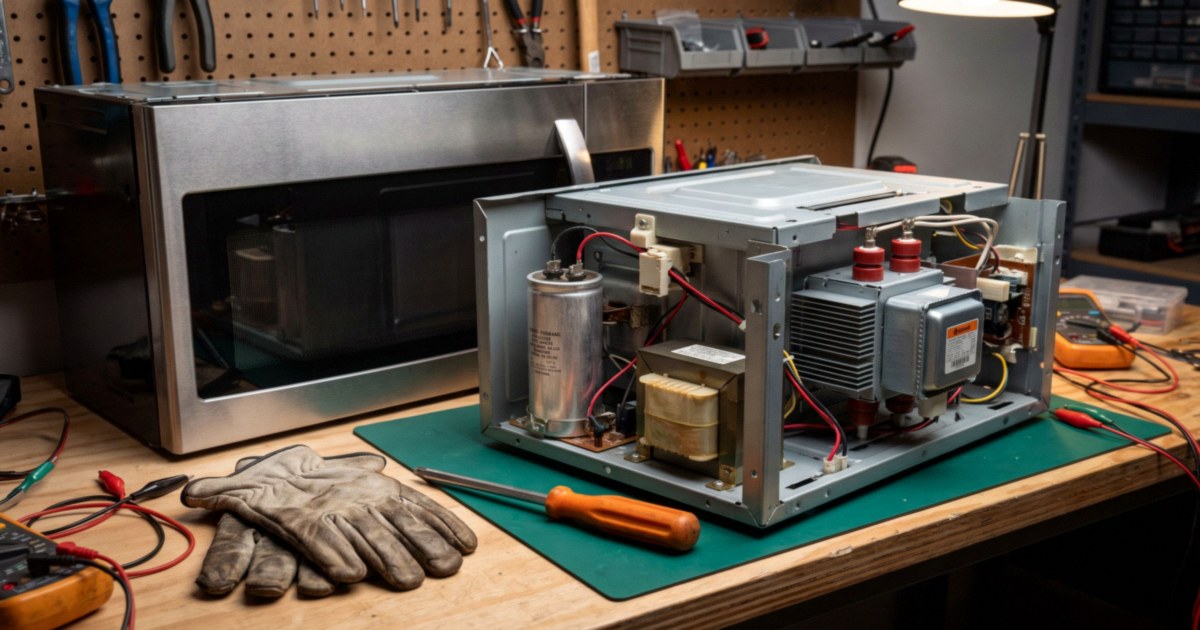
A microwave not heating is the one appliance complaint where the repair can kill you. The high-voltage capacitor inside stores enough energy to stop a heart, and it holds that charge after the oven is unplugged. Manufacturer service manuals do not treat this as a footnote. The one I pulled for this piece instructs the technician, in the general cautions, to discharge the high-voltage capacitor by shorting across the two terminals with an insulated screwdriver before replacing or checking anything.
Do the free checks first. If the oven still runs and will not heat, hand it to someone who owns a proper discharge tool or write it off. No other appliance has a wider gap between "looks simple" and "actually dangerous."
Why It Spins, Lights Up, and Cooks Nothing
A microwave has two electrical halves that share a cabinet and almost nothing else.
Display, turntable motor, cavity light and cooling fan all run off ordinary line voltage on the control side. Cooking is a separate high-voltage circuit: a transformer, a capacitor, a diode and the magnetron. In the service manual I worked from, the transformer's secondary produces roughly 2,100 volts AC, the diode and capacitor convert and boost that into negative DC applied to the magnetron filament, and a separate 3.2-volt winding heats that filament.
When only that second circuit quits, the oven looks perfectly healthy. Light on, fan roaring, plate turning, food stone cold. The fault sits downstream of the control board. Which is why swapping the board is almost always the wrong first move.
The Free Checks, Which Fix More Ovens Than You Would Think
Whirlpool's own troubleshooting page for this complaint leads with settings, not parts: Control Lock, Demo Mode, or a power level set too low can all leave a microwave running without cooking. Demo Mode is the sneaky one. Whirlpool describes it as switching on the light, rotating the turntable and running the fan while never firing the magnetron. That is an exact description of the symptom people bring us.
Test before you conclude anything. One cup of tap water in the cavity, full power, two minutes, then feel the water. Warm means the oven heats, and the real complaint is slow cooking, uneven results or a bad turntable. Cold after two minutes on high is a genuine no-heat.
How you exit Demo Mode is in the model's manual. It varies by brand and by model year. The button sequences floating around online are frequently wrong for the machine in front of you.
Door Interlocks: The Cause People Skip
Microwave ovens sold in the US are built to a federal performance standard, 21 CFR 1030.10, enforced by the FDA. The FDA states that the standard requires all ovens to have two independent interlock systems that stop microwave production the moment the latch is released or the door is opened, plus a monitoring system that halts oven operation if one or both interlocks fail.
In hardware, that means switches on the door latch.
A failed secondary interlock leaves the control side alive and the cooking circuit locked out, so you get the classic runs-but-no-heat. A failed monitor circuit is louder about it. The service manual describes the sequence: when the door opens, both the primary and secondary switches open to cut voltage to the high-voltage transformer's primary winding, and if the primary switch contacts fail to open, the fuse blows from the current surge the monitor switch creates. So an oven that suddenly goes completely dead when someone opens the door is a latch problem, not a "bad fuse." Replace the fuse without replacing the failed switch and you will blow the new one.
HD Supply lists a GE interlock and door switch as part WB24X10047, "Switch Interlock And Door For Microwave," at $47.99. That listing did not publish a model fitment list. Check the part number against your model number in the GE parts catalog before ordering. The switches are also position-specific within the latch assembly, and swapping a normally-open for a normally-closed is a fast way to defeat the interlock design.
Working the High-Voltage Circuit
Everything here happens with the oven unplugged, the outer case off, and the capacitor discharged and verified with a meter. Keep one hand out of the cabinet while probing. The service manual gives real target values for every component in the chain.
Transformer windings are the quickest condemnation: the manual gives a primary winding resistance of about 2.2 ohms and a secondary of about 130 ohms, and anything well off those figures means a new transformer. The capacitor wants an analog meter on the Rx1 range. A healthy one reads near zero the instant the leads touch, then climbs slowly toward 9 megohms, and does the same when you reverse the leads; one that never climbs off zero is shorted. The manual also has you check between a capacitor terminal and the cabinet, where a good part reads infinite.
On the magnetron, check both filament terminals to the shell. Continuity there means the filament has grounded out and the tube is finished.
The high-voltage diode gets replaced alongside the magnetron more often than any other part. It also gets tested wrong more often. On the Rx10k range, the manual expects roughly 150 kilohms in one polarity and an open reading in the other. A cheap digital meter will not bias a high-voltage diode into conduction at all, so a DMM diode-check that shows "OL" both ways proves nothing. Use an analog meter on a high range, or a meter with a 9-volt-plus test source.
A cavity thermostat or thermal fuse that opened after an overheat event, often from someone running the oven empty, kills the cooking circuit while leaving the control side alive. It is a cheap part. Finding out why it opened is the real diagnostic work.
The Parts, and What They Really Cost
GE's own page for the WB27X11079 magnetron marks it as no longer manufactured and priced as clearance, and Parts Town lists the same part number as a magnetron fitting HVM1540SP1SS, JNM7196SK3SS and JVM7195EK3ES. The WB27X10597 microwave diode cable is likewise listed by GE as clearance stock, and that page published no fitment list either. Confirm both against your model number before you order. Our guide to reading an appliance model and serial number covers where the tag hides on an over-the-range unit, which is usually behind the door on the cavity frame.


The Countertop Math Nobody Wants to Hear
A countertop microwave is not worth a magnetron.
Add it up on a GE part alone: about $122 to $129 for the magnetron, plus a service call, plus an hour of labor on a cabinet that was never designed to be opened twice. You are at or past the replacement cost of a perfectly good countertop unit, on an appliance whose remaining components are the same age as the one that just failed. I tell customers this on the phone rather than charging them a diagnostic to hear it in person.
Over-the-range and built-in units are sized to a cabinet opening, vented into an existing duct or recirculation path, and finished to match the rest of the kitchen. A replacement is a several-hundred-dollar appliance plus an install, and the color or trim may not be available anymore. Against that, a magnetron and a diode and two hours of labor look reasonable. We work through the general version of this decision in our repair or replace guide.
When a magnetron fails, replace the high-voltage diode at the same time. They sit in the same circuit, a shorted diode can take the magnetron with it, and the diode is the cheapest part in the assembly. The truck-roll you avoid is worth more than the $52 part. The same logic is why nobody replaces an oven igniter without looking at the safety valve in our oven not heating walkthrough.
What Actually Sends a Microwave to the Curb
Arcing from a burned-through waveguide cover is repairable. Arcing that has pitted the cavity wall is not, at least not economically.
The other retirement notice is a door. The FDA's guidance to consumers is direct about it: do not use an oven if the door does not close firmly, or is bent, warped or otherwise damaged. A door that has been dropped, sprung on its hinges, or forced closed against a broken latch is a radiation-leakage question rather than a heating question.
Sources
U.S. Food and Drug Administration. "Microwave Ovens." Radiation-Emitting Products. https://www.fda.gov/radiation-emitting-products/resources-you-radiation-emitting-products/microwave-ovens
U.S. Government Publishing Office. "21 CFR 1030.10: Microwave ovens." Electronic Code of Federal Regulations. https://www.ecfr.gov/current/title-21/chapter-I/subchapter-J/part-1030/section-1030.10
Premium Levella. "Microwave Oven Service Manual, model PM10080M." (Safety precautions, circuit description and component test procedures.) https://premiumlevella.com/wp-content/uploads/2021/01/service_manual_PM10080M.pdf
Whirlpool Corporation. "Microwave Not Heating: Possible Causes and Fixes." https://www.whirlpool.com/blog/kitchen/microwave-not-heating.html
GE Appliances. "Microwave Magnetron WB27X11079." https://www.geappliances.com/appliance/Microwave-Magnetron-WB27X11079
GE Appliances. "Microwave Diode Cable WB27X10597." https://www.geappliances.com/appliance/Microwave-Diode-Cable-WB27X10597
Parts Town. "GE Appliance WB27X11079 Magnetron." https://www.partstown.com/ge-appliance/gewb27x11079
HD Supply. "General Electric Switch Interlock and Door for Microwave, Part WB24X10047." https://hdsupplysolutions.com/p/general-electric-switch-interlock-and-door-for-microwave-part-wb24x10047-p558122
Why does my microwave run but not heat?▾
The light, fan and turntable run on the line-voltage control side. Heating comes from a separate high-voltage circuit made up of the transformer, capacitor, diode and magnetron, gated by the door interlock switches. A failure anywhere in that second circuit leaves an oven that looks completely normal and cooks nothing. Rule out a low power level, Demo Mode and Control Lock first, since Whirlpool lists all three as causes.
Is it worth replacing a microwave magnetron?▾
On a countertop oven, rarely. GE lists its WB27X11079 magnetron at roughly $122 to $129 depending on the supplier, and adding a service call plus labor puts you at or above the cost of a new countertop unit of similar capacity. On an over-the-range or built-in model the math changes, because the replacement appliance has to match a cabinet opening and a venting arrangement, which pushes the all-in replacement well past the repair.
Can a bad door switch stop a microwave from heating?▾
Yes. Federal rules require two independent interlock systems plus a monitoring system, so a failed secondary interlock can leave the control side running while the high-voltage circuit stays locked out. A failed monitor circuit behaves differently: the service literature describes the fuse opening from the current surge when the primary switch contacts stick, which makes the oven go completely dead instead of merely cold.
Is it safe to repair a microwave myself?▾
The settings checks are safe for anyone. Past the outer cover, no. The high-voltage capacitor holds a charge after the oven is unplugged, and service manuals instruct technicians to short its terminals with an insulated screwdriver before touching the circuit. Without a discharge tool and a meter to verify the result, this is one to hand off, whatever a video suggests.
Need a repair professional?
Get free quotes from verified technicians in your area.
Find a Pro Near You