


Samsung Washer Error Codes: Complete Reference With the Part Behind Each Code

Terry Okafor
Master refrigeration tech and NATE-certified instructor who moonlights as the magazine's advice columnist. His 'Ask Big Terry' mailbag has been settling shop disputes and diagnosing mystery leaks since 2011.
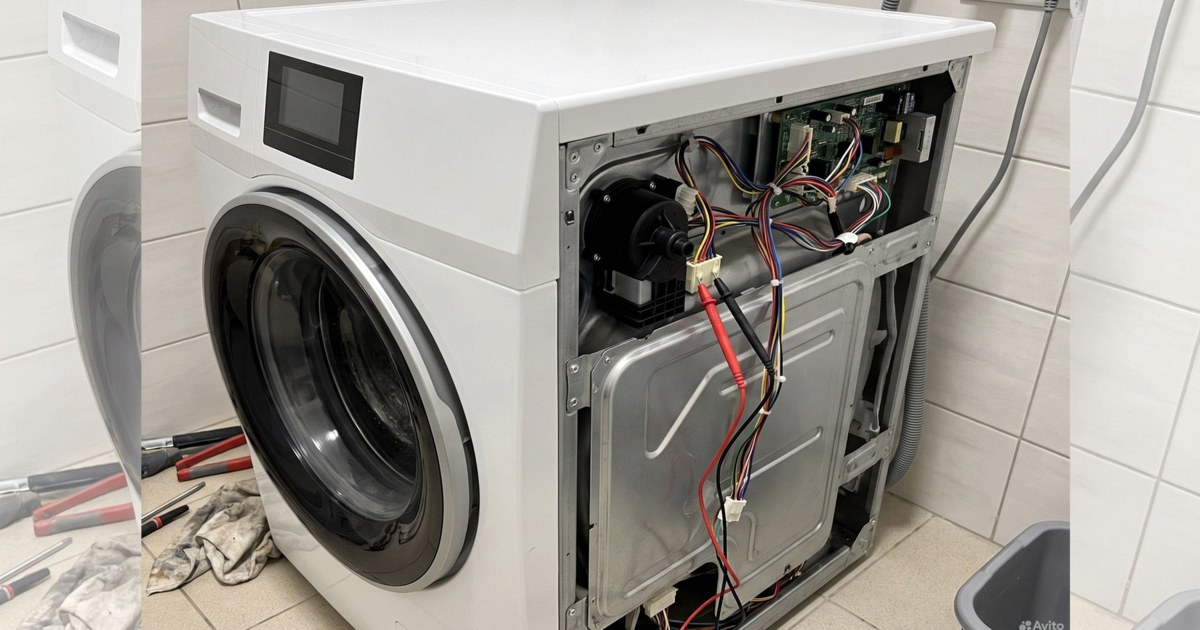
Samsung washer error codes get easier the moment you stop reading them as 30 separate faults. Samsung's own information-code documentation groups them by system, which is why 4C, 4E and nF all describe one condition, and 5C, 5E and SC all describe another. The letter-versus-digit business trips people up too. An older machine shows 4E where a current panel shows 4C, and they mean the same thing.
What follows is every family you will meet on a US front-loader or top-loader, what the control measured before it set the code, and the part that usually ends the call. The meanings here come from Samsung's published support pages, not from repair forums. The forums have been quietly copying each other's guesses for a decade.
| Code family | Samsung's stated meaning | Where to start |
|---|---|---|
| 4C, 4E, nF, nF1 | Water is not entering the washer correctly | Taps, hoses, inlet mesh screens |
| 4C2, 4E2, CE | Water on the cold supply is extremely hot | Hot and cold hoses reversed |
| 5C, 5E, SC, SE | Water is not draining | Pump filter, drain hose, pump |
| dC, dE, dC1, dE1, dL | Door not detected as closed and locked | Seal obstruction, strike, lock switch |
| ddC, dC3 | Add Door not closed or locked properly | Add Door latch |
| UE, Ub, Ur, U6 | Unbalanced load | Redistribute, then level and suspension |
| LC, LC1, 1C, LE, 1E | Moisture where it does not belong, or sensor fault | Real leak first, sensor second |
| OC, OE | Too much water in the washer | Level sensor, inlet valve stuck open |
| SUd, Sd | Excessive suds | Detergent dose and type |
| 9C1, 9C2, UC, PF | Voltage irregularity | Outlet, circuit, extension cords |
| 3C, 3E | Motor operation problem | Motor, hall sensor, inverter |
| bE2, 6E2, 8E2 | Jammed button or MEMS sensor error | Control panel |
4C, 4E and nF: The Fill Never Finished
This is the most searched Samsung washer error code family, and it is also the one most often fixed for nothing. The control opened the inlet valve, started its timer, and never saw the water level climb the way it expected. Samsung's US page states the meaning plainly: water is not entering the washer correctly.
Start at the wall. Both taps fully open, both hoses free of kinks, and neither hose crushed behind the machine after someone slid it back against the drywall.
Then pull the screens. Samsung's regional support pages walk homeowners through this directly: shut off the supply, unthread the fill hoses from the back of the washer, and clean the mesh filter screens sitting in the inlet ports. Those screens catch sand, pipe scale and the shredded remains of a failing water heater dip tube. On houses with galvanized supply lines I have found them packed solid.
If the screens are clean and the taps deliver real volume into a bucket, then the valve is fair game. Kill power, unplug the valve connector, and check each coil for continuity. An open coil is condemned. A coil that reads fine but never opens usually means the control is not sending it 120 volts during the fill step, which puts you on the board instead. DC97-15459H is the OEM inlet valve used across Samsung's WA series top-loaders, WA45H7000AW/A2, WA45M7050AW/A4, WA400PJHDWR/AA, WA50R5200AW/US and WA50R5400AV/US among them. AppliancePartsPros lists it as a Samsung water inlet valve at $168.95, cross-referenced to AP5621731 and PS4220862, and publishes no model list of its own. Front-load WF machines use a different valve, so run your model number before you order. Our guide on reading an appliance model and serial number covers where Samsung hides the tag on a front-loader.
One more in this family, and it is the one that saves an install callback. Samsung documents 4C2, 4E2 and CE separately: the water arriving on the cold supply is extremely hot. That is a plumber or a delivery crew putting the hoses on backwards. Swap them and the code is gone.
5C, 5E and SC: It Filled, It Just Will Not Leave
A drain code means the washer did not get the water out fast enough, or at all. Samsung's UK support page names the two usual causes before it names any part: a blocked filter or a kinked drain hose.
The debris filter behind the lower access door is the first stop, and it is genuinely grim work. Drain the machine through the emergency hose first, because a full tub holds several gallons that will find your shoes. Then rotate the filter counterclockwise to pull it, wash it in warm water, and thread it back clockwise until it seats. Coins, hairpins and underwire are the classics.
Samsung also asks you to confirm the drain hose is installed properly, is free of kinks, and has no blanking cap left in place from the install, and that the hose sits at least 60 cm above the floor. Get that height wrong and you can produce a drain code, a siphon, or both.
If the filter is clear and the hose runs clean, the pump is next. Power off, drop the pump, and spin the impeller by hand. A pump that is seized, noisy or reading open at the winding is done. Samsung runs several pump platforms, and this is where techs lose money. The DC96-01585L assembly, described in the OEM listing as "Assy Pump Drain; Bigbang2-Pjt," fits the WF2 series: WF210ANW/XAA, WF220ANW/XAA, WF231ANW/XAA and WF241ANW/XAA. It runs about $183. The WF331 platform takes a different pump entirely, DC31-00054D, which Samsung Parts USA lists at $52.95. Two transposed digits in the model number is a $130 mistake, so check the part against your model number before you order.
Most drain complaints are not the pump. For the full sequence across brands, see our washer not draining diagnostic guide.
dC, dE and dC1: The Door Is Not Confirmed Locked
Samsung's US documentation puts dC, dE, dC1, dE1, dL and a few display variants together under one meaning: the door is not detected as closed and locked. The international page splits it one level finer, calling dC1 and dE1 a main door lock that is not working properly, and dC3 or ddC an Add Door problem on the models that have one.
Order of work is boring and effective. Look for laundry caught in the boot. Look at the strike on the door for a cracked or worn tongue. Then unplug the lock assembly and test it.
Here is a part number worth getting right, because two suffixes float around and the retail listings disagree with themselves. The current Samsung door lock switch assembly is DC34-00024B, listed at PartSelect as the Door Lock Switch Assembly, DW-DL72, under PS4205052, and it supersedes the older DC34-00024D. Samsung Parts USA's own store page still shows DC34-00024D in its title while its part-number field reads DC34-00024B. Order the B. If a supplier ships you a D, it is the earlier revision of the same assembly.
Samsung Parts USA lists that lock assembly at $149.95. The same OEM number ranges widely by supplier, $108.42 at RepairClinic and $152.95 at AppliancePartsPros when we checked in September 2026, so shop the OEM number before you assume you need an aftermarket equivalent.
UE, Ub, Ur and U6: Unbalanced, and Usually Honestly So
Samsung groups Ub, U6, Ur and UE as one condition: the load in the tub is unbalanced. Samsung labels Ur as additional rinsing triggered when the machine senses an imbalance. In the field that shows up as the machine adding water and redistributing before it will attempt a high spin.
Nine times out of 10 the customer washed a comforter alone. Redistribute, add a few items, run it again.
The tenth time is real. A machine that throws UE on well-mixed medium loads is telling you about its feet, its floor or its suspension. Check level before you check anything mechanical, because a washer on an out-of-flat laundry room floor will chase this code forever. We cover the setup properly in how to level a washing machine. On front-loaders with real mileage, worn suspension rods let the tub swing far enough to trip the sensor even on a balanced load, and that is a parts job rather than a setup job.


LC, 1C and the Leak Sensor Question
Samsung's US information-code page bundles LC, LC1, 1C, LE and 1E and describes them as moisture detected somewhere it does not belong, or an issue with the sensor itself. Samsung's international support splits that family, reading LC, LC1 and LE as a drain hose problem and 1C and 1E as a water level sensor fault. The drain hose reading is the siphoning scenario: a hose pushed too far down a standpipe pulls water out of the tub and confuses the level circuit. On a US machine, follow the US page.
Both readings point the same direction. Find real water first.
Pull the lower panel and light up the base pan, then dry it and run a cycle while you watch. A weeping boot, a cracked dispenser hose or a pump seeping at the gasket will show itself. Replacing a leak sensor on a washer that is genuinely leaking just buys you a few weeks and a dead control board.
The Codes You Meet Less Often
SUd you can fix over the phone. Too much detergent, or non-HE detergent in an HE machine. The washer pauses, adds water, and tries to rinse the foam out on its own.
Voltage codes deserve more respect than they get. Samsung lumps 9C1, 9C2, UC and PF together as a supply irregularity, and in the field that means an extension cord, a shared circuit with a space heater, or a backstabbed receptacle loosening since 1994. Meter the outlet under load before you order a board.
The rest you will see rarely enough that a reference line is the honest answer rather than a diagnostic essay. 3C is a motor complaint, 8C is Samsung's MEMS vibration sensor, bE2 is a jammed button or a MEMS fault, Cb is calibration mode, dn means a firmware download is in progress, and CL is just the child lock. None of those are a cue to condemn the main board on the first visit.
What the Parts Run
Those part figures are retail list prices from the pages we opened in September 2026. OEM Samsung parts move around a lot between suppliers, and aftermarket equivalents on the common numbers routinely undercut list by half.
Before you order anything on a Samsung washer, note the exact step in the cycle where the code appears. A drain code at the end of the wash and a drain code during the spin ramp are different faults on the same machine: the first is usually flow, the second is usually the pump losing head under load. Samsung's control does not distinguish them for you, and the code is identical either way.
Clearing a Code Without Fooling Yourself
Cut power at the outlet or the breaker for about five minutes, then restore it. The display clears. Nothing else does.
If the fault condition is still there, the control measures it again at the same point in the program and posts the same code. That repetition is a gift, not a nuisance. A code landing at an identical step every cycle points at one circuit. A code that wanders is usually a connection or a supply problem. Samsung's newer machines will also hand the fault history to the SmartThings app, which is worth using before you take a panel off; our guide to connected appliance diagnostics and service modes covers what those app-side readouts are actually good for.
The trap on this platform is the control board. It is the most expensive part in the machine and the easiest thing to blame, and a surprising share of boards get swapped for a $12 connector that corroded behind the tub. If the code does not point you at a circuit you have actually tested, the board is a guess, and guesses on a Samsung board cost real money. Our roundup of common misdiagnoses in washer repair has the rest of that list.
Sources
Samsung Electronics America. "Samsung washing machine information and error codes." Samsung US Support. https://www.samsung.com/us/support/troubleshoot/TSG10000997/
Samsung Electronics. "About the Information Codes On a Samsung washing machine." Samsung Singapore Support. https://www.samsung.com/sg/support/home-appliances/check-out-the-information-codes-on-my-washing-machine/
Samsung Electronics. "How to resolve a 5E or 5C error code on a washing machine." Samsung UK Support. https://www.samsung.com/uk/support/home-appliances/how-to-resolve-a-5e-or-5c-error-code-on-a-washing-machine/
Samsung Electronics. "Resolve 4C, 4E, NF or NF1 error codes on your Samsung washing machine." Samsung Saudi Arabia Support. https://www.samsung.com/sa_en/support/home-appliances/resolve-4c-4e-nf-or-nf1-error-codes-on-your-samsung-washing-machine/
AppliancePartsPros. "Samsung DC97-15459H Water Inlet Valve (AP5621731)." https://www.appliancepartspros.com/samsung-assy-valve-water-dc97-15459h-ap5621731.html
PartSelect. "Samsung DC96-01585L Assembly Pump Drain; Big Bang 2 (PS4217041)." https://www.partselect.com/PS4217041-Samsung-DC96-01585L-Assembly-Pump-Drain-Big-Bang-2.htm
PartSelect. "Samsung DC34-00024B Door Lock Switch Assembly; DW-DL72 (PS4205052)." https://www.partselect.com/PS4205052-Samsung-DC34-00024B-Door-Lock-Switch-Assembly-DW-DL72.htm
What does 4C mean on a Samsung washer?▾
Samsung's US information-code page groups 4C with 4E and nF and defines the family as water not entering the washer correctly. The control called for a fill and never saw the level rise on schedule. Open both taps fully, straighten the hoses, and clean the mesh screens in the washer's inlet ports. The valve is the last suspect in that sequence, not the first.
How do I clear a Samsung washer error code?▾
Cut power at the outlet or the breaker for about five minutes, then restore it. That clears the display but not the fault. If the underlying condition is still present, the control measures it again and posts the same code at the same step in the program. A code that lands at an identical point every cycle is telling you which circuit to test.
Does the LC code mean my Samsung washer is actually leaking?▾
Often, yes. Samsung's US documentation describes the LC family as moisture detected where it does not belong or a sensor fault, while Samsung's international support reads the same codes as a drain hose problem. Dry the base pan completely, then run a cycle and watch. Replacing the sensor on a washer that is really leaking just delays a much more expensive control board failure.
What is the difference between 4C and 4C2 on a Samsung washer?▾
4C is a fill failure. 4C2 is a temperature complaint: Samsung documents it as the water on the cold supply arriving extremely hot, which on a new installation nearly always means the hot and cold hoses were connected to the wrong inlets. Swap them at the back of the washer. It costs nothing and it is one of the most common delivery callbacks on Samsung front-loaders.
Need a repair professional?
Get free quotes from verified technicians in your area.
Find a Pro Near YouSamsung Parts USA. "Samsung WF331ANW/XAA Washer DC31-00054D Drain Pump." samsungpartsusa.com
Samsung Parts USA. "Samsung DC34-00024D Washer Door Lock Switch" (part-number field reads DC34-00024B). samsungpartsusa.com
Samsung Philippines. "Check out the information codes on my washing machine." samsung.com
RepairClinic. "Samsung DC34-00024B Door Lock." repairclinic.com