


Thermostat Not Working or Blank? How to Trace 24V Power From the Furnace Board to the Wall

Dale Resnick
A 30-year veteran of residential HVAC who's crawled through more attics than he can count. Dale writes the 'Duct Tape & Beyond' column and believes every compressor tells a story if you listen close enough.
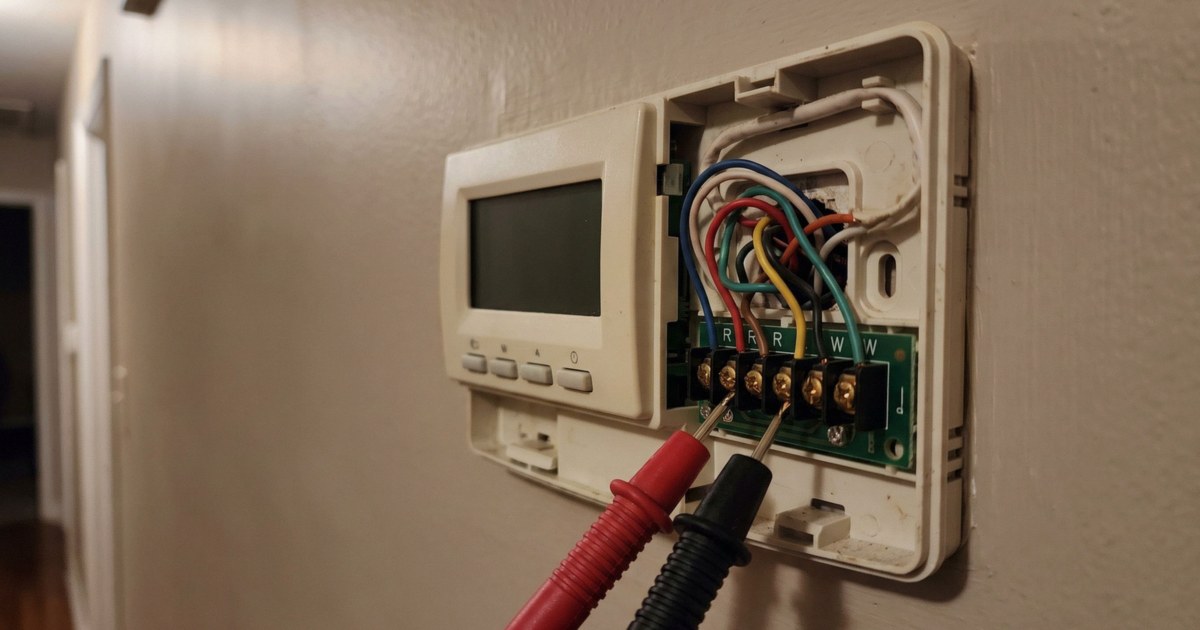
A thermostat not working is usually not a thermostat problem. The stat is fine. Something upstream cut its 24V supply, and the screen went dark because there was nothing left to light it. A dead battery, a blower door panel hanging open, a blown 3 A fuse on the control board, a condensate float switch that filled up and did exactly what it was installed to do.
The customer calls it a broken thermostat. The actual fault is usually 20 feet away in a closet or an attic.
What follows is the order I work it, and the order matters, because every step rules out everything below it. The same trace applies to a gas furnace, an electric air handler, or a packaged rooftop unit. The wire colors and the terminal letters don't change.
Safety Before the Meter Comes Out
The 24V control circuit is low voltage and won't hurt you, but the rest of the cabinet carries line voltage that will.
Inside a furnace or air handler you are inches away from 120V at the board, the transformer primary and the door switch, and on an electric furnace you may have two 240V legs feeding heat strips. Kill power at the breaker and at the service switch on the side of the unit before you pull panels, then verify with your meter that it's actually dead instead of trusting the label on the panel.
If you have to open the blower compartment, the run capacitor on a PSC blower motor holds a charge after the power is off. Discharge it through a resistor before your screwdriver finds it for you. On gas equipment, if you smell gas at any point, stop, leave, and call the gas utility from outside. That is not a troubleshooting step.
Homeowners: batteries, breaker and door panel are yours. Everything from the control board inward means live 24V work next to line voltage, and that's where this article stops being a to-do list and starts being a reading assignment.
Step 1: Batteries, Breaker, and the Door Switch
Three checks, maybe 5 minutes, and they account for a large share of the no-power calls I run.
Pull the thermostat off its subbase. If it takes AA or AAA cells, replace them even if they test fine at rest. Alkaline cells sag under the load of a backlight and a relay pull, and a battery that reads 1.4V open-circuit can still drop below the display's cutoff the moment the stat tries to do anything.
Next the panel. The furnace has a dedicated breaker, and a breaker that has tripped only partway still looks like it's on, so push it firmly to OFF and then back to ON. While you're there, find the service switch on the side of the unit. It looks like an ordinary light switch, and somebody turns it off by accident more often than you'd think, usually a painter or a homeowner hunting for the basement light.
Then the blower door. Furnaces and air handlers carry an interlock switch that opens when the access panel comes off, and it cuts everything, including the transformer that feeds the thermostat. Dust packs the actuator, the panel gets reinstalled a quarter inch proud, and the system is dead. If the stat went blank right after a filter change, look here first. It costs nothing to check.
When the thermostat is blank AND the equipment is dead, you have a power-path problem and this whole article applies. When the thermostat is lit but the equipment won't run, you have a different problem and you should be in our common HVAC electrical failures guide instead. Sorting those two apart in the first 30 seconds saves you an hour.
Why Your Thermostat Is Not Getting Power: the 24V Path, in Order
Line voltage comes into the control board, which feeds the 24V transformer primary. The secondary puts out roughly 24 to 28 volts AC, with one leg landing on the R terminal and the other on C. Everything between those two points is somewhere the circuit can open.
Set the meter to VAC. At the thermostat subbase, measure R to C. You should see 24 to 28 volts AC with the system idle, and if it's there while the stat is still blank, the thermostat itself is the problem and you can stop tracing.
No voltage at the wall means you move to the board. Restore power, keep your hands clear of the primary side, and measure across the transformer's secondary screws. Voltage at the transformer but nothing at the wall puts the fault between them: the board fuse, a float switch, or the cable itself. No voltage at the transformer secondary means the transformer or its primary feed.
Step 2: The Control Board Fuse
This is the most common cause of a completely blank hardwired thermostat, and it's a $2 part.
Furnace and air handler boards carry a small automotive blade fuse, usually silkscreened F1 or FUSE, protecting the 24V side. Carrier boards use a pink 3 A blade fuse; other manufacturers use 3 A or 5 A depending on the board. Pull it and look through the plastic body. A blown one usually shows a visibly broken link and sometimes a scorch mark.
Replace it with the same rating. Not higher. The fuse is protecting thermostat wire stapled through joists, and a 20 A automotive fuse in a 3 A slot turns a $2 repair into a wall fire.
Fuses don't blow from boredom. Something shorted R to C or R to ground, and most of the time it's a shiner where thermostat wire got pinched against a sheet-metal edge, or a conductor nicked during a recent install out at the condenser. If the new fuse goes instantly, disconnect the thermostat wire at the board and try again. A fuse that holds with the wire off puts your short in the field wiring.
Step 3: The Condensate Float Switch
Every cooling system with an indoor coil should have one. It's a float wired in series with the 24V circuit, sitting in the secondary drain pan or inline on the primary drain. The drain clogs with biofilm, water backs up, the float rises, the circuit opens, and everything stops before the ceiling stains.
The symptom is identical to a blown fuse, right down to the blank display and the dead equipment, except that somewhere there is water. Look in the secondary pan, look at the primary drain line, and look at the ceiling below an attic air handler.
RectorSeal's Safe-T-Switch SS1, part number 97632, is the version I see most in attics, and it's rated for 24 VAC at 1.25 A. Check the part number against your own installation before ordering, because float switches come in inline, pan-mount and vertical styles that are not interchangeable. And when a float switch does its job, swapping the switch fixes nothing. Clear the drain, find out why it clogged, treat the pan.


Step 4: The Transformer and the Wiring
No 24V at the transformer secondary, but confirmed line voltage at its primary, means the transformer is done. Most residential units are 40 VA, 120V primary to 24V secondary, and they fail open in the primary winding often enough that a continuity check across the primary answers the question quickly.
Before you condemn it, check the boring stuff: loose or backed-out screws on R, C, W, Y and G at the board, wire nuts that were twisted rather than tightened, a thermostat cable run along a rodent highway in a crawlspace. I pull gently on each conductor at the board before I reach for a part, and about once a season that alone finds the fault.
Why C-Wire-less Smart Thermostats Blank Out Intermittently
A smart thermostat installed without a C-wire has to keep an internal battery charged. It does that by pulling a small current through the heating or cooling wire while the equipment is off, a technique the industry calls power stealing. On some systems that trickle is enough to make a sensitive gas valve or contactor twitch, and on others the battery never quite catches up during heavy Wi-Fi use.
Google's support page on the common wire lists the symptoms plainly: reduced thermostat battery life, a display that won't turn on, occasional Wi-Fi disconnects, equipment that turns on or off unexpectedly, heating or cooling that runs continuously, and the E1, E297, N260 and N261 error codes. Google sells an accessory called the Nest Power Connector for exactly this situation.
The tell in the field is intermittency. A blown fuse is blank and stays blank, while a power-stealing thermostat goes dark, comes back after the equipment runs, then goes dark again that evening. Customers describe it as the thermostat "resetting itself."
Three fixes, in order of how much I like them. Pull a new 18/8 thermostat cable and land a real C, which is the right answer and the one I quote first. Use an existing spare conductor in the bundle, which costs nothing when a previous installer left one coiled in the wall. Or install an adapter: ecobee's Power Extender Kit combines the Y and G functions onto a single conductor to free up a wire for C, and ecobee lists it as 24 VAC only, incompatible with millivolt, high-voltage, dual-transformer, and fan coil or communicating systems. Honeywell Home's CWIREADPTR4001/U filled the same role but is no longer available, with the THP9045A2098/U wire adapter shown as its alternative.
Check the part number against your model number before ordering any of these. Adapter compatibility moves around more than anything else in this article.
Those are the ranges we see in Southern California. Coastal metro labor runs higher and rural markets run lower, so treat the table as a sanity check on a quote rather than a price list.
When to Call a Pro
Homeowners should stop at the equipment cabinet. Batteries, the breaker, the service switch and the blower door are all fair game, and they solve a real share of these calls. Once the panel comes off you're working next to line voltage, a gas train and a charged capacitor, and the fuse you're after is worth less than the emergency room copay.
Call regardless if the new fuse blows immediately, if you find water anywhere near the air handler, if anything at the board smells burnt, or if the thermostat is blanking intermittently on a system you know has no C-wire. That last one usually ends with a wire pull, and pulling cable through a finished wall is a trade skill.
For a system that has power but still won't fire, our furnace not turning on diagnostic picks up where this one leaves off. If you want to get faster with the meter itself, start with advanced multimeter techniques for HVAC.
Why is my thermostat screen blank?▾
A blank screen means the thermostat lost 24V power. Batteries first on battery models. On hardwired and smart thermostats, work this order: furnace breaker, service switch, blower door safety switch, the 3 A or 5 A blade fuse on the control board, the condensate float switch, then the 24V transformer. Measure R to C at the subbase; 24 to 28 VAC there means the stat itself has failed.
What does a C-wire do and do I need one?▾
The C-wire is the return leg of the 24V transformer circuit, giving the thermostat continuous power instead of forcing it to borrow current through the heating or cooling wires. A basic battery-powered stat doesn't need one. Any Wi-Fi thermostat does. Google's support documentation lists blank displays, Wi-Fi dropouts, short battery life and unexpected equipment cycling as symptoms of inadequate power.
Where is the fuse for my thermostat?▾
On the furnace or air handler control board, not at the thermostat. Look for a small automotive blade fuse, usually marked F1 or FUSE, rated 3 A or 5 A. Carrier boards typically use a pink 3 A fuse. Cut power at the breaker before pulling it, inspect the link through the plastic, and replace it with the identical rating. A higher-rated fuse removes the protection on your thermostat wiring.
Can a clogged AC drain make my thermostat go blank?▾
Yes. Condensate float switches sit in series with the 24V circuit so a backed-up drain pan shuts the system down before water reaches drywall. When the float opens, the thermostat loses power the same instant the equipment does, which looks exactly like a blown fuse. Check the secondary drain pan and the primary drain line. Clearing the drain restores power; replacing the switch does not.
Sources
Google Nest Help. "Learn about the common or C wire." Google. support.google.com/googlenest/answer/9251212
ecobee. "Power Extender Kit." Product and compatibility page. ecobee.com
Resideo / Honeywell Home. "C-Wire Power Adapter CWIREADPTR4001/U." Listed as discontinued, with THP9045A2098/U shown as the alternative. honeywellhome.com
RectorSeal. "Safe-T-Switch SS1 (Legacy)," SKU 97632. rectorseal.com
Need a repair professional?
Get free quotes from verified technicians in your area.
Find a Pro Near You