


It's Not Just the Stove: Gas Dryers Raised Indoor NO2 Up to 54% in a 344-Home Study

Terry Okafor
Master refrigeration tech and NATE-certified instructor who moonlights as the magazine's advice columnist. His 'Ask Big Terry' mailbag has been settling shop disputes and diagnosing mystery leaks since 2011.
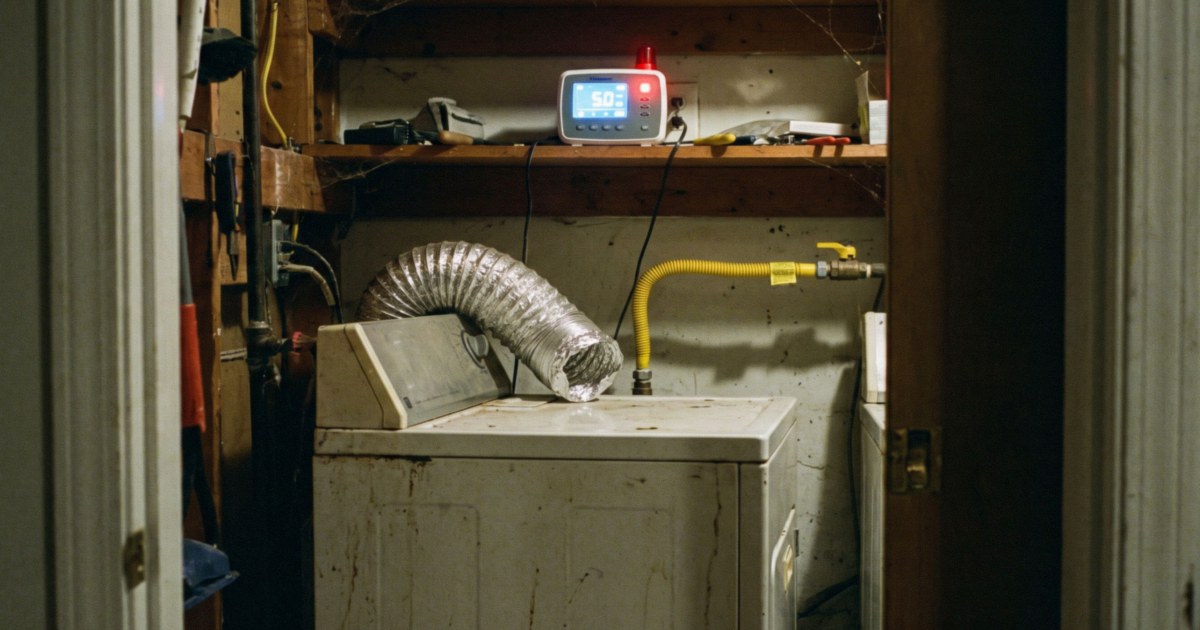
Health Canada researchers who measured indoor air in 344 homes found that having a gas clothes dryer was associated with 54% higher indoor nitrogen dioxide in winter and 47% higher in summer. Nearly every indoor air study that reaches appliance techs is about the stove. The basement dryer has gone unexamined.
The paper, by Liu Sun, Marie-Ève Héroux, Xiaohong Xu and Amanda J. Wheeler, ran in the Journal of Exposure Science & Environmental Epidemiology in 2025. Sun and Héroux work in Health Canada's Water and Air Quality Bureau, which also funded the underlying field campaigns.
It pooled four separate Canadian indoor air quality studies: Windsor in 2005 and 2006, Regina in 2007, Halifax in 2009, and Edmonton in 2010. Regina contributed the most homes at 121, followed by Windsor at 91, Edmonton at 74 and Halifax at 58. Every home was non-smoking, and 92% were detached houses. NO2 was sampled with Ogawa passive samplers on 24-hour integrated cycles, running five consecutive days in Regina and Windsor and seven in Edmonton and Halifax. The authors then ran mixed models and general linear models, city by city and pooled, splitting winter from summer.
Different animal from the Stanford work we covered when that team put gas stove exposure at 4 ppb. Stanford metered emission rates off individual appliances and modeled the exposure that follows. The Canadian team measured what was actually in the air of occupied houses, then asked which appliances the concentrations tracked with. Bigger house count, Canadian sample, and gas equipment beyond the range.
Reading the Gas Dryer NO2 Number Honestly
The pooled geometric mean indoor NO2 across all four cities and both seasons was 9.0 µg/m3. That is low to start with. A 54% increase on a low base is still a low absolute concentration.
Thin sample, too. Only about 6% of the 344 homes had a gas clothes dryer, roughly 20 houses. The authors did not attempt a city-level breakdown of that result, and they flag limited statistical power for small appliance subgroups generally. Concentrations are all this study measured. It reports no health outcome, and it should not be read as one.
Gas stoves, present in 24% of homes, carried much larger associations: a 191% increase in winter indoor NO2, 114% in summer, plus a 43% jump in peak hourly carbon monoxide in winter.
Oil heating was associated with a 58% increase in winter indoor NO2. Gas heating showed a 62% increase in winter NO2, but only in homes built before 1949, and only at marginal significance (the authors report p = 0.057).


What This Changes for a Shop
What the paper cannot tell you is whether those 20 gas dryers were vented well, vented badly, or vented into a crawlspace. Venting isn't a variable in the study at all. That's frustrating, because it's the one variable a technician controls completely. A gas dryer moving its combustion products through an intact, clear duct to the outdoors is a different appliance entirely from one with a crushed transition hose behind it or 30 feet of lint-packed flex running uphill. Our read is that the association in this dataset is at least partly an installation-quality story wearing a fuel-type label.
When a homeowner brings up indoor air on a gas dryer call, start with a vent inspection. Confirm the transition duct is connected and undamaged, confirm the run terminates outside, confirm the termination damper actually opens, and clear the lint. That work is already billable, and the dryer vent cleaning procedure doesn't change because of a study.
The pre-1949 heating result points HVAC somewhere obvious. Old housing stock means old venting: masonry chimneys, atmospheric draft, orphaned water heaters left on an oversized flue after the furnace got replaced. Spillage there is a known problem with known tests. If you own an analyzer, combustion analysis on every gas appliance in a pre-war house is a defensible line item, and this paper gives you something concrete to point at when the customer asks why.
One caution on selling any of this. The field data was collected between 2005 and 2010, gas dryer market share has moved since, and dryer designs have changed. Nobody has yet gone out and metered NO2 at the drum and the vent termination of a modern gas dryer under controlled conditions.
Sources
Sun, L., Héroux, M.-È., Xu, X., Wheeler, A.J. (2025). "Associations between residential fossil fuel combustion and indoor concentrations of nitrogen dioxide, carbon monoxide, and aldehydes in Canadian homes." Journal of Exposure Science & Environmental Epidemiology, 35(4), 649-660. doi:10.1038/s41370-025-00762-6 (free full text: PMC12234359)
Kashtan, Y., Nicholson, M., Finnegan, C.J., Ouyang, Z., Garg, A., Lebel, E.D., Rowland, S.T., Michanowicz, D.R., Herrera, J., Nadeau, K.C., Jackson, R.B. (2024). "Nitrogen dioxide exposure, health outcomes, and associated demographic disparities due to gas and propane combustion by U.S. stoves." Science Advances, 10(18), eadm8680. doi:10.1126/sciadv.adm8680