


Does That Recirculating Range Hood Actually Work? What the Lab Data Says
Maria Solano
Former appliance warranty claims adjuster turned investigative repair journalist. Maria's 'What Went Wrong' teardown series has made her the most feared woman in the white-goods industry.
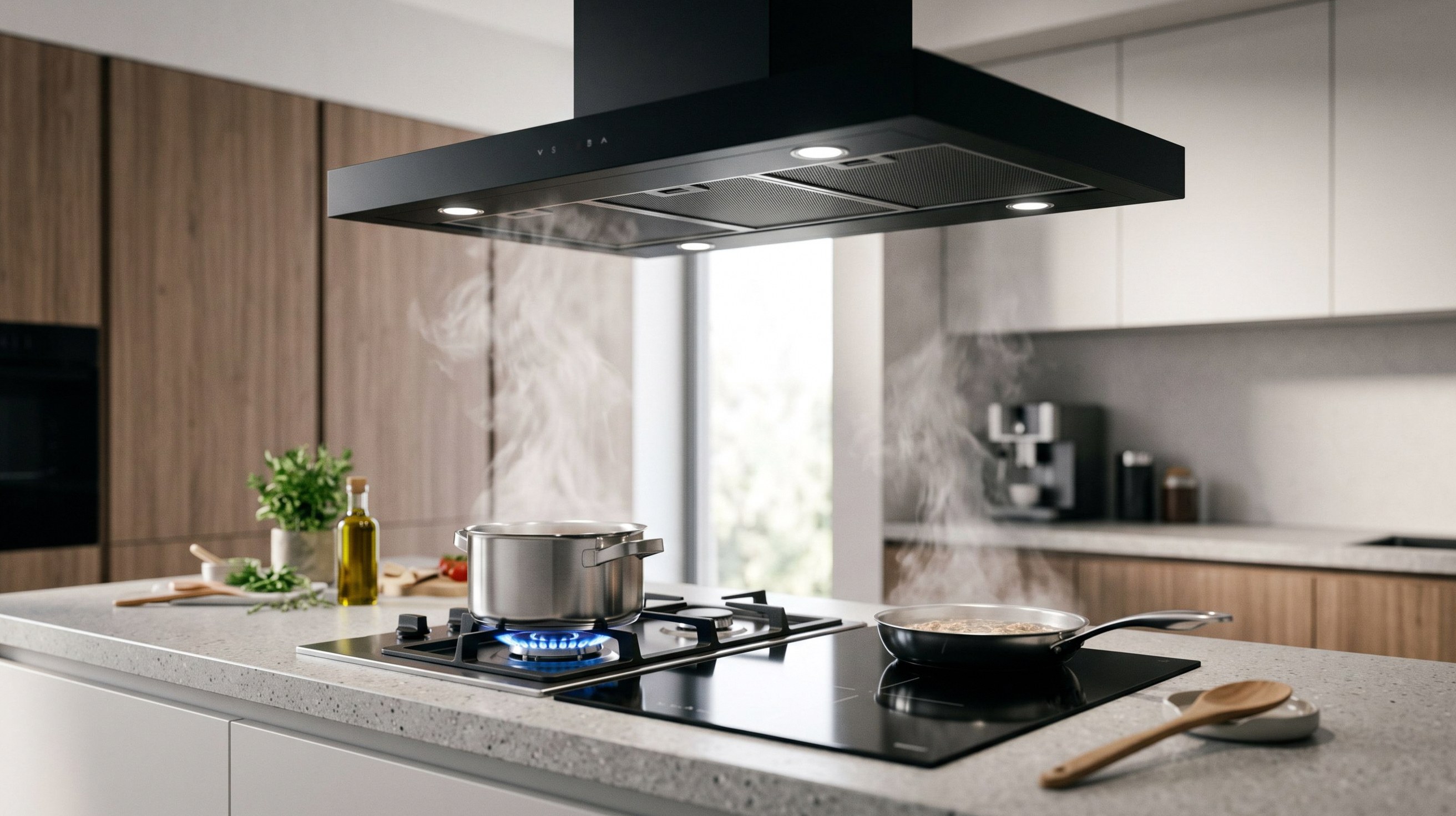
Most over-the-range microwaves and a lot of budget hoods do not vent outside. They pull air through a filter and blow it right back into the kitchen. So the practical question for anyone who installs or services cooking equipment is simple: does a recirculating range hood actually cut the pollution a stove throws off, or does it just move the air around? A controlled study out of Lawrence Berkeley National Laboratory ran the test, and the answer is a qualified "sort of."
Researchers cooked a standardized meal in an instrumented test kitchen, once on a gas cooktop and once on induction, and measured what ended up in the air. Two findings stand out.
First, the appliance mattered a lot. Cooking the meal on gas produced substantially higher nitrogen dioxide and more ultrafine particles than cooking the same meal on induction, because gas combustion generates both at the burner. One result cut against the grain, though: induction likely produced more fine particles (PM2.5) than gas. The particles coming off the food and the hot pan matter too, not just the fuel, so induction is not automatically cleaner on every measure. What it clearly avoids is the NO2.
Second, the two recirculating hoods with filters helped. Both substantially reduced particle exposure, more than you might expect from a unit that vents nowhere. But neither cleared the air completely, and cooking still pushed pollutant levels up while the hood ran. The study's read is careful, and so is ours: a ductless hood with a filter is partial mitigation, not a full solution.
That distinction is the whole story for a service tech.
Why Recirculating Range Hood Effectiveness Falls Short
A recirculating hood's filter is built mainly to grab grease, and in the study the hoods did cut particles sharply, with one also lowering some of the VOCs. What a ductless hood does not reliably do is clear the NO2 a gas burner keeps producing. Combustion gases slip through a grease or carbon filter far more easily than particles do, and carbon media has limited, short-lived capacity for gases anyway. The practical read: a ductless hood recaptures a meaningful share of particles, but it is not a dependable long-term answer for the combustion gases coming off a gas burner.
Ducted exhaust is a different animal. A hood that actually moves air outside removes both the particles and the gas, assuming the duct run is real and the damper opens. That is the reliable lever, and it is one a service company can inspect.


What to Tell the Homeowner
You do not have to take a side in the gas-versus-electric argument to use this data. It points to three concrete moves.
If the kitchen has a recirculating hood and the customer cooks on gas a lot, be honest that the hood is doing less than they assume. Suggest cracking a window during and after cooking, and running the fan on high, not because it fixes the air but because it helps at the margin.
If a homeowner is renovating or the cabinet run allows it, a ducted hood is the upgrade that actually changes the numbers. This is a legitimate line item, not an upsell, and it pairs naturally with other energy-efficient appliance upgrades people plan during a kitchen refresh.
And when the conversation turns to swapping the appliance itself, induction is now a mainstream ask rather than a niche one. A tech who can explain what an induction switch involves (often a 240V circuit, sometimes panel work) and weigh it against a straight repair-versus-replace decision is more useful than one who shrugs at the question.
The honest takeaway from the lab: a recirculating hood is better than no hood, but it is not clean air. Ducted exhaust and lower-emitting appliances are what the measurements actually reward. That is a service item you can verify on the ticket, not a talking point.
Sources
Li, J., Zhao, H., Russell, M.L., Delp, W.W., Johnson, A., Tang, X., Walker, I.S., Singer, B.C. (2024). "Air pollutant exposure concentrations from cooking a meal with a gas or induction cooktop and the effectiveness of two recirculating range hoods with filters." Indoor Environments (Elsevier / Lawrence Berkeley National Laboratory). https://doi.org/10.1016/j.indenv.2024.100047